Use these 30 pilot interview technical questions to practise an explanation, then handle a panel follow-up without reading your notes. Each answer connects the principle to a decision in the cockpit.
Test yourself first on the free technical questions. Mark each topic explain, verify or revisit, and write one next action beside every gap.
Scope: These are independent interview teaching examples, not an airline question list or operating instructions. Regulatory examples use EASA commercial air transport aeroplanes, with US differences identified; aircraft limits, calls, intervention procedures and stabilisation gates come from your aircraft and operator documents. Manufacturer and safety recommendations are labelled separately from regulations.
Last reviewed: November 2026
What technical interviews look like by stage
Use your experience to choose the depth of the answer; these are preparation priorities rather than claims about a particular airline's selection.
| Your stage | What to practise |
|---|---|
| Cadet | Explain the principle clearly and work through a simple example. |
| Frozen ATPL | Connect theory to flight planning, weather and crew decisions. |
| Type-rated direct-entry first officer | Explain the system, its failure indications and the operational consequence on your type. |
| Captain | Explain the decision, alternatives, crew roles and how you reassess risk. |
Flight principles and aircraft handling
1. What determines a stall?
A stall occurs when the wing exceeds its critical angle of attack; a single memorised airspeed does not describe every stall condition. I would relate the indications to load factor, configuration and contamination, then explain why recovery must address angle of attack; the longer stall model answer develops the basic theory.
Likely panel follow-up: Can an aircraft stall above its published 1g stall speed?
2. How does load factor affect stall speed?
For the same mass, configuration and maximum lift coefficient, Vs(n) = Vs(1g) × √n. In a steady, level, coordinated 60° bank, n = 1/cos 60° = 2, so stall speed is approximately 1.41 times the 1g value, an increase of about 41%. A 100 kt 1g stall speed would therefore become approximately 141 kt in that example; the level-turn assumption matters.
Likely panel follow-up: Does a 60° bank always mean 2g if the aircraft is descending or unloading?
3. How do you recognise and recover an energy problem on approach?
I compare height against distance, vertical deviation and the speed trend: approximately 300 ft per NM is a rough 3° descent check, not a substitute for the published path. The Flight Safety Foundation's ALAR reference recommends stabilisation by 1,000 ft above airport elevation in IMC or 500 ft in VMC, with speed between VREF and VREF+20 kt and descent normally no greater than 1,000 ft/min; these are safety recommendations, with a special briefing for a greater planned descent rate. For the late-vector scenario: “I'd call out both deviations, slow down early, use permitted drag or earlier gear extension, and ask for more track miles while recovery is still realistic.” If we cannot meet our operator's criteria, I would discontinue the approach rather than rush the final part.
Likely panel follow-up: What trend would make you ask for extra distance before reaching the stabilisation gate?
4. Why does centre of gravity matter?
In a conventional aeroplane, a more forward CG generally increases longitudinal stability, tail downforce, trim drag and stall speed, and can increase control forces and fuel consumption. Moving the CG aft reduces stability and can reduce trim drag and stall speed, but reduces the margin for nose-down recovery and can increase over-rotation or tail-strike risk. I would use the loading envelope for the particular aircraft, since a favourable performance effect never permits operating outside its CG limits.
Likely panel follow-up: Why can a forward CG make the landing flare difficult?
5. How would windshear change your priorities?
Windshear is a change in wind speed or direction over a short distance, which can cause rapid changes in airspeed and flight path. Prevention starts with warnings, reports and avoiding a hazardous departure or approach; once encountered, the priority becomes the aircraft's windshear escape procedure rather than trying to maintain the original profile. I would distinguish a predictive warning from an actual encounter and explain the response for the type I fly.
Likely panel follow-up: Why can the initial headwind increase in a microburst be misleading?
These principles are covered in the FAA Pilot's Handbook of Aeronautical Knowledge, chapters 5 and 10. The numerical stabilisation example is from the Flight Safety Foundation ALAR briefing notes; Airbus's unstable-approach guidance explains energy management. Continue with principles of flight questions.
Aircraft systems and automation
6. How is an essential system supplied after a failure?
An essential electrical bus supplies selected loads needed to retain essential functions when normal generation is lost. Depending on the aircraft, supply may transfer to another generator, an emergency source or a battery, with load shedding to preserve capacity. I would trace one real supply path on my type and identify which indications show that the transfer succeeded, without borrowing another aircraft's architecture.
Likely panel follow-up: Which equipment would you lose, and what limits the endurance of the remaining supply?
7. What makes a hydraulic failure operationally significant?
Hydraulic pressure transmits force to users such as flight controls, landing gear or brakes, but the allocation of those users varies by type. A failure matters because it may remove a function, its redundancy, or a normal extension or braking method. I would connect the actual indications and checklist to configuration, landing-distance and runway-exit consequences.
Likely panel follow-up: Can normal pressure on one system prove that all flight-control functions remain available?
8. How does pressurisation work?
A pressurised cabin receives conditioned air while an outflow valve regulates how much leaves, controlling cabin pressure within structural limits. The crew monitors cabin altitude, cabin rate and differential pressure; oxygen equipment and the descent response address the risk if cabin altitude becomes excessive. A cabin-altitude warning is an operational problem even if aircraft altitude has not changed.
Likely panel follow-up: What distinguishes cabin altitude from differential pressure?
9. How do you confirm what the automation is doing?
“I'd read the flight mode annunciator to identify active and armed modes, then compare those modes with the aircraft's actual path.” Selecting an approach mode does not itself establish glidepath capture: if the aircraft stays level when descent was expected, I would call out the mismatch and resolve the mode or target before the deviation grows. I would describe the FMA indications on the aircraft I know.
Likely panel follow-up: What is the difference between an armed mode and an active mode?
10. How do you manage a discrepancy between indications?
I first keep a controlled flight path and identify which information is conflicting, using independent sources where available. For an airspeed disagreement, I would explain the recognition and cross-check, then use the type's unreliable-airspeed procedure rather than diagnose a sensor while allowing the aircraft to diverge. Agreement between two displays is only useful if I understand whether they share a source.
Likely panel follow-up: Which sources on your type are genuinely independent?
For system fundamentals, see the FAA PHAK, chapter 7. Monitoring examples are discussed in the UK CAA's pilot monitoring scenarios. Use aircraft general knowledge for revision, then prepare your type: A320 and B737 routes and the published A320 family and Boeing 737 profiles.
Performance and flight planning
11. What does V1 mean for a reject decision?
V1 marks both the latest speed for the first stopping action within the accelerate-stop distance and the minimum continuation speed after the critical engine fails at VEF, reaching the specified height within the take-off distance. In CS-25 performance, dry take-off distance uses a 35 ft screen height; the wet-runway calculation also considers 15 ft, with V2 achieved by 35 ft, and cannot produce a shorter take-off distance than the dry requirement. VEF is at least VMCG, V1 allows for the recognition interval after VEF, and VR cannot be below V1; operational brake-energy limits also constrain the selected speeds. For the calculated accelerate-stop performance to apply, the first stopping action must begin no later than V1. The operator’s standard operating procedures (SOPs) define who makes the decision, the callout and the crew actions.
Likely panel follow-up: Why does a 15 ft wet-runway screen height not mean that obstacles can be ignored above 15 ft?
12. How do TORA, TODA and ASDA differ?
TORA is the runway length declared suitable for the take-off ground run; TODA adds any declared clearway to TORA. ASDA adds a declared stopway that can support the aeroplane under the prevailing conditions, whereas a clearway is flown over. The comparisons are take-off run ≤ TORA, take-off distance ≤ TODA and accelerate-stop distance ≤ ASDA. Under EASA performance class A, the clearway credited in the take-off-distance comparison cannot exceed half the TORA.
Likely panel follow-up: Why is a clearway unusable for stopping after a rejected take-off?
13. What can invalidate a take-off calculation?
“The calculation used the full runway, but we've been offered an intersection departure. I'd check the published declared distances for that intersection and recalculate with the current conditions.” I would make sure the calculation accounts for runway lost during line-up, without deducting it again if the approved tool already includes it. AMC1 CAT.POL.A.205 identifies distance L for TORA/TODA and N for ASDA. A change in wind, runway condition, mass, configuration or an MEL performance penalty can also change the result, so I would not accept the intersection using full-length figures.
Likely panel follow-up: Which part of the available-distance calculation changes when you line up from a 90° taxiway?
14. Which factor limits the permitted take-off mass?
The limiting mass is the lowest mass allowed by the relevant structural, runway, climb, obstacle and other performance constraints for that departure. A longer runway may solve an accelerate-stop limit while leaving an obstacle or climb limit unchanged. I would identify the limiting code or result in the performance calculation, explain its cause, and recalculate any proposed alternative.
Likely panel follow-up: Would using the full runway necessarily solve a second-segment climb limitation?
15. How do you compare a landing requirement with the available distance?
For ordinary EASA performance-class-A dry-runway dispatch, CAT.POL.A.230 requires the full-stop distance from 50 ft to fit within 60% of LDA for a turbojet or 70% for a turboprop; separately approved reduced-distance operations have different provisions. On a wet runway, CAT.POL.A.235 uses AFM wet dispatch data where provided, with the dry requirement as a floor; without those data, the ordinary requirement is at least 115% of the dry required distance. I would then make a separate arrival assessment using the latest runway and weather information: CAT.OP.MPA.303 requires LDA of at least 115% of LDTA for CS-25 performance-class-A aeroplanes. The dispatch margin and arrival assessment serve different purposes, so I would not transfer a factor from one calculation to the other or apply an already included factor twice.
Likely panel follow-up: Why might a runway pass dispatch checks yet fail the landing-distance assessment at arrival?
Definitions and speed constraints: 14 CFR 1.2 and 25.107, and EASA CS-25, 25.107 and 25.113. The brake-energy constraint is explained in Airbus, Control your speed at take-off. Operational comparisons and line-up allowance: CAT.POL.A.205 and AMC1. Landing: CAT.POL.A.230/.235 and CAT.OP.MPA.303.
For a different interview angle on V1, read Q26 in the 45-question guide. Practise Performance questions with model answers in the premium library.
Weather and navigation
16. How would you assess a convective-weather threat?
I combine forecasts, SIGMETs, radar, visual information and reports, keeping track of their age and limitations. The FAA AIM recommends at least 20 miles of avoidance for a severe thunderstorm or an intense radar echo, particularly near an anvil; I would use the greater separation required by my operator and avoid going beneath the storm or anvil. Radar precipitation intensity does not directly measure turbulence, and an apparently clear gap or an attempt to outclimb a storm is not evidence of a safe route. If there is no safe way around, I would delay, divert or land and wait.
Likely panel follow-up: Why is delayed data-link weather unsuitable for tactical weaving between cells?
17. What changes when the runway is contaminated?
The Global Reporting Format uses an RCR with a RWYCC for each runway third, from 6 for dry down to 0, together with contaminant, coverage and depth information. In the usual single-contaminant assessment, coverage above 25% of a third drives the contaminant-based code; 10–25% coverage can still be reported with code 6 and the contaminant description, so “below 25%” does not mean “nothing is reported”. I use the complete report with the matching aircraft performance data, including any limiting contaminant or crosswind provisions. GRF took effect in the EU on 12 August 2021 and at ICAO level on 4 November 2021.
Likely panel follow-up: What further information would you need before calculating performance from a report of 3/3/3?
18. How do you use a forecast with changing conditions?
A TAF predicts conditions over a defined period; a METAR reports an observation, so they answer different questions. I would compare the forecast groups with the expected arrival time, consider uncertainty and the weather trend, and keep the diversion option under review. For decoding practice, use the separate METAR answer and CAVOK versus SKC answer.
Likely panel follow-up: What would a deteriorating observation change if the TAF still looked favourable?
19. What distinguishes navigation accuracy from integrity?
Navigation accuracy describes how closely estimated position matches true position; the specified path-keeping performance uses total system error, which includes more than sensor position error. For RNP 1, the lateral and along-track total system error must remain within ±1 NM for at least 95% of total flight time. Integrity concerns confidence in the information and timely warning when it should no longer be used; RNP specifications add onboard performance monitoring and alerting to the RNAV concept. Good accuracy on a display alone therefore does not demonstrate that an RNP operation is supported.
Likely panel follow-up: Can an RNAV 1 capability automatically be treated as an RNP 1 capability?
20. How would you assess a navigation capability restriction?
I would identify the procedure's navigation specification and verify the aircraft capability, crew qualification and operational approval where required. I would then check equipment status, database validity and any relevant NOTAM or GNSS interference information. A loss of a required function can make one procedure unavailable while leaving a different navigation option usable. I would advise ATC of the restriction and request an alternative consistent with the remaining capability and the contingency procedure.
Likely panel follow-up: What would you do if the aircraft lost its required PBN capability before commencing the arrival?
Weather avoidance: FAA AIM 7-1-28 and 7-1-29. Runway reporting: EASA ADR.OPS.B.037 and its AMC/GM, EASA SIB 2021-12R1, and ICAO's GRF explanation. PBN: Transport Canada AC 700-025, section 4.2 and EASA CAT.OP.MPA.126 and associated guidance.
Continue with meteorology and navigation questions.
Operations and decision-making
21. How do minimum fuel and a fuel emergency differ?
Under EASA CAT.OP.MPA.185, the commander declares MINIMUM FUEL after committing to a specific aerodrome if a change to the existing clearance could leave landing fuel below planned final reserve. It is an advisory, with no implied priority. The crew should obtain reliable delay information early enough for the commander to decide whether to continue or divert. If predicted usable fuel on landing at the nearest aerodrome where a safe landing is possible falls below planned final reserve, the commander declares the emergency promptly with “MAYDAY MAYDAY MAYDAY FUEL” and the crew coordinates a safe landing. The US AIM describes minimum fuel as being unable to accept undue delay at destination. If priority becomes necessary, declare an emergency due to low fuel and state fuel remaining in minutes.
Likely panel follow-up: Why does declaring MINIMUM FUEL not replace the continue-or-divert decision?
22. What would make you discontinue an approach?
“As pilot monitoring (PM), if we reach our stabilisation gate outside the required criteria, I'd make the go-around call specified by our SOP.” If it is clear earlier that the aircraft cannot stabilise in time, the crew should discontinue the approach using the applicable operator procedure. The pilot flying (PF) flies the manoeuvre; the PM monitors the flight path and makes the applicable callouts.
On the ground, you can study how a missed approach is designed. In an arrival briefing in flight, describe the trajectory and altitude instructions that apply to this approach, using the current chart and clearance under your SOP. The FAA AIM’s arrival procedures illustrate published and ATC-assigned missed approaches in US airspace.
Likely panel follow-up: What do you do after the go-around call if the PF does not respond?
23. How do you prepare for a diversion?
I would compare suitable aerodromes using fuel, weather, runway performance, terrain, facilities and the reason for diverting. The PF maintains the flight path. The PM gathers information, prepares the route and coordinates as assigned while continuing to monitor the flight path. The crew cross-checks the clearance, approach and landing assumptions under its SOP, coordinates with ATC and the cabin as the situation requires, and reassesses if the chosen option deteriorates.
Likely panel follow-up: What could make the nearest aerodrome unsuitable despite having the shortest flying time?
24. How do you assess a dispatch restriction?
I use the operator's MEL entry, including its conditions, rectification interval and required (O) operational or (M) maintenance procedures; the MMEL is the basis for the operator's MEL rather than a dispatch authorisation by itself. The standard CS-MMEL categories are B: 3, C: 10 and D: 120 consecutive calendar days, excluding the discovery day; A uses the item's stated interval (calendar or flight-day intervals exclude the discovery day; other units start when the defect is deferred). A CDL addresses permitted missing external parts and any associated limitations or performance penalties. I would assess combined defects and the actual route before the commander's dispatch decision, since an MEL permission does not make every flight suitable.
Likely panel follow-up: When does the clock start for a Category A item stated in flight hours rather than calendar days?
25. What do you do when a rule and your recollection differ?
I would identify the original provision, its jurisdiction and when it applies, then compare it with the controlled operator instructions. If my recollection is wrong, I would correct the answer explicitly and update my notes rather than defend an old memory. Radio failure is a useful example: the EU SERA lost-communications article illustrates why a rule change needs a State-specific check.
Likely panel follow-up: Where would you confirm whether an EU SERA change applies to a UK flight?
Fuel criteria: EASA CAT.OP.MPA.185 and FAA AIM 5-5-15. MEL: EASA CS-MMEL.125/.130 and GM5 MMEL.120.
Practise flight operations and air law. The PF and PM approach answers develop Q22, while simulator assessment preparation and what an examiner looks for in a sim check connect technical knowledge to observable decisions.
Human performance and crew coordination
26. How do you recognise rising workload?
“Both of us are trying to finish a runway change while the radio calls keep coming; I'd stop working on the setup long enough to confirm who's flying and monitoring.” I would ask ATC for more time if needed and defer a non-urgent cabin update until the flight path and setup are under control. Narrowed attention, missed calls and unfinished tasks tell me to simplify and redistribute the work before an error grows.
Likely panel follow-up: Which task would you stop first, and who retains flight-path responsibility?
27. How would you challenge an unsafe decision?
I name the deviation and the action required: “We're still high and fast; go around.” If the PF fails to act after the further challenge required by our SOP, I would intervene and take control using the operator’s control-transfer callout; an immediate danger may require immediate intervention. PACE can structure escalation, but it is not a reason to wait through four steps or assume that every operator has the same two-challenge rule. TSB report A11H0002 explicitly discusses PACE and the transition to taking control.
Likely panel follow-up: When would you skip straight to an emergency intervention?
28. How does a threat become an operational problem?
A late runway change is a threat because it adds complexity from outside the crew; selecting the wrong FMS transition and missing the cross-check are crew errors. If that leaves the aircraft high and fast with insufficient distance, the resulting crew-induced deviation is an undesired aircraft state with reduced safety margins. I would first manage that state, discontinuing the approach when required, then review the earlier error after the flight path is safe.
Likely panel follow-up: What barrier could trap the FMS error before it creates an undesired aircraft state?
29. How do you manage an interruption?
“If an ATC call interrupts the checklist, I'd say where we stopped.” After dealing with the call, I would resume or restart at the point required by the checklist procedure and confirm completion with the other pilot. I would not rely on the feeling that we probably finished it, because interruption can break the shared understanding of what has been done.
Likely panel follow-up: How do you prevent both pilots assuming that the other completed the interrupted item?
30. How do you debrief your own mistake?
I would describe my own action, its effect and the barrier that detected or limited it, without shifting responsibility to another crew member. I would then give a specific change I made and an example showing that I used it later. The STAR method helps keep the event, personal action and result distinct.
Likely panel follow-up: What evidence shows that your learning changed your behaviour?
Escalation: TSB A11H0002, section 1.17.8.5 and Table 11. TEM terminology: EASA GM12 Annex I Definitions. Practise human performance and HR/CRM questions.
Add a short mental-maths round
For a small track error, the 1-in-60 approximation gives track error in degrees ≈ 60 × distance off track / distance flown: 1 NM off after 30 NM is about 2°, before adding a separate correction to regain the route. A crosswind component is wind speed × sin(angle to runway): 20 kt at 30° gives 10 kt. These are revision examples; use the maths bank to practise the calculation and explain its assumptions.
Widen the next mock interview
Keep the core 30 as your first pass, then prepare one follow-up on each of these subjects using your type or ATPL material:
| Subject | Question to prepare |
|---|---|
| Icing | How does airframe ice change stall indications and performance, and what is the prevention strategy on your type? |
| Engines | How does a turbofan produce thrust, and what indications would make you suspect a malfunction? |
| Swept wings | How does sweep affect low-speed handling? For the linked topics, use the existing Dutch roll and Mach tuck answers. |
| TCAS RA | What changes in crew priorities and ATC communication when a resolution advisory is issued? |
| RVSM | What aircraft capability, approval and contingency information do you need for an RVSM flight? |
The existing ETOPS answer covers another common follow-up without repeating it here.
What if I don't know the answer?
Say where your knowledge stops, explain the part you do know and identify the source you would use. For example: “I can explain the principle, but I haven't confirmed that limit on this variant; I'd use the current FCOM limitations section.” If the panel gives you new information, use it and revise your conclusion instead of guessing a number.
Frequently asked questions
Should I memorise every answer?
Learn the principle and practise saying it in your own words. A follow-up tests whether you understand the answer beyond its opening sentence.
How detailed should my first answer be?
Start with the definition, one useful example and the operational consequence. Let the panel's follow-up determine the next level of detail.
Which sources should I use for aircraft numbers?
Use the current documents for the type and operation you are discussing. General study articles support the explanation; they cannot establish a variant-specific limit.
Turn your results into a revision plan
Choose the two gaps that most affect your preparation, identify the reference and rehearse the relevant answer and follow-up. Use the four-week interview preparation plan to organise the work and the ATPL EASA study space to rebuild theory where needed.
Unlock 896 premium questions by topic, with monthly membership from 25 EUR; the 3-month pass is 55 EUR as a one-off payment. For a preparation window of 4–12 weeks, choose the access period that matches your own selection date. Independent preparation resource, not affiliated with or endorsed by any airline.
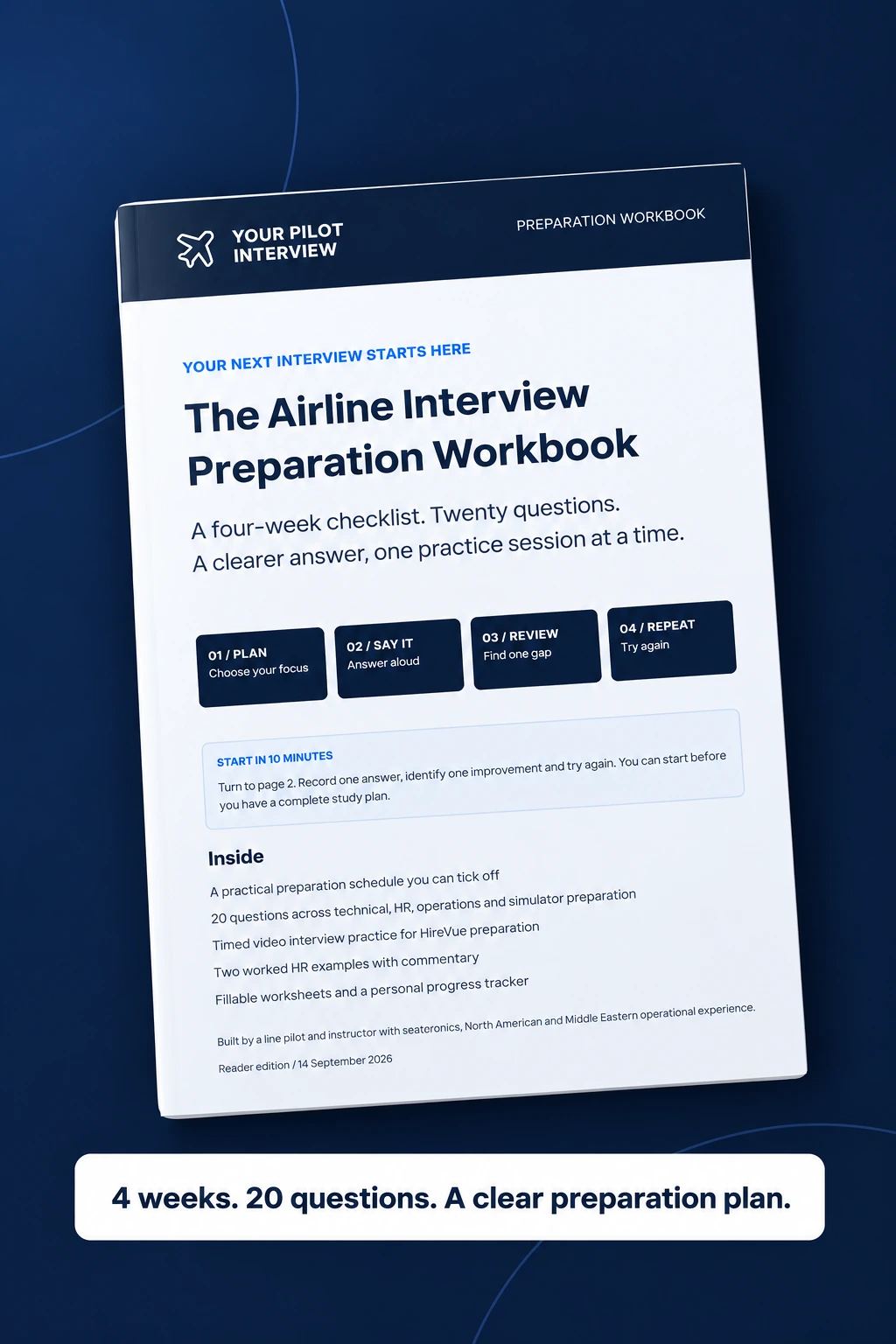
Practise aloud with the AI video interview simulator. You can also download the existing free 20-question PDF and browse pilot jobs when choosing what to prepare next.