“How do you stay current?” asks whether your reading changes your preparation and your decisions. A credible pilot interview answer names a source, gives one example you understand and explains what you did with it. A list of aviation websites does not show that learning happened.
Use the model below as a structure, then replace its activities with work you have actually completed. The regulatory examples concern EU SERA and EASA Air Operations; they are interview study material and must be matched to your State, aircraft and operator documents before operational use.
A 60-second pilot interview answer
For an employed pilot who has completed this reading:
I work in three layers. First, I follow our OM revisions, crew notices and flight briefings, including NOTAMs. Second, I read official material: EASA Easy Access Rules and Safety Information Bulletins, plus FAA SAFOs when preparing for US operations. Third, I learn from BEA, AAIB or NTSB investigations and manufacturer safety publications such as Airbus Safety First. I keep a short log of the source, the change and my follow-up. For example, after reading the EU radio-failure amendment, I rewrote my old revision note and compared it with our procedure. I would explain that example and its geographical limits. Before an interview I also read the airline's own announcements and results, separating confirmed facts from speculation.
Cadet or between operators:
Without an operator yet, I use EASA Easy Access Rules and SIBs, my training organisation's notices and investigation reports. I keep a source log, explain one finding in my own words and test it against a scenario. When I join an airline, I will connect that learning to its controlled manuals and briefing process.
Do not claim access to an OM you have not used. If the interviewer asks what you changed, describe your actual note, discussion or training follow-up.
Say this answer out loud and get feedback in the AI video interview simulator. For broader practice, use the pilot interview questions and answers guide.
What the question evaluates
An interviewer can probe your curiosity, source judgment and ability to turn reading into an explanation. Give enough detail to show what you learned without presenting yourself as the authority on an unfamiliar operation.
| Weak answer | Stronger answer |
|---|---|
| “I read aviation news every day.” | “I read the original notice, recorded its scope and changed this part of my notes.” |
| “EASA published it, so it is a new rule.” | “I identified whether it was a regulation, guidance or a safety recommendation.” |
| “It applies everywhere in Europe.” | “This example concerns EU SERA; I would open the State AIP for another jurisdiction.” |
| “The airline is ordering aircraft, so it must be hiring.” | “I can cite the announcement; recruitment plans need their own evidence.” |
The stronger column illustrates an answer structure. Supply your own evidence for the interview.
Know what kind of document you are reading
Start with the EASA Easy Access Rules for Air Operations for Air Ops, and use the separate Easy Access Rules for SERA for the rules of the air.
| Document | How to describe its role |
|---|---|
| EU regulation | A binding legal requirement within its scope. Read the provision and commencement text. |
| Acceptable Means of Compliance (AMC) | A non-binding means of demonstrating compliance with a requirement. |
| Guidance Material (GM) | Explanatory material that supports interpretation. |
| Safety Information Bulletin (SIB) | Safety information and recommendations; a SIB is not itself a mandatory instruction. |
| Airworthiness Directive (AD) | Mandatory action for the products and conditions it covers. |
| Operations manual (OM) | The operator's controlled instructions for its operation, reflecting the governing requirements. |
The legal status of AMC and GM is explained in EASA ED Decision 2024/007/R, recitals 1–2. EASA separately explains the difference between ADs and SIBs. These documents have different functions; the table is not a ladder on which an OM can override legislation.
Under ORO.MLR.100(e), operators must keep the OM current and make staff aware of changes relevant to their duties. Under (f), crew members receive relevant sections and keep their copies updated with supplied revisions. (h) allows immediate safety amendments provided any required approval has already been applied for. Those paragraphs explain why a reading routine must connect with the operator's revision process rather than wait for a monthly study session. See ORO.MLR.100 in the Air Ops rules.
For US-related reading, the FAA SAFO page identifies SAFOs as safety information and recommendations for operators.
Worked regulatory example: SERA radio failure
Commission Implementing Regulation (EU) 2024/404 introduced SERA.14083. Article 2 sets 1 May 2025 as the start date for this change. Retain the original regulation with your notes.
After unsuccessful communication-recovery attempts, (c)(2) specifies 7600 and/or the ADS-B communications-loss indication. A VFR flight continues in VMC, lands at the nearest suitable aerodrome and reports arrival promptly. For an IFR flight encountering VMC, (c)(6) specifies 7601 when the pilot-in-command chooses to remain in VMC, with the same landing and reporting obligations.
For the IFR case in (c)(4)(i), retain the last assigned speed and level, or minimum flight altitude if higher, for 20 minutes, rather than using a seven-minute surveillance timer. Timing starts at a missed required report or, where surveillance is provided, selection of 7600 and/or transmission of the relevant ADS-B mode. Then adjust speed and level to the filed flight plan, including delay or modification messages. (c)(5) instead requires any radio-failure procedure published on the SID or STAR being flown. This summary covers the timer and code logic; read the remaining route, descent and arrival provisions in SERA.14083 in EASA's Easy Access Rules for SERA.
Treat this as an EU SERA example. In 2025, the UK CAA said its own procedures were unchanged; that Safety Notice SN-2025/005 was withdrawn on 21 April 2026. It does not establish today's UK position. For both the UK and Switzerland, open the current State AIP and NOTAMs before describing the local procedure; no current adoption claim is made here.
For the longer explanation, read the lost-comms and squawk 7601 briefing. Practise related air law questions and the free pilot interview questions.
Worked safety-reading example: GNSS interference
EASA's 3 July 2026 announcement confirms SIB 2022-02R4 on GNSS outages and alterations affecting navigation or surveillance. Its highlighted changes include pilot–ATC phraseology and EFB considerations. This gives you a concrete example of safety learning alongside a regulatory amendment.
A concise interview explanation could be: “I noted the revised GNSS interference bulletin and identified the briefing and training material I needed to read for the routes I was preparing. I would use our OM and current notices for crew actions.” Describe that follow-up only if you completed it. The SIB's recommendations must not be presented as an AD or as an aircraft checklist.
Keep a source-to-action study log
Use one row for each item. Separate what you have read from follow-up that is still open.
| Source and reference | Date and scope | Learning or follow-up |
|---|---|---|
| Reg. (EU) 2024/404; SERA.14083(c)(4), (c)(6) | Applies from 1 May 2025; EU SERA; UK/CH: consult State AIP | Update the timer/code note; compare with the operation's procedure. |
| EASA SIB 2022-02R4 | Published 3 July 2026; GNSS interference | Read the bulletin and the relevant company briefing; record remaining questions. |
| Airbus Safety First, Prevention of Unstable Approaches | Undated web version | Compare its learning points with the stabilisation policy for the aircraft and operator. |
The manufacturer item links to Airbus Safety First. Connect it with the unstable-approach interview examples, while keeping manufacturer safety learning distinct from your operator's procedures.
Publication is not the effective date. ICAO's AIRAC explanation distinguishes publication, latest reception and effective dates. A chart amendment can be in your briefing pack before it takes effect. Similarly, for an international NOTAM, the FAA AIM identifies field B as the start and field C as the end of validity; include any field D schedule when interpreting its time window.
Industry and airline current affairs
Prepare one company development and one wider industry subject. Use the airline's newsroom, annual report, published results or official recruitment page as the starting point. Trade reporting can identify a story, but take the facts you intend to quote back to their origin.
For a fleet announcement, distinguish an order from aircraft already delivered. For a new route, separate an announced launch from an operating service. Explain one possible implication for the business, and label it as your inference. Avoid turning fleet growth or an earnings headline into an unsupported hiring forecast.
A useful worksheet has four lines: confirmed fact; original source and date; why it interests me; question I still have. For example, a fictional airline announcing a new base might prompt you to discuss network development and ask how the base fits its published strategy. Do not invent a real announcement to fill the worksheet. Compare the official vacancy with the first officer jobs board when preparing for an application.
Prepare for the panel's follow-ups
- What was the last change you read? Name one item from your log and explain what you learned, rather than listing several headlines.
- Where is it reflected in your OM? Identify the actual section and revision you used. A cadet can explain which training document they read and what company material they would need after joining.
- Was it a SIB or an AD? Explain the different status, then identify the document you actually reviewed.
- Does the EU example apply in the UK or Switzerland? Open the current State material; do not treat a withdrawn notice or remembered NOTAM as current evidence.
- What if you have not read that update? “I haven't reviewed that yet; I'd check the original source and our OM before acting on it.”
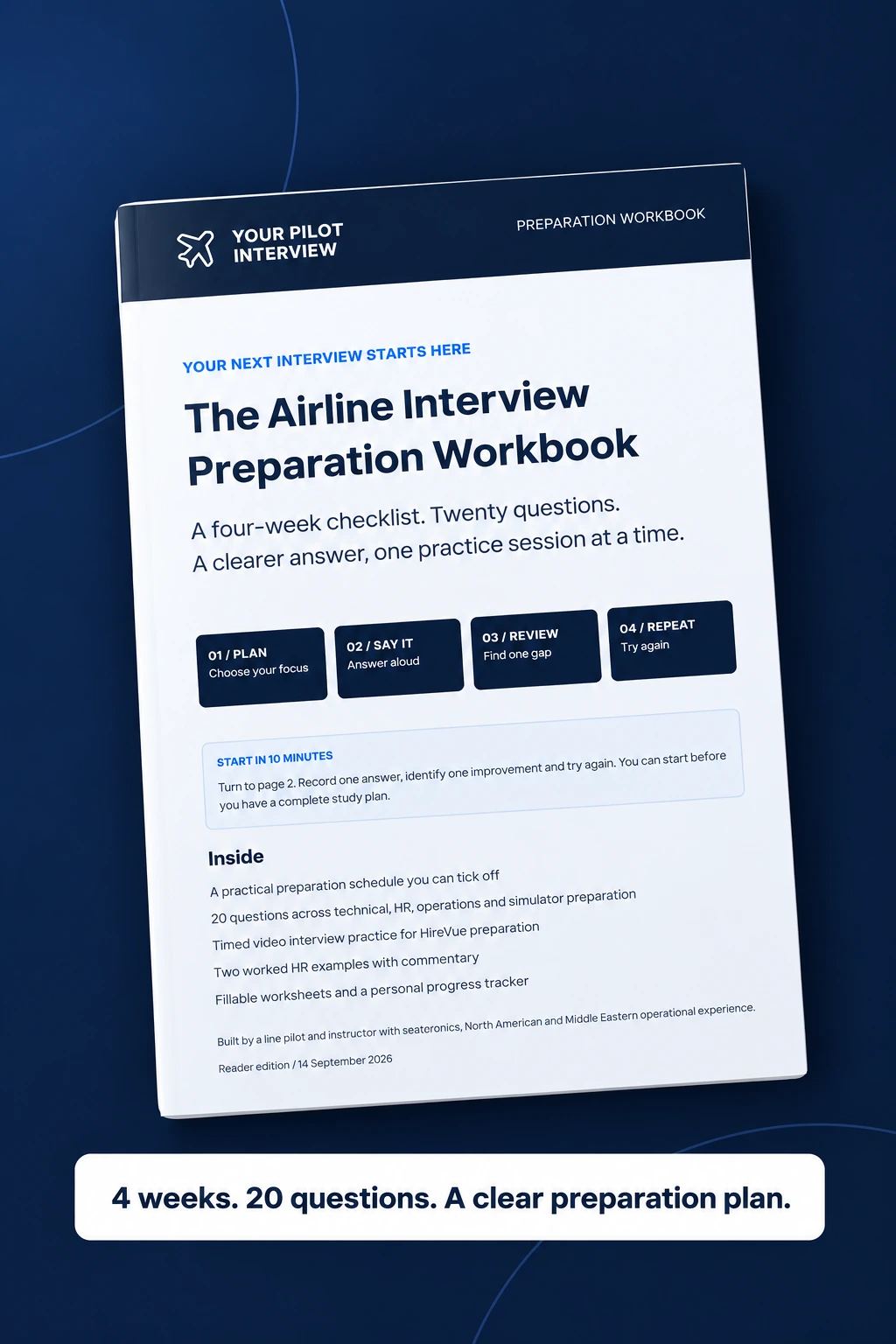
Use the STAR method if the panel asks about a real occasion when learning changed your behaviour. Build the routine into your four-week preparation plan, alongside flight operations practice and the ATPL EASA study space.
Choose one item and rehearse it
Before the interview, open the original source for your chosen example. Explain what you read, what it means for the operation you know and what you did next. Keep unresolved questions visible in your log. You can also download the existing free pilot interview PDF for question practice.
Independent preparation resource, not affiliated with or endorsed by any airline.
Last reviewed: 5 November 2026