European radio communication failure preparation needs more than remembering “7600” or a waiting time. Under SERA.14083, the applicable branch depends on flight rules, conditions and any published departure or arrival procedure. This guide helps you organise a technical interview answer and find the relevant rule; it is not an operational checklist.
Scope: the SERA rules discussed here apply where that framework is applicable. Do not assume the same procedure applies worldwide. Source verification for this substantive update: 15 October 2026, using EASA's August 2025 Easy Access Rules and its amendment explanation. Use current approved operational references and the applicable AIP/charts for actual operations.
What changed, and when
The amendments associated with Commission Implementing Regulation (EU) 2024/404 became applicable on 1 May 2025. EASA's subsequent August 2025 revision incorporates the rules applicable from that date. The updated framework includes SERA.14083 and a specific use of Mode A code 7601. EASA amendment explanation, EASA revision history.
A preparation note based only on the older “seven-minute rule” can miss the current branches. Learn how to locate the provision rather than treating one historical number as the whole answer.
A study map of the rule
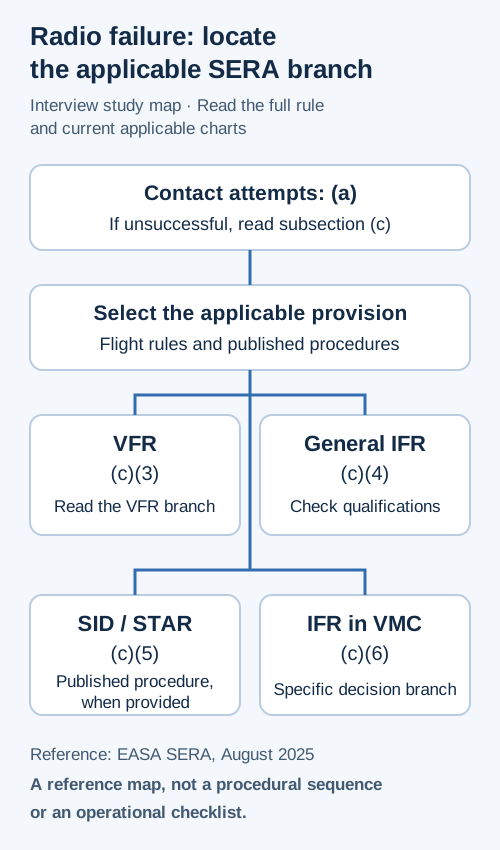
The diagram is an original YPI learning aid. It points you to the provisions to read; it omits the detail required to carry out a procedure.
Read the branches, not just the codes
SERA.14083(a) covers attempts to restore contact using the previous and another appropriate channel, then available alternatives. If these fail, subsection (c) covers failure indication and the applicable flight-rule branches. VFR is addressed in (c)(3); the general IFR route is in (c)(4). Published SID/STAR failure procedures, when provided, are covered by (c)(5).
The general IFR provision includes 20 minutes, with distinct triggering events for procedural and surveillance circumstances, and retains the minimum-flight-altitude qualification. It also covers route, descent and approach details. Under (c)(6), an IFR pilot who encounters VMC and decides to continue in VMC uses 7601, lands at the nearest suitable aerodrome and reports arrival promptly to ATS. VFR under (c)(3) is a different branch; 7601 is not a general VMC code. Full SERA.14083 text.
This summary identifies points to revise. It deliberately does not reproduce the full IFR route, timing or approach procedure. Read the complete provision alongside the applicable chart and operating instructions.
An original interview preparation exercise
Prompt: “Explain why a radio-failure answer should not begin and end with a single timer.”
Organise an answer in three parts:
- Identify the framework: Which rules and current references apply to the described operation?
- Locate the branch: Which flight-rule and published-procedure provisions need to be checked?
- Explain the detail accurately: Use the actual reference for timing, route and other requirements, rather than completing an incomplete memory with a guess.
For example, an interview answer could begin:
If you tell me the failure happens during an IFR departure on a SID, I'd check whether that SID has a published radio-failure procedure. That changes the branch I need to explain. If you then change the scenario to an IFR flight that encounters VMC and whose commander decides to continue in VMC, SERA.14083(c)(6) gives a different answer: 7601, land at the nearest suitable aerodrome and report arrival promptly. I need those facts before choosing a timer.
These are fictional study cases. Explain the full branch from the current rule and chart when working through one; the short answer above illustrates why the scenario matters.
Compare two fictional study notes
Incomplete note: “Lost communications in Europe means one code and one timer.”
More useful note: “IFR departure on a SID: find any published radio-failure procedure. IFR flight that encounters VMC and decides to continue in VMC: review SERA.14083(c)(6), including 7601 and landing at the nearest suitable aerodrome. Keep the current rule and relevant chart beside the note.”
The second note gives you two different cases to explain and identifies where to check each one. Keep the full procedure available while revising.
Check your reference sheet
For interview study, record the source, edition, jurisdiction and date checked. Write down which branch you reviewed and any question you need to resolve with a qualified instructor or current operational reference. Keep regulatory requirements separate from your own memory aids.
Arrival reporting to ATS and occurrence reporting are separate subjects. Verify any occurrence-reporting obligations through the applicable reporting framework and operator process; this article does not give a blanket reporting deadline for every situation.
Continue with technical revision
Use air law interview questions to revise the surrounding rules, and communication topics to practise explaining the issue clearly. For a different operating environment, read the oceanic contingency guide with its own scope and references.
The pilot interview question guide provides other practice prompts. Keep each technical answer connected to the current reference that supports it.