Prepare for Your Airline Pilot Interview

Technical, HR, simulator and A320/B737 interview questions organised by subject, with explained answers and timed video practice to help you prepare for interview day.

Monthly access renews automatically. Cancel anytime.
169 free questions. No account or credit card needed to preview.

  • 1065 questions across 15 subjects
  • Created by an airline pilot and instructor
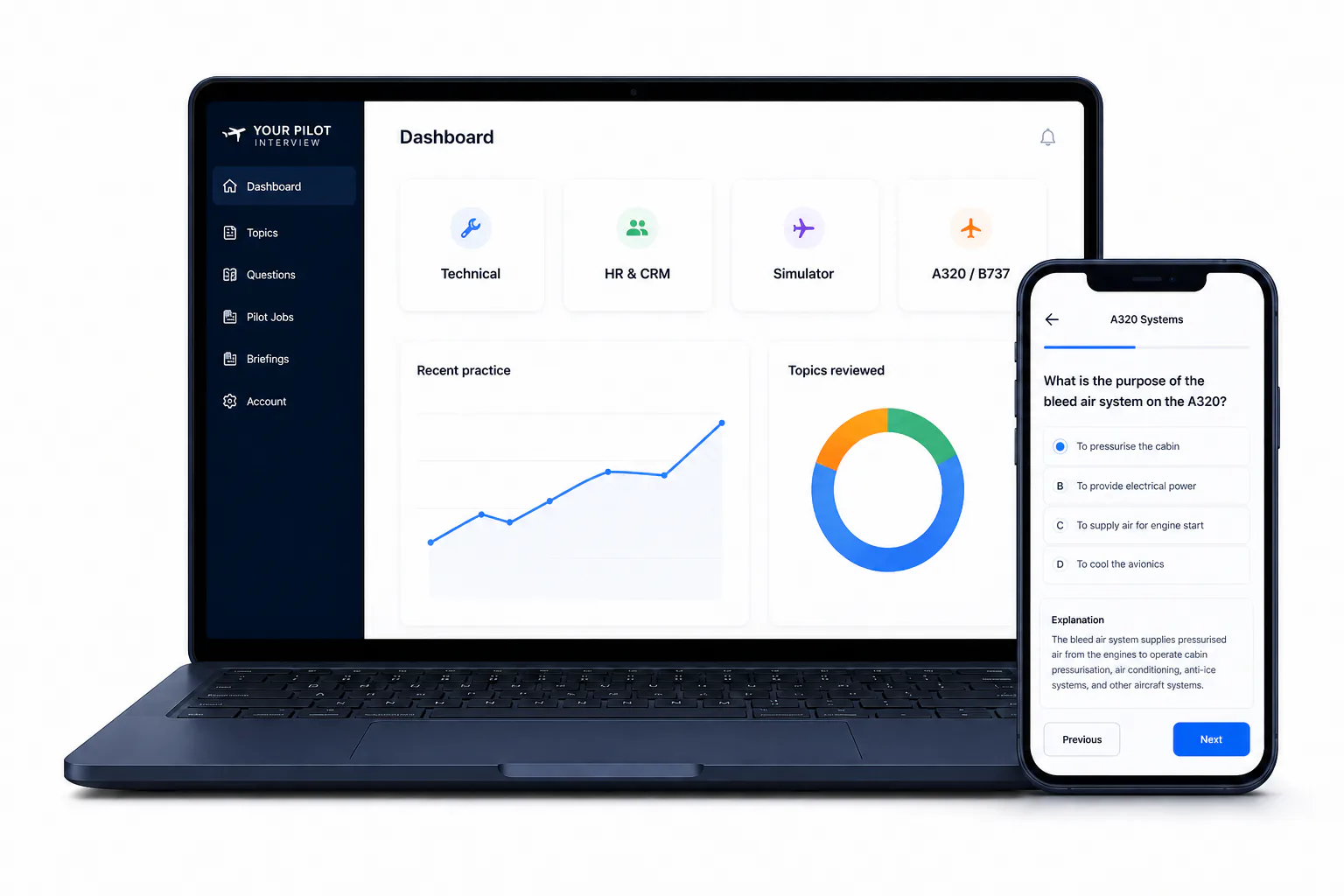
Your Pilot Interview question library shown on a laptop and phone

Practise with Realistic Interview QuestionsTry an Interview Question

Try a technical explanation and an HR answer framework from the free library.Explore two illustrated technical answers from the free library. Premium adds 896 questions and video interview practice.

Think through your answer, then reveal the explanation.

Technical · Air Law Explain the difference between transition altitude and transition level. Reveal explanationHide explanation

Transition altitude is the altitude at or below which aircraft use local QNH. Above it, pilots set standard pressure (1013.25 hPa); it is used during climb.

Transition level is the lowest usable flight level at or above which aircraft use standard pressure. It is used during descent and normally varies with QNH.

The airspace between them is the transition layer. Apply the published procedure for your airspace.

Transition altitude, transition level and the transition layer Read the full technical answer
Technical · Performance Define balanced V₁. Reveal explanationHide explanation

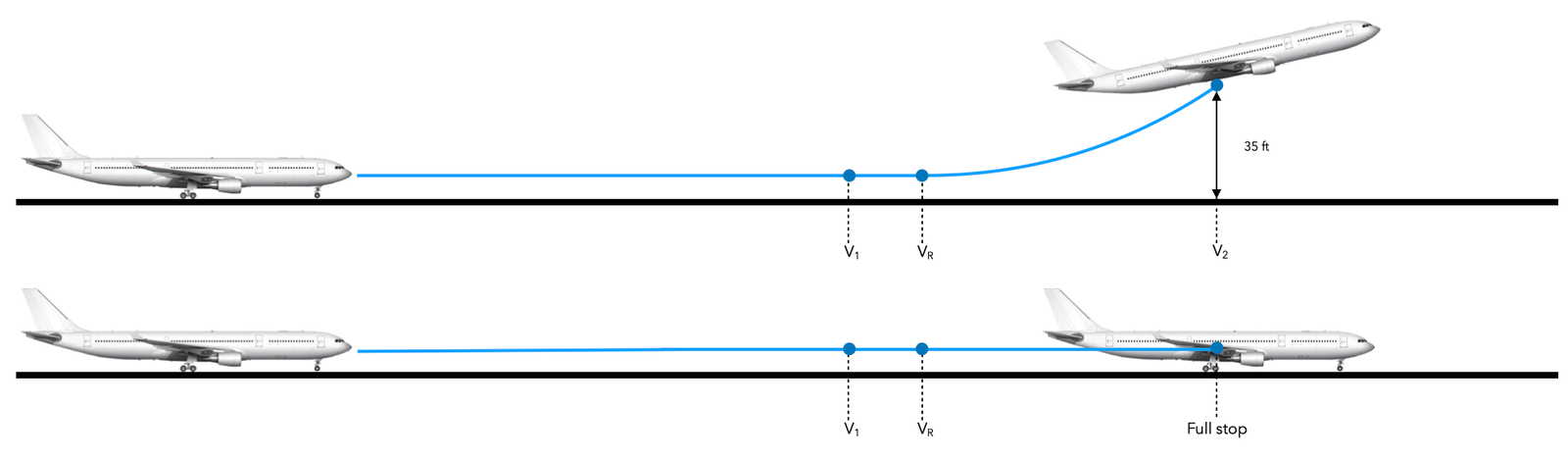
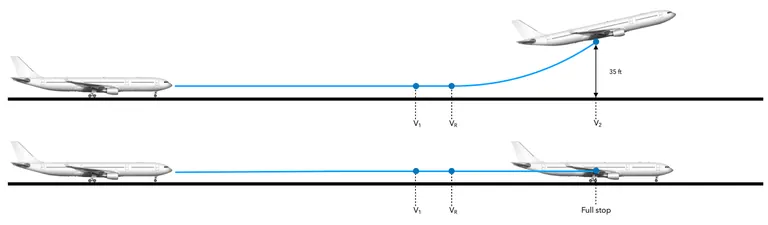
Balanced V₁ is the takeoff decision speed at which the takeoff distance required equals the accelerate-stop distance required.

V₁ is the latest point to initiate a rejected takeoff. Apply the approved aircraft performance data for the actual conditions.

Balanced V1 illustration comparing a continued takeoff with an accelerate-stop path Read the full Performance answer

Air Law

Explain the difference between transition altitude and transition level.

Transition altitude

The altitude at or below which aircraft use local QNH. Above it, pilots set standard pressure (1013.25 hPa); it is used during climb. Apply the published procedure for your airspace.

Transition level

The lowest usable flight level at or above which aircraft use standard pressure. It is used during descent and normally varies with the QNH.
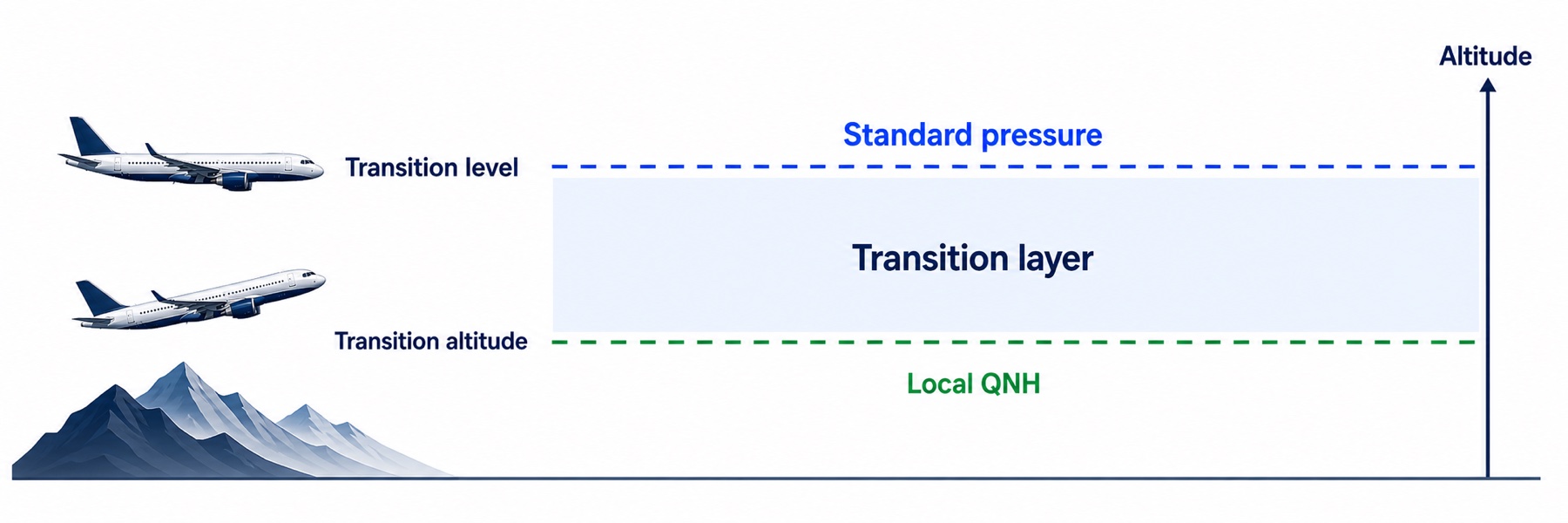
Diagram showing standard pressure above the transition level, local QNH below the transition altitude, and the transition layer between them

The airspace between them is the transition layer.
Read the full technical answer

A320 · Electrical systems

How many TRs are installed on the A320 and which buses do they supply?

Explained answer

There are 3 TRs: TR1 supplies DC BUS 1, TR2 supplies DC BUS 2, and ESS TR can power the essential DC circuit from the emergency generator, if the engine and APU generators all fail, or if TR 1 or TR 2 fails.

Read the full A320 answer

Flight Operations

What is RVSM?

Reduced vertical separation

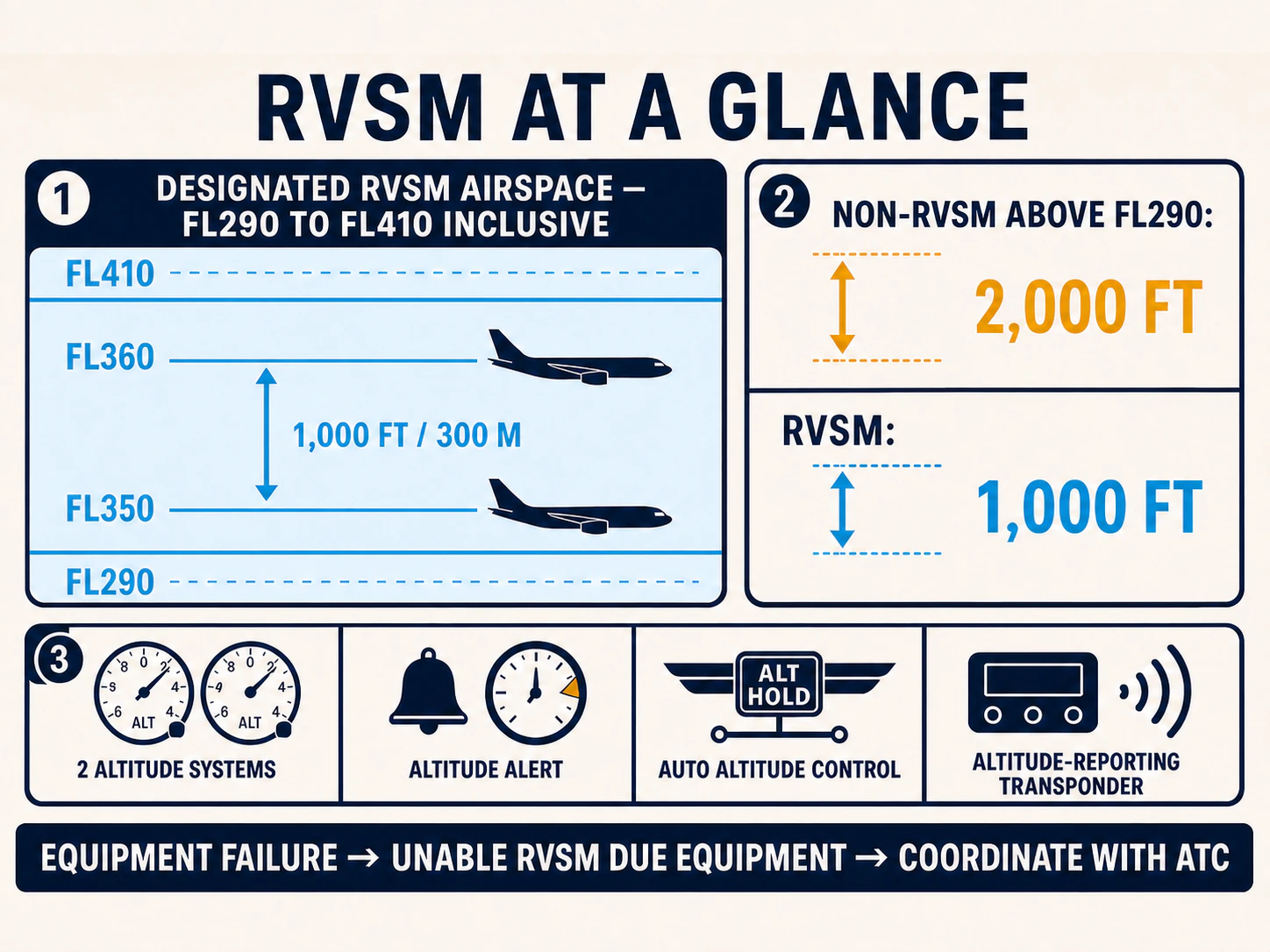
RVSM applies 1,000 ft (300 m) vertical separation between FL290 and FL410 inclusive in designated RVSM airspace.

Aircraft and operational approval

The aircraft must meet the applicable equipment and approval requirements. After an equipment failure, inform ATC and coordinate a revised clearance; a descent below FL290 is not automatic.

RVSM and non-RVSM vertical separation, required equipment, and equipment-failure phraseology
Vertical separation, required equipment and coordination with ATC. Open full size
Read the full RVSM answer

Performance

Define balanced V₁.

Balanced field length

Balanced V₁ is the takeoff decision speed at which the takeoff distance required equals the accelerate-stop distance required.

The decision-speed limit

V₁ is the latest point to initiate a rejected takeoff. Apply the approved aircraft performance data for the actual conditions.

Balanced V1 illustration comparing an engine-out continued takeoff with an accelerate-stop path
The continued-takeoff and accelerate-stop paths. Open full size
Read the full Performance answer

Meteorology

How does a microburst affect an aircraft during flight?

Rapidly changing wind

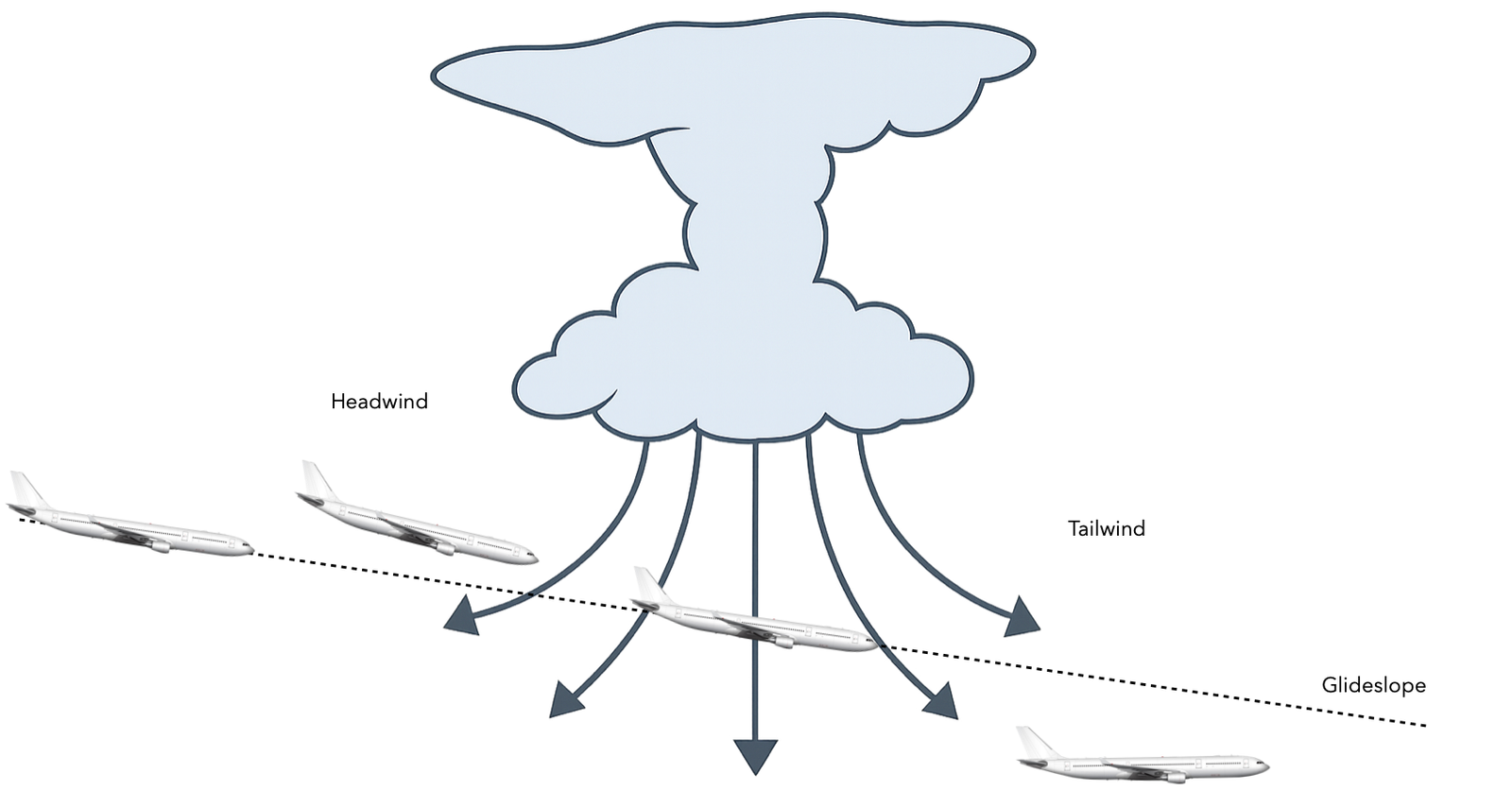
A microburst is a strong, localised downdraft that spreads horizontally when it reaches the ground.

Headwind, downdraft, tailwind

An initial headwind can increase airspeed, followed by a downdraft and then a tailwind that reduce airspeed and increase descent. Microbursts can exceed aircraft performance capabilities and must be avoided.

Aircraft encountering an initial headwind, a microburst downdraft and an increasing tailwind near the ground
A changing wind field along the approach path. Open full size
Read the full Meteorology answer

HR & CRM

How would you answer “Tell me about yourself”?

Answer framework

Give a short progression from relevant background to training or current flying, then explain your next career step. Select two or three facts that connect directly to the role.

Explore HR interview answers

Used by Pilots Preparing for Their Next Career Move

“The structure helped me prepare topic by topic instead of jumping between random notes.”

ThomasA320 First Officer

1065
Interview Questions
15
Subjects
A320 & B737
Type-Specific Routes
Oct 2026
Content Updated

Practise your one-way video interview

Four timed questions, four pilot career profiles and personalised AI coaching. Your camera stays on your device.

Explore Video Interview

A Simple and Structured Way to Prepare

  1. 1

    Explore Free Questions

    Read full answers before you pay. No account needed.

  2. 2

    Practise by Subject

    Focus on the technical, HR or simulator topics you need.

  3. 3

    Prepare Until Interview Day

    Return to your chosen subjects until assessment day.

EUR prices include applicable taxes.

Simple, Transparent Pricing

Every plan unlocks the same Premium library. Choose your access period and included video interview attempts.

Access for 1 month

Pro Monthly

€25/ month

Auto-renews. Cancel anytime.

Best for continuous weekly revision.

1 simulator attempt included

  • 896 Premium Questions
  • Model answers and explanations
  • Technical Questions library
  • Simulator Assessment prep
  • HR Interview and CRM prep
  • A320/B737 type-specific questions
View price breakdown
Monthly equivalent
€25 per month
Compared with monthly
Lowest upfront payment

Access for 6 months

Extended Prep

€89one-time

One-time payment. No auto-renew.

Best for a longer preparation window or several applications.

6 simulator attempts included

  • 896 Premium Questions
  • Model answers and explanations
  • Technical Questions library
  • Simulator Assessment prep
  • HR Interview and CRM prep
  • A320/B737 type-specific questions
View price breakdown
Monthly equivalent
€14.83 per month equivalent
Compared with monthly
Save €61 versus 6 monthly payments
Best value

Access for 12 months

Full Access

€129one-time

One-time payment. No auto-renew.

Best value for long-term prep and multiple applications.

12 simulator attempts included

  • 896 Premium Questions
  • Model answers and explanations
  • Technical Questions library
  • Simulator Assessment prep
  • HR Interview and CRM prep
  • A320/B737 type-specific questions
View price breakdown
Monthly equivalent
€10.75 per month equivalent
Compared with monthly
Save €171 versus 12 monthly payments

Frequently Asked Questions

Can I cancel my subscription at any time?

Yes. The monthly plan can be cancelled at any time and remains active until the end of the billing period.

Does the platform cover the Airbus A320?

Yes. The library includes A320 material alongside B737, technical, operational, simulator and HR topics.

Is this only for airline interviews?

No. Pilots also use the library for technical refreshers and preparation before simulator assessments.

Is there a free trial?

You can explore 169 free questions with full answers before choosing a paid plan.

Are the questions specific to individual airlines?

YPI focuses on commonly assessed knowledge and does not claim to provide confidential interview questions.

How often is the content updated?

The library is reviewed as new questions and briefings are added. The latest question activity was October 2026.

Ready to Start Preparing?

Build a structured revision plan and approach your next airline interview with greater confidence.