Topic question bank: Performance

Questions and Answers

Cold Weather Operations

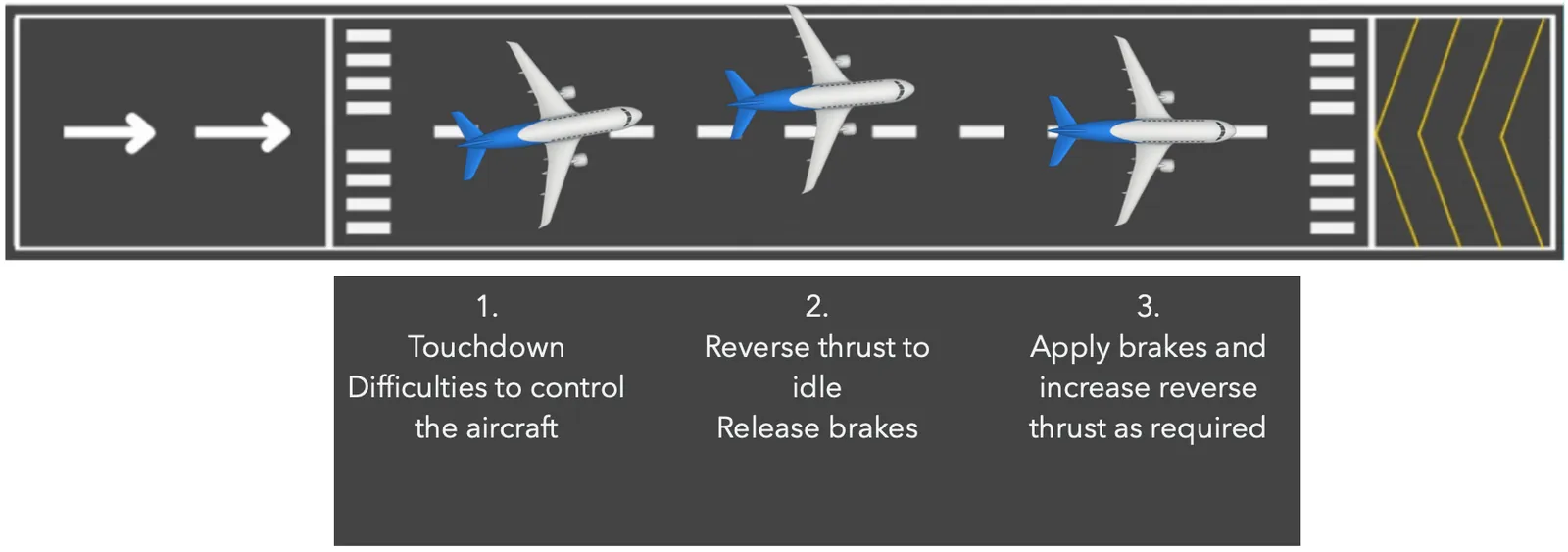
After landing on a slippery runway, the aircraft begins to drift toward the left side due to a strong crosswind from the right.
What action should be taken to regain directional control?

On landing with a strong crosswind from the right on a slippery runway, two main forces tend to push the aircraft toward the left (downwind side):
– the crosswind, which acts on the aircraft’s tail, causing the nose to yaw right
– and the reverse thrust, which acts opposite to the aircraft’s heading and reinforces the sideways force

In this scenario, the aircraft is pointing slightly to the right (into the wind), so the reverse thrust vector pushes further toward the left, combining with the crosswind to degrade directional control.

To regain control, we need to reduce the forces pushing us downwind. Since we cannot act on the wind, the best option is to:
reduce reverse thrust to idle (not cancel it entirely)
release the brakes to regain tire traction
– use rudder and differential braking as needed to steer back to the centerline

Once directional control is restored, reverse thrust and braking can be reapplied as appropriate.
Image

What runway condition code is used when dry or wet snow covers the runway with a depth of 4 mm or more?

Member-only answer

This is a real airline technical interview question. Unlock the structured, examiner-ready answer used by successful candidates.

Unlock full access
What runway condition code is reported when slush or standing water is present with a depth greater than 3 mm?

Member-only answer

This is a real airline technical interview question. Unlock the structured, examiner-ready answer used by successful candidates.

Unlock full access
What runway condition code is assigned when water, slush, dry snow, or wet snow covers the runway with a depth of 3 mm (1/8 inch) or less?

Member-only answer

This is a real airline technical interview question. Unlock the structured, examiner-ready answer used by successful candidates.

Unlock full access
Runway condition code is reported 2/3/2 . Is the condition code 2 always the most limiting for RTOW?

Member-only answer

This is a real airline technical interview question. Unlock the structured, examiner-ready answer used by successful candidates.

Unlock full access

Take-off and Climb

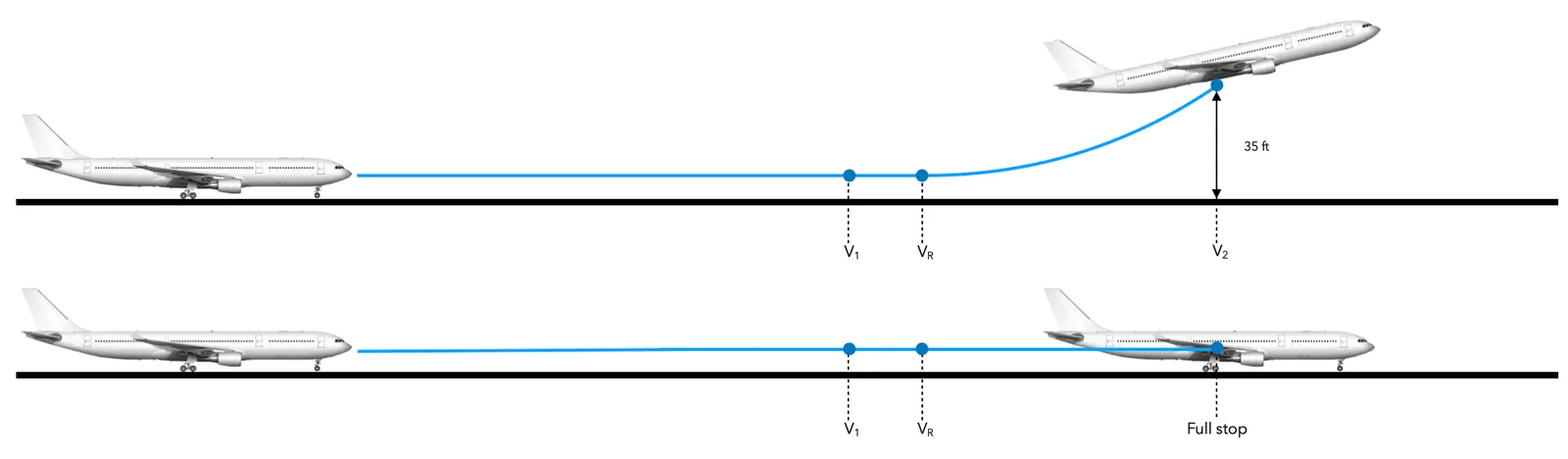
Define balanced $V_{1}$.

Balanced V₁ is the takeoff decision speed at which the Take-Off Distance Required (TODR) equals the Accelerate-Stop Distance Required (ASDR).
At this speed, if an engine fails just before $V_{1}$, the aircraft can either:

  • Stop within the ASDR, or
  • Continue the takeoff and reach screen height within the TODR.

This condition defines the balanced field length, which is the minimum runway length required for a given aircraft weight.

Choosing a lower $V_{1}$ increases TODR, since the aircraft needs more distance to accelerate to $V_{2}$ with one engine inoperative.
Choosing a higher $V_{1}$ increases ASDR, as more energy must be absorbed by the brakes in case of a rejected takeoff.

In essence, balanced $V_{1}$ optimizes field-length-limited takeoff performance.

Balanced V1

Note: The field length may be limited by:
- ASDR
- TODR
- 115% of all-engine TODR

Reminder: If an engine fails exactly at $V_{1}$, the aircraft may not be able to stop within ASDR, due to the reaction time required to recognize the failure and initiate a rejected takeoff (RTO).
That’s why $V_{1}$ is the latest point to initiate the RTO, not to complete it.

What is the effect of clearway on field length limited TOW and how does it affect $V_{1}$?

When using a balanced V₁ (i.e. when TODR = ASDR), the maximum takeoff weight (TOW) is achieved for a given field length.

On a runway without clearway or stopway, TODA = ASDA.
In such a case, for a field length limited takeoff:
- Balanced V₁ results in:
TODR = ASDR = ASDA = TODA
- Since ASDR = ASDA, V₁ cannot be increased further
- And since TODA is fixed, TOW cannot be increased either

This is because:
- Increasing TOW requires a lower V₁ (to keep ASDR ≤ ASDA)
- But lowering V₁ increases TODR, which would then exceed TODA → not allowed

However, introducing a clearway increases TODA (Take-Off Distance Available).
This allows:
- A slightly lower V₁ (to reduce ASDR)
- A slightly higher Vr (to generate the required lift at higher TOW)
- Even though TODR increases slightly with the lower V₁, the added clearway ensures TODR remains ≤ TODA

✅ Result: Higher takeoff weight becomes possible, thanks to the clearway, by using an unbalanced V₁ configuration.

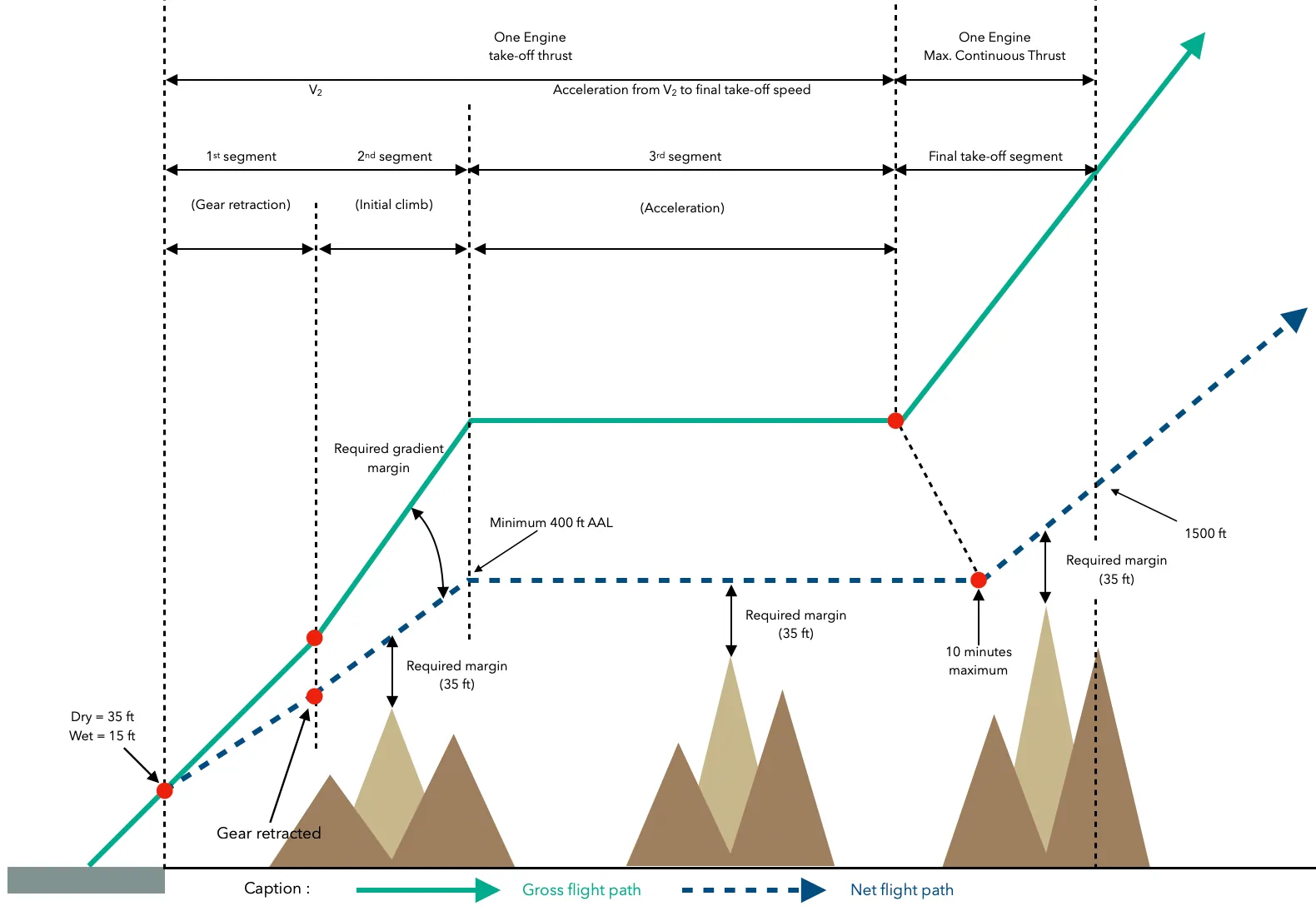
What are the four takeoff flight path segments following an engine failure?

In the event of an engine failure after takeoff, the flight path is divided into four distinct segments, each with specific configuration and performance requirements:

  1. First segment – From screen height (35 ft) to the point where the landing gear is fully retracted.
    – Aircraft is still accelerating with gear down
    – Climb gradient must be positive for twin-engined aircraft and at least equal to 0.5% for quad-engined aircraft

  2. Second segment – From gear up to acceleration altitude (no lower than 400 ft AAL).
    – Flaps remain extended
    – Aircraft must maintain $V_{2}$
    Minimum required climb gradient is 2.4% for twin-engined aircraft and 3.0% for quad-engined aircraft.

  3. Third segment – From acceleration altitude to the point where the flaps and slats are fully retracted.
    – The aircraft accelerates from $V_{2}$ toward final segment speed
    – Configuration transitions to clean

  4. Fourth segment – From flaps retracted to 1500 ft AAL or the applicable minimum safe altitude (MSA).
    – Climb continues at a higher speed with reduced thrust
    Minimum required climb gradient is 1.4% for twin-engined aircraft and 1.7% for quad-engined aircraft

Image

What is TORA?

Member-only answer

This is a real airline technical interview question. Unlock the structured, examiner-ready answer used by successful candidates.

Unlock full access
Define Stopway.

Member-only answer

This is a real airline technical interview question. Unlock the structured, examiner-ready answer used by successful candidates.

Unlock full access
Define clearway.

Member-only answer

This is a real airline technical interview question. Unlock the structured, examiner-ready answer used by successful candidates.

Unlock full access
What are the clearway limitations?

Member-only answer

This is a real airline technical interview question. Unlock the structured, examiner-ready answer used by successful candidates.

Unlock full access
Define TODA.

Member-only answer

This is a real airline technical interview question. Unlock the structured, examiner-ready answer used by successful candidates.

Unlock full access
Define ASDA.

Member-only answer

This is a real airline technical interview question. Unlock the structured, examiner-ready answer used by successful candidates.

Unlock full access
Define $V_{1}$.

Member-only answer

This is a real airline technical interview question. Unlock the structured, examiner-ready answer used by successful candidates.

Unlock full access
Define unbalanced $V_{1}$.

Member-only answer

This is a real airline technical interview question. Unlock the structured, examiner-ready answer used by successful candidates.

Unlock full access
Why does balanced $V_{1}$ increase as aircraft weight increases?

Member-only answer

This is a real airline technical interview question. Unlock the structured, examiner-ready answer used by successful candidates.

Unlock full access
How does $V_{1}$ change on a non-dry runway?

Member-only answer

This is a real airline technical interview question. Unlock the structured, examiner-ready answer used by successful candidates.

Unlock full access
Define $V_{R}$.

Member-only answer

This is a real airline technical interview question. Unlock the structured, examiner-ready answer used by successful candidates.

Unlock full access
Describe the relationship between $V_{1}$ and $V_{R}$.

Member-only answer

This is a real airline technical interview question. Unlock the structured, examiner-ready answer used by successful candidates.

Unlock full access
Define $V_{2}$.

Member-only answer

This is a real airline technical interview question. Unlock the structured, examiner-ready answer used by successful candidates.

Unlock full access
Define $V_{MCG}$.

Member-only answer

This is a real airline technical interview question. Unlock the structured, examiner-ready answer used by successful candidates.

Unlock full access
What are the consequences of losing the upwind engine at $V_{MCG}$ during a takeoff in crosswind conditions?

Member-only answer

This is a real airline technical interview question. Unlock the structured, examiner-ready answer used by successful candidates.

Unlock full access
Define $V_{MBE}$.

Member-only answer

This is a real airline technical interview question. Unlock the structured, examiner-ready answer used by successful candidates.

Unlock full access
Define $V_{MCA}$.

Member-only answer

This is a real airline technical interview question. Unlock the structured, examiner-ready answer used by successful candidates.

Unlock full access
Describe the relationship between $V_{MCA}$ and $V_{R}$.

Member-only answer

This is a real airline technical interview question. Unlock the structured, examiner-ready answer used by successful candidates.

Unlock full access
Describe the relationship between $V_{MCG}$ and $V_{1}$.

Member-only answer

This is a real airline technical interview question. Unlock the structured, examiner-ready answer used by successful candidates.

Unlock full access
Describe the relationship between $V_{MCA}$ and $V_{2}$.

Member-only answer

This is a real airline technical interview question. Unlock the structured, examiner-ready answer used by successful candidates.

Unlock full access
What is the effect of pressure altitude and temperature on $V_{MCA}$ and $V_{MCG}$?

Member-only answer

This is a real airline technical interview question. Unlock the structured, examiner-ready answer used by successful candidates.

Unlock full access
What is the minimum obstacle clearance required along the net take-off flight path.

Member-only answer

This is a real airline technical interview question. Unlock the structured, examiner-ready answer used by successful candidates.

Unlock full access
What is the purpose of the assumed temperature (or FLEX temperature on Airbus aircraft)?

Member-only answer

This is a real airline technical interview question. Unlock the structured, examiner-ready answer used by successful candidates.

Unlock full access
Describe the impact of derated take-off thrust on fuel consumption.

Member-only answer

This is a real airline technical interview question. Unlock the structured, examiner-ready answer used by successful candidates.

Unlock full access
What is the purpose of the derated take-off thrust.

Member-only answer

This is a real airline technical interview question. Unlock the structured, examiner-ready answer used by successful candidates.

Unlock full access
Why is there a "80 knots" or "100 knots" callout during the takeoff roll?

Member-only answer

This is a real airline technical interview question. Unlock the structured, examiner-ready answer used by successful candidates.

Unlock full access
Define an aircraft’s critical engine.

Member-only answer

This is a real airline technical interview question. Unlock the structured, examiner-ready answer used by successful candidates.

Unlock full access
Explain how the P-factor influences the critical engine on a twin-engine propeller aircraft.

Member-only answer

This is a real airline technical interview question. Unlock the structured, examiner-ready answer used by successful candidates.

Unlock full access
Which engine failure on a twin-engine jet aircraft with crosswind from the left would produce the most adverse handling characteristics during takeoff?

Member-only answer

This is a real airline technical interview question. Unlock the structured, examiner-ready answer used by successful candidates.

Unlock full access
Does a twin-engine jet aircraft have a critical engine?

Member-only answer

This is a real airline technical interview question. Unlock the structured, examiner-ready answer used by successful candidates.

Unlock full access
Identify which engines are considered critical on a four-engine jet aircraft and explain why.

Member-only answer

This is a real airline technical interview question. Unlock the structured, examiner-ready answer used by successful candidates.

Unlock full access
If failure of the upwind engine on takeoff would result in the most adverse handling characteristics, why isn’t that engine considered critical?

Member-only answer

This is a real airline technical interview question. Unlock the structured, examiner-ready answer used by successful candidates.

Unlock full access
Describe the effect of aircraft weight on takeoff speeds.

Member-only answer

This is a real airline technical interview question. Unlock the structured, examiner-ready answer used by successful candidates.

Unlock full access
Describe the effect of flap settings on takeoff speeds.

Member-only answer

This is a real airline technical interview question. Unlock the structured, examiner-ready answer used by successful candidates.

Unlock full access
How should the aircraft be configured for a field length limited takeoff?

Member-only answer

This is a real airline technical interview question. Unlock the structured, examiner-ready answer used by successful candidates.

Unlock full access
What is the appropriate configuration for a climb- or obstacle-limited takeoff?

Member-only answer

This is a real airline technical interview question. Unlock the structured, examiner-ready answer used by successful candidates.

Unlock full access
Define climb gradient.

Member-only answer

This is a real airline technical interview question. Unlock the structured, examiner-ready answer used by successful candidates.

Unlock full access
How does Regulated Takeoff Weight differ from Maximum Takeoff Weight?

Member-only answer

This is a real airline technical interview question. Unlock the structured, examiner-ready answer used by successful candidates.

Unlock full access
What is the minimum rate of climb required during the second takeoff segment if V2 is 150 kts and one engine fails at V1 on a twin-engine jet aircraft?

Member-only answer

This is a real airline technical interview question. Unlock the structured, examiner-ready answer used by successful candidates.

Unlock full access
What is the minimum climb gradient required during a missed approach?

Member-only answer

This is a real airline technical interview question. Unlock the structured, examiner-ready answer used by successful candidates.

Unlock full access
What is the minimum climb gradient required for a SID?

Member-only answer

This is a real airline technical interview question. Unlock the structured, examiner-ready answer used by successful candidates.

Unlock full access
Define $V_{x}$.

Member-only answer

This is a real airline technical interview question. Unlock the structured, examiner-ready answer used by successful candidates.

Unlock full access
Define $V_{y}$.

Member-only answer

This is a real airline technical interview question. Unlock the structured, examiner-ready answer used by successful candidates.

Unlock full access

General Concepts

Define Screen height.

Member-only answer

This is a real airline technical interview question. Unlock the structured, examiner-ready answer used by successful candidates.

Unlock full access
Explain the difference between $V_{MO}$ and $M_{MO}$.

Member-only answer

This is a real airline technical interview question. Unlock the structured, examiner-ready answer used by successful candidates.

Unlock full access
Define $V_{D}$

Member-only answer

This is a real airline technical interview question. Unlock the structured, examiner-ready answer used by successful candidates.

Unlock full access
Define $V_{NE}$.

Member-only answer

This is a real airline technical interview question. Unlock the structured, examiner-ready answer used by successful candidates.

Unlock full access
Define $V_{NO}$.

Member-only answer

This is a real airline technical interview question. Unlock the structured, examiner-ready answer used by successful candidates.

Unlock full access
Define cost index.

Member-only answer

This is a real airline technical interview question. Unlock the structured, examiner-ready answer used by successful candidates.

Unlock full access
How does fuel consumption and flight time change with variations in the cost index?

Member-only answer

This is a real airline technical interview question. Unlock the structured, examiner-ready answer used by successful candidates.

Unlock full access
What does Cost Index 0 correspond to?

Member-only answer

This is a real airline technical interview question. Unlock the structured, examiner-ready answer used by successful candidates.

Unlock full access
Describe the impact of flap settings on fuel burn during takeoff.

Member-only answer

This is a real airline technical interview question. Unlock the structured, examiner-ready answer used by successful candidates.

Unlock full access
How does flying below your optimum altitude affect fuel consumption and performance?

Member-only answer

This is a real airline technical interview question. Unlock the structured, examiner-ready answer used by successful candidates.

Unlock full access
Define density altitude.

Member-only answer

This is a real airline technical interview question. Unlock the structured, examiner-ready answer used by successful candidates.

Unlock full access
Why do aircraft fly at high altitudes?

Member-only answer

This is a real airline technical interview question. Unlock the structured, examiner-ready answer used by successful candidates.

Unlock full access
Define optimum altitude.

Member-only answer

This is a real airline technical interview question. Unlock the structured, examiner-ready answer used by successful candidates.

Unlock full access
How does the optimum altitude change during flight?

Member-only answer

This is a real airline technical interview question. Unlock the structured, examiner-ready answer used by successful candidates.

Unlock full access
What are the inconveniences of flying at high altitudes?

Member-only answer

This is a real airline technical interview question. Unlock the structured, examiner-ready answer used by successful candidates.

Unlock full access
Define absolute ceiling.

Member-only answer

This is a real airline technical interview question. Unlock the structured, examiner-ready answer used by successful candidates.

Unlock full access
Define service ceiling.

Member-only answer

This is a real airline technical interview question. Unlock the structured, examiner-ready answer used by successful candidates.

Unlock full access
Which types of energy are involved in aircraft energy management during flight?

Member-only answer

This is a real airline technical interview question. Unlock the structured, examiner-ready answer used by successful candidates.

Unlock full access
Explain the difference between $V_{LE}$ and $V_{LO}$.

Member-only answer

This is a real airline technical interview question. Unlock the structured, examiner-ready answer used by successful candidates.

Unlock full access
Define $V_{MCL}$.

Member-only answer

This is a real airline technical interview question. Unlock the structured, examiner-ready answer used by successful candidates.

Unlock full access
Define $V_{REF}$.

Member-only answer

This is a real airline technical interview question. Unlock the structured, examiner-ready answer used by successful candidates.

Unlock full access
Define ground effect.

Member-only answer

This is a real airline technical interview question. Unlock the structured, examiner-ready answer used by successful candidates.

Unlock full access
Under what conditions is a runway considered contaminated?

Member-only answer

This is a real airline technical interview question. Unlock the structured, examiner-ready answer used by successful candidates.

Unlock full access
Define the aquaplaning/hydroplaning speed. How is it calculated?

Member-only answer

This is a real airline technical interview question. Unlock the structured, examiner-ready answer used by successful candidates.

Unlock full access
Define the 3-Kelvin spread rule.

Member-only answer

This is a real airline technical interview question. Unlock the structured, examiner-ready answer used by successful candidates.

Unlock full access
Until when is a go-around still possible?

Member-only answer

This is a real airline technical interview question. Unlock the structured, examiner-ready answer used by successful candidates.

Unlock full access

Approach and Landing

Define displaced threshold.

Member-only answer

This is a real airline technical interview question. Unlock the structured, examiner-ready answer used by successful candidates.

Unlock full access
How does approach speed accuracy affect landing performance and safety?

Member-only answer

This is a real airline technical interview question. Unlock the structured, examiner-ready answer used by successful candidates.

Unlock full access
Describe the impact of flap settings on landing distance.

Member-only answer

This is a real airline technical interview question. Unlock the structured, examiner-ready answer used by successful candidates.

Unlock full access
What are the effects of weight, altitude, temperature, wind, and pressure on takeoff and landing performance?

Member-only answer

This is a real airline technical interview question. Unlock the structured, examiner-ready answer used by successful candidates.

Unlock full access
What percentage of the headwind and tailwind components is used in takeoff and landing performance calculations?

Member-only answer

This is a real airline technical interview question. Unlock the structured, examiner-ready answer used by successful candidates.

Unlock full access
How does the ground effect affect landing distance?

Member-only answer

This is a real airline technical interview question. Unlock the structured, examiner-ready answer used by successful candidates.

Unlock full access
What are the primary deceleration means used by jet aircraft during the landing roll?

Member-only answer

This is a real airline technical interview question. Unlock the structured, examiner-ready answer used by successful candidates.

Unlock full access
What factor must be applied to the landing distance when assessing in-flight landing performance?

Member-only answer

This is a real airline technical interview question. Unlock the structured, examiner-ready answer used by successful candidates.

Unlock full access
Define the landing climb gradient.

Member-only answer

This is a real airline technical interview question. Unlock the structured, examiner-ready answer used by successful candidates.

Unlock full access
Define the approach climb gradient.

Member-only answer

This is a real airline technical interview question. Unlock the structured, examiner-ready answer used by successful candidates.

Unlock full access
What is the effect of runway slope on takeoff and landing performance?

Member-only answer

This is a real airline technical interview question. Unlock the structured, examiner-ready answer used by successful candidates.

Unlock full access
How does Regulated Landing Weight differ from Maximum Landing Weight?

Member-only answer

This is a real airline technical interview question. Unlock the structured, examiner-ready answer used by successful candidates.

Unlock full access
Explain the difference between dispatch LDR for dry and wet runway.

Member-only answer

This is a real airline technical interview question. Unlock the structured, examiner-ready answer used by successful candidates.

Unlock full access
You are flying a VOR-DME approach with a 4.1° approach angle and a groundspeed of 150 kt.
What vertical speed should you maintain to stay on the glide path?

Member-only answer

This is a real airline technical interview question. Unlock the structured, examiner-ready answer used by successful candidates.

Unlock full access
You are flying a LOC/DME approach with a descent gradient of 5.8% and a groundspeed of 135 kt.
What vertical speed is required to stay on the profile?

Member-only answer

This is a real airline technical interview question. Unlock the structured, examiner-ready answer used by successful candidates.

Unlock full access

Mass and Balance

Define Dry Operating Weight.

Member-only answer

This is a real airline technical interview question. Unlock the structured, examiner-ready answer used by successful candidates.

Unlock full access
Define traffic load.

Member-only answer

This is a real airline technical interview question. Unlock the structured, examiner-ready answer used by successful candidates.

Unlock full access
Define Operating weight.

Member-only answer

This is a real airline technical interview question. Unlock the structured, examiner-ready answer used by successful candidates.

Unlock full access
Define Zero Fuel weight.

Member-only answer

This is a real airline technical interview question. Unlock the structured, examiner-ready answer used by successful candidates.

Unlock full access
Two identical aircraft with different gross weights begin descent at the same airspeed and under the same wind conditions. Which one will have a higher rate of descent?

Member-only answer

This is a real airline technical interview question. Unlock the structured, examiner-ready answer used by successful candidates.

Unlock full access
Describe the relationship between stability and maneuverability of an aircraft.

Member-only answer

This is a real airline technical interview question. Unlock the structured, examiner-ready answer used by successful candidates.

Unlock full access
Define center of gravity.

Member-only answer

This is a real airline technical interview question. Unlock the structured, examiner-ready answer used by successful candidates.

Unlock full access
Describe the relationship between the center of pressure and the center of gravity.

Member-only answer

This is a real airline technical interview question. Unlock the structured, examiner-ready answer used by successful candidates.

Unlock full access
How does the center of gravity affect an aircraft’s stall speed?

Member-only answer

This is a real airline technical interview question. Unlock the structured, examiner-ready answer used by successful candidates.

Unlock full access
How does the center of gravity affect fuel consumption?

Member-only answer

This is a real airline technical interview question. Unlock the structured, examiner-ready answer used by successful candidates.

Unlock full access
What would happen if an aircraft is loaded with a center of gravity forward of its limit?

Member-only answer

This is a real airline technical interview question. Unlock the structured, examiner-ready answer used by successful candidates.

Unlock full access
What would happen if an aircraft is loaded with a center of gravity aft of its limit?

Member-only answer

This is a real airline technical interview question. Unlock the structured, examiner-ready answer used by successful candidates.

Unlock full access
What are the advantages and disadvantages of loading an aircraft with a forward center of gravity?

Member-only answer

This is a real airline technical interview question. Unlock the structured, examiner-ready answer used by successful candidates.

Unlock full access
What are the advantages and disadvantages of loading an aircraft with an aft center of gravity?

Member-only answer

This is a real airline technical interview question. Unlock the structured, examiner-ready answer used by successful candidates.

Unlock full access
Does the center of gravity shift during flight?

Member-only answer

This is a real airline technical interview question. Unlock the structured, examiner-ready answer used by successful candidates.

Unlock full access
NEWSLETTER CTA

Join Weekly Briefings

Get notified when new articles, new interview questions, and new pilot jobs are published.

Newsletter Coming Soon