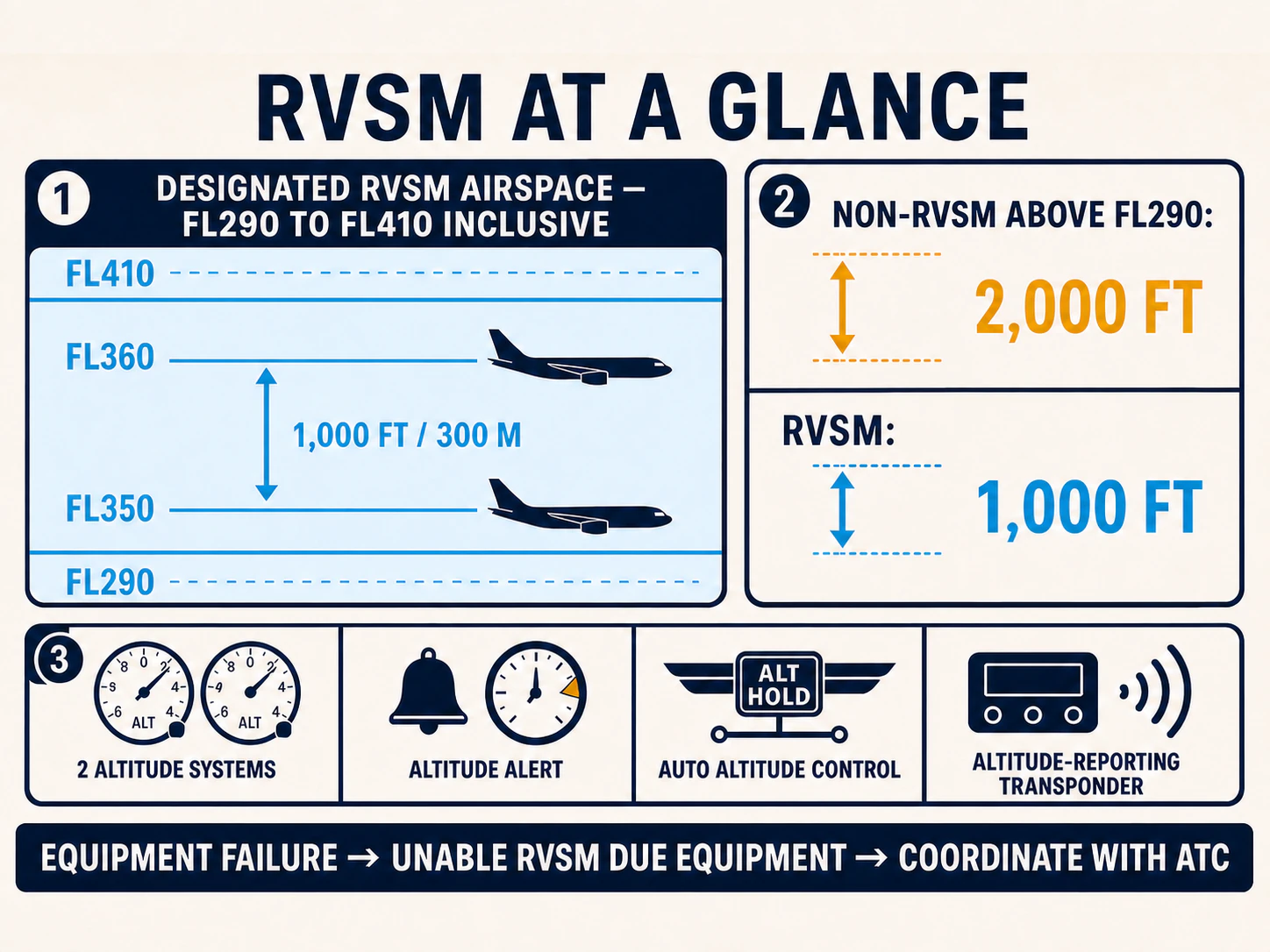
RVSM stands for Reduced Vertical Separation Minimum. It is the application of a reduced vertical separation of 1,000 ft (300 m) between FL290 and FL410 inclusive in designated RVSM airspace.
RVSM increases airspace capacity and allows more aircraft to operate near their optimum cruise levels. Operating in RVSM airspace requires the applicable aircraft airworthiness approval, operational approval and procedures.
Required RVSM equipment
Under EASA rules, the aircraft must have:
- Two independent altitude-measurement systems.
- One altitude-alerting system.
- One automatic altitude-control system.
- An SSR transponder with altitude reporting, connected to the altitude source used for altitude control.
Before entering RVSM airspace, the required equipment must be operating normally. Under EASA procedures, at least two primary altitude indications must agree within 200 ft. This is an agreement tolerance between the indications, not a statement that each altimeter is accurate to ±200 ft.
What happens after an equipment failure?
If the automatic altitude-control capability required for RVSM is lost after entering the airspace:
- Maintain the cleared flight level as far as possible while assessing the failure.
- Inform ATC using the phrase “UNABLE RVSM DUE EQUIPMENT”.
- Request and coordinate an appropriate revised clearance.
ATC may apply 2,000 ft vertical separation, provide horizontal separation, or clear the aircraft out of RVSM airspace. A descent below FL290 is therefore not automatic, and the crew must not leave the cleared level without a clearance unless an immediate deviation is required for safety.
Always apply the aircraft procedures, the operator’s Operations Manual and any regional contingency procedure.
References: EASA Air Operations — SPA.RVSM.100 to SPA.RVSM.110 and AMC2 SPA.RVSM.105; ICAO Doc 9574.