Take your preparation offline
20 questions to practise offline.
Free 31-page PDF with model answers, examiner tips and a 4-week preparation plan.
The MMEL is provided by the aircraft manufacturer and approved by the relevant aviation authority. The MEL is developed by the operator for its aircraft and operation, based on the MMEL, and approved by its competent authority. It cannot be less restrictive than the MMEL and includes the applicable conditions, limitations and required procedures.
Compare the access plans to open the complete answer library for your selected period.
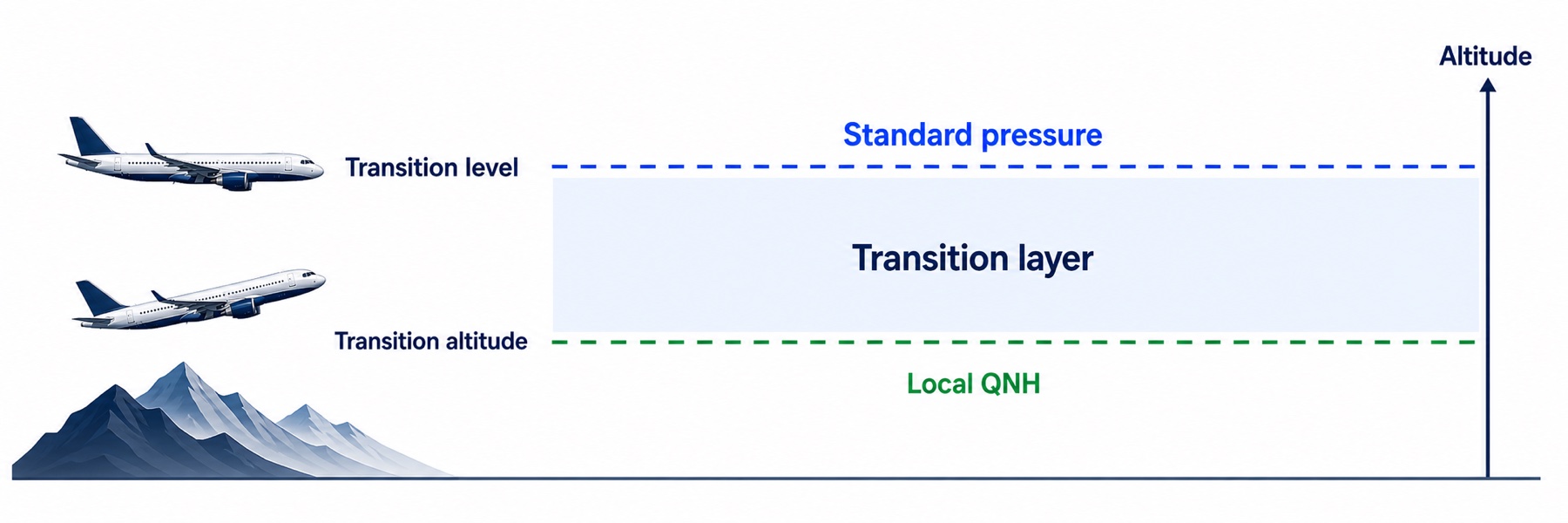
Compare access plansThe transition altitude is the altitude at or below which aircraft use the local QNH setting. Above this point, they switch to standard pressure (1013.25 hPa or 29.92 inHg).
→ It is used during climb.
→ Its value and the associated changeover procedure are State-specific; the United States and Canada do not use an identical nationwide rule.
The transition level is the lowest usable flight level at or above which aircraft operate on standard pressure. Below this point, they must use the local QNH setting.
→ It is used during descent.
→ It usually varies depending on the current QNH, but may be fixed at some airports.
The airspace between the transition altitude and the transition level is called the transition layer.

Note: Level flight is not permitted within the transition layer.
For example, if the transition altitude is 5000 ft and the transition level is FL070, an aircraft would not be cleared to maintain FL060 or 6,000 ft within that layer.
United States: use 29.92 inHg at and above 18,000 ft MSL. The lowest usable flight level is not automatically FL180 when the altimeter setting is low; ATC may use a higher lowest usable flight level.
Canada: the Standard Pressure Region includes all airspace at and above 18,000 ft, but also low-level airspace outside the Altimeter Setting Region. Standard pressure can therefore be used below 18,000 ft in northern and remote Canadian airspace. Apply the changeover procedure for the region being entered rather than treating 18,000 ft as a universal Canadian transition altitude.
Official references: FAA AIM, Altimeter Setting Procedures; TC AIM RAC, Altimeter Setting and Standard Pressure Regions.
Aircraft approach categories are based on the aircraft’s $V_{AT}$, which is the indicated airspeed at threshold.
Under the ICAO approach-categorisation convention, VAT is based on 1.3 VS0 or 1.23 VS1g (one-g stall speed), as applicable, in landing configuration at maximum certificated landing mass. Do not confuse this with an operational approach target that includes speed additives.
| Category | $V_{AT}$ Range |
|---|---|
| A | < 91 kt |
| B | 91 kt ≤ $V_{AT}$ < 121 kt |
| C | 121 kt ≤ $V_{AT}$ < 141 kt |
| D | 141 kt ≤ $V_{AT}$ < 166 kt |
| E | 166 kt ≤ $V_{AT}$ < 211 kt (military) |
Note: These categories are used to determine approach minima, obstacle clearance requirements, and procedure design.
References: Regulation (EU) 965/2012 CAT.OP.MPA.320 aeroplane categories; EASA CS 25.125(b)(2) (Amendment 28); 14 CFR Part 25 sections 25.107 25.121 25.125 and 25.149.
ICAO Annex 14, Volume I, defines the standard number of longitudinal white threshold stripes according to runway width:
| Runway width | Number of threshold stripes |
|---|---|
| 18 m | 4 |
| 23 m | 6 |
| 30 m | 8 |
| 45 m | 12 |
| 60 m | 16 |
Each stripe is at least 30 m long and approximately 1.80 m wide. The spacing between adjacent stripes is approximately 1.80 m, with a larger central separation between the two stripes nearest the runway centre line.
Therefore, a threshold displaying 8 standard stripes normally indicates a 30 m runway, 12 stripes a 45 m runway, and 16 stripes a 60 m runway.
This remains a visual recognition aid rather than authoritative runway-width data. An alternative marking pattern may be used on certain non-precision approach and non-instrument runways that are 45 m or wider. The published AIP or aerodrome chart should be used to confirm the actual runway width.
Reference: ICAO Annex 14, Volume I, §5.2.4 “Threshold marking” and Figure 5-2.
United States: FAA aiming-point markings are approximately 1,000 ft from the landing threshold. FAA threshold markings can use eight stripes or the width-related 4/6/8/12/16 pattern.
Canada: TP 312 and the aerodrome's certified layout control. Canadian aiming-point placement can vary with landing distance available and visual-slope-system geometry.
In both countries, markings are a recognition aid only. Use the current aerodrome chart/publication—not stripe counting—to determine runway dimensions.
Official references: FAA AIM 2-3-3; Transport Canada TP 312 material.
The ICAO maximum holding speeds depend on the holding altitude and aircraft category:
| Altitude | Max Holding Speed |
|---|---|
| ≤ 14,000 ft | 230 kt (Category C–E) / 170 kt (Category A–B) |
| > 14,000 ft to ≤ 20,000 ft | 240 kt |
| > 20,000 ft to ≤ 34,000 ft | 265 kt |
| > 34,000 ft | Mach 0.83 |
Note: These are standard ICAO limits. Local procedures or ATC instructions may specify lower values.
The North American default holding speeds differ from the ICAO/PANS-OPS table above:
| Altitude | United States | Canada |
|---|---|---|
| MHA through 6,000 ft | 200 KIAS | 200 KIAS at or below 6,000 ft |
| 6,001 through 14,000 ft | 230 KIAS | 230 KIAS |
| Above 14,000 ft | 265 KIAS | 265 KIAS |
A charted restriction or ATC instruction can require a different/lower speed.
Official references: FAA AIM 5-3-8; TC AIM RAC 10.7.
ICAO wake turbulence categories are based on an aircraft’s Maximum Certified Takeoff Weight (MTOW) and are used by ATC to apply appropriate separation minima to mitigate wake turbulence risk.
| Category | Letter Code | MTOW Criteria | Examples |
|---|---|---|---|
| Super | J | Specific aircraft designated as "Super" in ICAO Doc 8643 | Airbus A380 |
| Heavy | H | ≥ 136 tonnes and not classified as Super | Boeing 747, A350 |
| Medium | M | > 7 tonnes and < 136 tonnes | Boeing 737, A320, ATR72 |
| Light | L | ≤ 7 tonnes | Cessna 172, PC-12 |
Note:
- The "Super" category is not based solely on MTOW, but on ICAO designation found in Doc 8643.
- Wake turbulence categories are filed in the ICAO flight plan (Item 9) using the codes J, H, M, or L.
Do not apply an ICAO wake or final-spacing number as a universal North American minimum.
United States: FAA facilities may use legacy wake categories or approved consolidated/RECAT categories. The current FAA AIM specifies a 4-minute interval for aircraft taking off behind a Super aircraft in the same-threshold/closely spaced parallel-runway cases it describes. Reduced 2.5-NM final spacing is allowed only under stated runway, surveillance, aircraft and facility conditions; wake separation can require more.
Canada: use the current TC AIM, NAV CANADA procedures and the clearance actually issued. Wake separation and reduced final spacing depend on the aircraft pair, runway geometry and authorized local procedure.
Official references: FAA AIM 7-4 and JO 7110.65; TC AIM RAC.
The ICAO airspace classes (A to G) determine the level of ATC services, separation, and communication requirements provided to aircraft.
| Class | ATC Clearance Required | Separation Provided | Traffic Information | VFR Flights Allowed |
|---|---|---|---|---|
| A | Yes | IFR vs IFR | Not applicable | ❌ Not allowed |
| B | Yes | IFR vs IFR, IFR vs VFR, VFR vs VFR | Yes (to all) | ✅ Yes |
| C | Yes | IFR vs IFR, IFR vs VFR | VFR receives traffic info on VFR | ✅ Yes |
| D | Yes | IFR vs IFR | VFR receives info on IFR, traffic info as far as practical | ✅ Yes |
| E | IFR: Yes / VFR: No | IFR vs IFR | VFR gets info as far as practical | ✅ Yes |
| F | IFR: Advised / VFR: No | Advisory only (IFR) | Info available if possible | ✅ Yes |
| G | No | None | Available if possible | ✅ Yes |
Important: The exact usage of each class may vary depending on the state’s AIP.
United States: Classes A through E are controlled; the United States does not use Class F. Class B requires an explicit ATC clearance. In Classes C and D, two-way radio communication must be established before entry, with the precise acknowledgement/entry rule given in the FAA AIM and 14 CFR.
Canada: Class F is special-use airspace and may be controlled, uncontrolled, or a combination of both. Canadian Class B normally covers controlled low-level airspace above 12,500 ft ASL up to, but not including, 18,000 ft ASL; it is used by IFR and controlled-VFR flights rather than ordinary VFR traffic.
Official references: FAA AIM Chapter 3; Transport Canada, Flying in Canada / TC AIM RAC 2.8.
Compare the access plans to open the complete answer library for your selected period.
Compare access plansCompare the access plans to open the complete answer library for your selected period.
Compare access plansTake your preparation offline
Free 31-page PDF with model answers, examiner tips and a 4-week preparation plan.