Your pilot CV should make it easy to understand where you stand: what you are qualified to fly, how much relevant experience you have, and what you have been doing recently.
The reader should not have to search through a personal statement to find your licence or reconstruct your flight hours from several employment entries.
The strongest starting point is simple: put your qualifications and flying experience near the top, support them with a clear career history, and make every claim easy to verify.
Here is how to build that structure.
Start With the Vacancy, Then Build the CV
Before editing your CV, read the actual job requirements.
A cadet application and a direct-entry First Officer application need different evidence. Even similar roles can use different definitions of qualifying experience. An airline may ask for total flight time, time on type, command experience, or hours in a particular operating environment.
For example, Ryanair’s cadet recruitment page distinguishes between training pathways and specifies supporting qualifications. That is why your application should follow the requirements of the particular vacancy rather than a generic pilot CV template. Ryanair cadet recruitment
Create a short checklist from the advert:
- Licence and issuing authority.
- Required ratings and training.
- Medical and language requirements.
- Flight-time categories.
- Recent flying experience, if specified.
- Work eligibility or relocation requirements.
- Documents and application format.
Use this checklist to decide what belongs near the top of your CV. If a requirement is not met, describe your actual position accurately. Presentation cannot replace eligibility.
Make the Top Third Useful
The first section should establish your professional identity and relevant qualifications.
Include your name, telephone number with international dialling code, professional email address and current location. Then give a compact summary of your licence, flying experience and current role or training status.
An experienced pilot might write:
A320 First Officer with 3,240 hours total flight time, including 2,180 hours on the A320 family. Currently employed in scheduled European short-haul operations. EASA ATPL(A), with licence and rating details below.
A newly qualified pilot might write:
Commercial pilot seeking a first airline role. EASA CPL(A) with multi-engine instrument rating, ATPL theoretical knowledge examinations completed and APS MCC completed. Flight-time breakdown and training details below.
These are illustrative profiles, not phrases to copy regardless of your circumstances.
Avoid opening with a paragraph about being passionate, highly motivated and safety-conscious. Use that space to establish facts. Your experience and interview examples can demonstrate your professional qualities.
Present Your Licence and Qualifications Precisely
Give the reader enough information to understand what you hold without having to interpret shorthand.
Depending on the role, include:
- Licence type and issuing authority.
- Relevant class or type ratings.
- Instrument rating.
- Medical class and expiry date, where requested or useful.
- English language proficiency level and validity, where applicable.
- MCC or APS MCC completion.
- Other training specifically requested by the vacancy.
Distinguish between qualifications already completed and training still in progress. If a course is booked, label it as booked and give the expected date; do not list it as completed.
Where you use familiar shorthand such as “frozen ATPL,” also specify your actual licence and completed theoretical training. Your CV should be understandable without relying on an informal label.
Use a Clear Flight-Hours Table
Flight experience deserves its own section. A small table is usually easier to read than a sentence containing six different totals.
The example below shows how an experienced pilot could present selected categories.
Fictional example — hours as of 1 September 2026
| Flight-time category | Hours |
|---|---|
| Total flight time | 3,240 |
| Pilot in command | 160 |
| Multi-pilot aircraft | 2,760 |
| Jet aircraft | 2,180 |
| A320 family | 2,180 |
| Flight time in the preceding 12 months | 690 |
These categories overlap. They are not separate amounts to add together.
Choose the categories that answer the vacancy’s requirements. A cadet may need to show PIC and multi-engine experience, while an experienced applicant may need a more detailed breakdown by aircraft, role or operation.
Keep simulator training separately labelled. Do not silently combine simulator sessions with aircraft flight time. When an application specifies how hours must be calculated, follow that definition.
Before submitting, reconcile the figures against your logbook and the online application. If different totals reflect different update dates, refresh them or make the dates explicit.
Describe Experience Through Concrete Responsibilities
List employment in reverse chronological order. For each relevant position, include the operator or organisation, job title, dates and aircraft where applicable.
Then explain the work with a few specific statements.
Compare:
Responsible for safe and efficient flight operations.
With:
First Officer on the A320 family in scheduled European short-haul operations. Experience includes multi-sector duties, winter operations and coordination with dispatch, cabin crew and ground teams.
The second version gives the reader a clearer picture of the operating environment.
Relevant details might include instructor duties, line-training responsibilities, a fleet transition or an additional company role. Include them only when they accurately describe your experience.
You do not need a numerical achievement for every position. Avoid inventing performance metrics or presenting ordinary responsibilities as exceptional accomplishments.
If You Are a Cadet, Make Your Training and Work History Count
A cadet CV should present a credible early-career profile.
Give your training a prominent position:
- Training organisation and dates.
- Programme or training pathway.
- Licence and ratings achieved.
- Relevant course completion.
- Clearly labelled simulator training.
- Specific academic achievements, where useful and verifiable.
Then include employment outside aviation where it provides evidence of responsibility.
For example:
Shift supervisor, hospitality sector — coordinated a team of six, allocated tasks during busy periods and handled customer complaints alongside routine service duties.
That gives an interviewer something concrete to explore about communication, prioritisation and teamwork.
You do not need to describe a non-aviation role using cockpit terminology. Explain what you actually did and be ready to discuss what you learned.
A Practical CV Structure
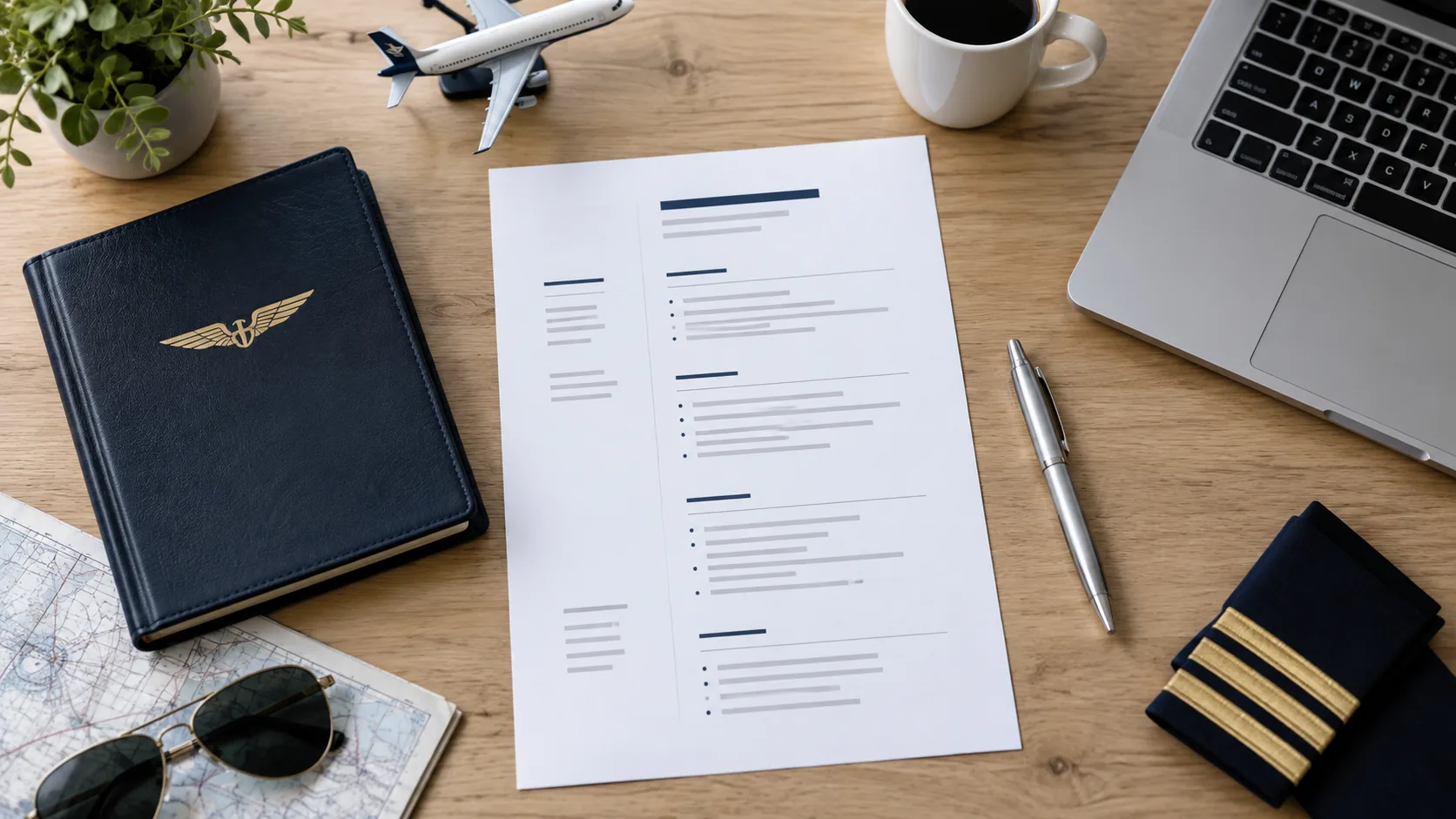
The following outline uses a fictional candidate. It illustrates the order and level of detail; it is not a complete application or an airline-approved template.
ALEX MORGAN
Lyon, France · Telephone · Professional email
Professional summary
A320 First Officer with 3,240 hours total flight time and 2,180 hours on type. Currently flying scheduled European short-haul services.
Licences and qualifications
EASA ATPL(A) — issuing authority
A320 type rating — relevant validity details
Class 1 medical — expiry date
English language proficiency — level and applicable validity
Flight experience
Dated table showing total time, PIC, multi-pilot experience, jet time and time on type.
Employment
First Officer, Example Air — March 2023–present
A320 family, scheduled short-haul operations. Two or three concise statements describing the operating environment and relevant responsibilities.
First Officer, Sample Regional — June 2021–February 2023
Regional turboprop operations. Brief description of aircraft and experience.
Training and education
Flight training organisation, qualifications and dates. Relevant further education.
Additional information
Languages, work eligibility where relevant, and notice period.
For a cadet, move flight training above employment and replace the experienced-pilot summary with a factual training profile.
Keep the Layout Simple
Use clear headings, readable text and consistent dates. Give the flight-hours section enough space to be scanned easily.
A one-page CV can work well for a cadet or a short career history. Two pages may be appropriate when relevant experience requires them. Treat length as an editorial choice unless the airline sets a limit.
Avoid shrinking the text to force everything onto one page.
Use the file format requested by the application. If submitting a PDF, check that the text is selectable and that the exported document has not introduced broken lines, missing characters or an unexpected second page.
A straightforward filename also helps:
Alex_Morgan_Pilot_CV.pdf
Leave Out Material That Does Not Help the Application
Remove information that adds length without clarifying your suitability:
- Repeated claims about passion or motivation.
- Decorative skill bars and self-awarded proficiency scores.
- Long descriptions of unrelated hobbies.
- Unexplained abbreviations.
- Duplicate information across several sections.
- Unsupported claims about leadership or performance.
Follow the employer’s instructions for photographs and personal details. Avoid adding sensitive identifiers, such as a passport number or licence number, simply to fill the CV. Supply requested documents through the designated application process.
Keep relevant career breaks clear. A concise entry such as “Full-time flight training” or “Career break for family responsibilities,” with dates, can explain the chronology without unnecessary personal detail.
Tailor the Evidence, Not Your Identity
Tailoring means making the relevant facts easier to find.
If the vacancy emphasises time on type, show it prominently. If it requests instructor experience, explain that experience clearly. If you are applying for a first airline role, make training completion and eligibility straightforward to assess.
Avoid guessing that every short-haul operator wants one personality and every long-haul operator wants another. Use the published role requirements.
If a cover letter is requested, use it to explain your interest in the airline and the role. Keep the CV focused on qualifications, experience and career history.
Check That Your CV Can Survive an Interview
Read every line as if an interviewer were about to ask: “Tell me more about that.”
Can you explain the responsibility you have listed? Give an example of the teamwork you describe? Clarify your flight-time breakdown? Account for the dates?
Before sending, check that:
- Your qualifications match your documents.
- Your hours match your records and application form.
- Completed and planned training are clearly distinguished.
- Employment dates are consistent.
- Contact details work.
- The exported file is readable.
- Every statement is something you can confidently explain.
Once the CV is ready, use it to prepare for the interview. Choose three experiences from your training or employment that you can discuss in depth: a challenge, a mistake and a situation that required teamwork.
Explore YPI’s interview topics to develop those examples, or practise explaining your background with the video interview tool.