Topic question bank: Principles of Flight

Questions and Answers

General POF

How can you maintain both altitude and airspeed during a turn?

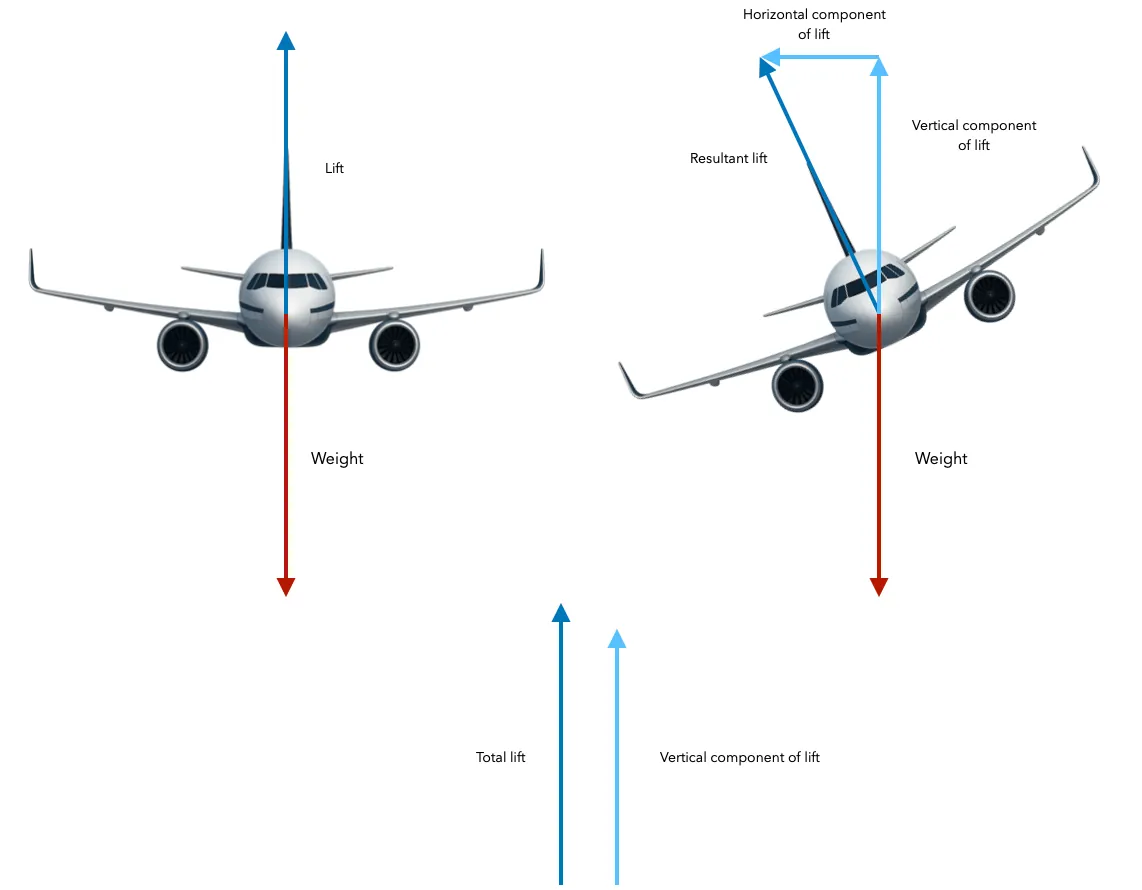
In a banked turn, the total lift remains constant, but it is divided into two components: one vertical and one horizontal. The vertical component of lift becomes smaller as the bank angle increases, which would normally cause a descent.

To maintain altitude, the angle of attack must be increased to restore the vertical lift component to match the aircraft’s weight. However, increasing the angle of attack also increases drag and may reduce airspeed.

To counter this, additional thrust is required to maintain airspeed while sustaining the turn.

Image

Note: During a level turn, the total lift must be greater than the aircraft’s weight in order to maintain a vertical lift component equal to the weight. As a result, the load factor exceeds 1 G, since Load Factor = Lift / Weight.

Define the difference between $M_{crit}$ and MMO.

$M_{crit}$ (critical Mach number) is the lowest Mach number at which airflow over any part of the aircraft — typically the wing — first reaches Mach 1, leading to the onset of compressibility effects such as shock waves, drag rise, and flow separation.

MMO (Maximum Mach Operating number) is the maximum authorized Mach number for safe operation of the aircraft. It ensures that the aircraft remains below speeds that could cause structural stress, control issues, or high-speed buffet.

In summary:
- $M_{crit}$ marks the start of transonic effects
- MMO is a design limitation to avoid unsafe flight conditions
- $M_{crit}$ is always lower than MMO

Flying beyond MMO may result in loss of control or airframe damage, and must be avoided.

Define pitch angle.

Member-only answer

This is a real airline technical interview question. Unlock the structured, examiner-ready answer used by successful candidates.

Unlock full access
Define flight path angle.

Member-only answer

This is a real airline technical interview question. Unlock the structured, examiner-ready answer used by successful candidates.

Unlock full access
Define primary flight controls.

Member-only answer

This is a real airline technical interview question. Unlock the structured, examiner-ready answer used by successful candidates.

Unlock full access
Define secondary flight controls.

Member-only answer

This is a real airline technical interview question. Unlock the structured, examiner-ready answer used by successful candidates.

Unlock full access
Why are flaps used during takeoff and landing?

Member-only answer

This is a real airline technical interview question. Unlock the structured, examiner-ready answer used by successful candidates.

Unlock full access
Is more lift required during climb or during straight and level flight, assuming the same aircraft weight?

Member-only answer

This is a real airline technical interview question. Unlock the structured, examiner-ready answer used by successful candidates.

Unlock full access
Explain the purpose of slats.

Member-only answer

This is a real airline technical interview question. Unlock the structured, examiner-ready answer used by successful candidates.

Unlock full access
What are Krüger flaps?

Member-only answer

This is a real airline technical interview question. Unlock the structured, examiner-ready answer used by successful candidates.

Unlock full access
What are Fowler flaps?

Member-only answer

This is a real airline technical interview question. Unlock the structured, examiner-ready answer used by successful candidates.

Unlock full access
What are the functions of spoilers on an aircraft?

Member-only answer

This is a real airline technical interview question. Unlock the structured, examiner-ready answer used by successful candidates.

Unlock full access
Explain the function of the horizontal stabilizer.

Member-only answer

This is a real airline technical interview question. Unlock the structured, examiner-ready answer used by successful candidates.

Unlock full access
How does airspeed affect the effectiveness of flight controls?

Member-only answer

This is a real airline technical interview question. Unlock the structured, examiner-ready answer used by successful candidates.

Unlock full access
How is aileron effectiveness influenced by load factor?

Member-only answer

This is a real airline technical interview question. Unlock the structured, examiner-ready answer used by successful candidates.

Unlock full access
Why should pitch attitude be reduced before rolling wings level during a nose-high upset recovery?

Member-only answer

This is a real airline technical interview question. Unlock the structured, examiner-ready answer used by successful candidates.

Unlock full access
Why should wings be rolled level before pulling up during a nose-low upset recovery?

Member-only answer

This is a real airline technical interview question. Unlock the structured, examiner-ready answer used by successful candidates.

Unlock full access
Why is rudder input necessary to achieve a coordinated turn?

Member-only answer

This is a real airline technical interview question. Unlock the structured, examiner-ready answer used by successful candidates.

Unlock full access
Define Dutch roll.

Member-only answer

This is a real airline technical interview question. Unlock the structured, examiner-ready answer used by successful candidates.

Unlock full access
Define aspect ratio.

Member-only answer

This is a real airline technical interview question. Unlock the structured, examiner-ready answer used by successful candidates.

Unlock full access
Define wingtip vortices.

Member-only answer

This is a real airline technical interview question. Unlock the structured, examiner-ready answer used by successful candidates.

Unlock full access
What is the purpose of winglets (or sharklets on Airbus aircraft)?

Member-only answer

This is a real airline technical interview question. Unlock the structured, examiner-ready answer used by successful candidates.

Unlock full access
Explain the diifference between chordwise and spanwise airflow.

Member-only answer

This is a real airline technical interview question. Unlock the structured, examiner-ready answer used by successful candidates.

Unlock full access
Why do most jet aircraft have dihedral wings (with wingtips higher than the wing roots)?

Member-only answer

This is a real airline technical interview question. Unlock the structured, examiner-ready answer used by successful candidates.

Unlock full access
Define angle of incidence.

Member-only answer

This is a real airline technical interview question. Unlock the structured, examiner-ready answer used by successful candidates.

Unlock full access
Define wing washout.

Member-only answer

This is a real airline technical interview question. Unlock the structured, examiner-ready answer used by successful candidates.

Unlock full access
What is the primary advantage of a T-tail configuration?

Member-only answer

This is a real airline technical interview question. Unlock the structured, examiner-ready answer used by successful candidates.

Unlock full access
What is the primary disadvantage of a T-tail aircraft?

Member-only answer

This is a real airline technical interview question. Unlock the structured, examiner-ready answer used by successful candidates.

Unlock full access
Describe the function of vortex generators on the upper surface of the wing.

Member-only answer

This is a real airline technical interview question. Unlock the structured, examiner-ready answer used by successful candidates.

Unlock full access
Define center of pressure.

Member-only answer

This is a real airline technical interview question. Unlock the structured, examiner-ready answer used by successful candidates.

Unlock full access
How does extending trailing edge flaps affect the center of pressure?

Member-only answer

This is a real airline technical interview question. Unlock the structured, examiner-ready answer used by successful candidates.

Unlock full access

Aerodynamic Forces

What are the two main types of aerodynamic drag?

The two primary types of aerodynamic drag acting on an aircraft are:

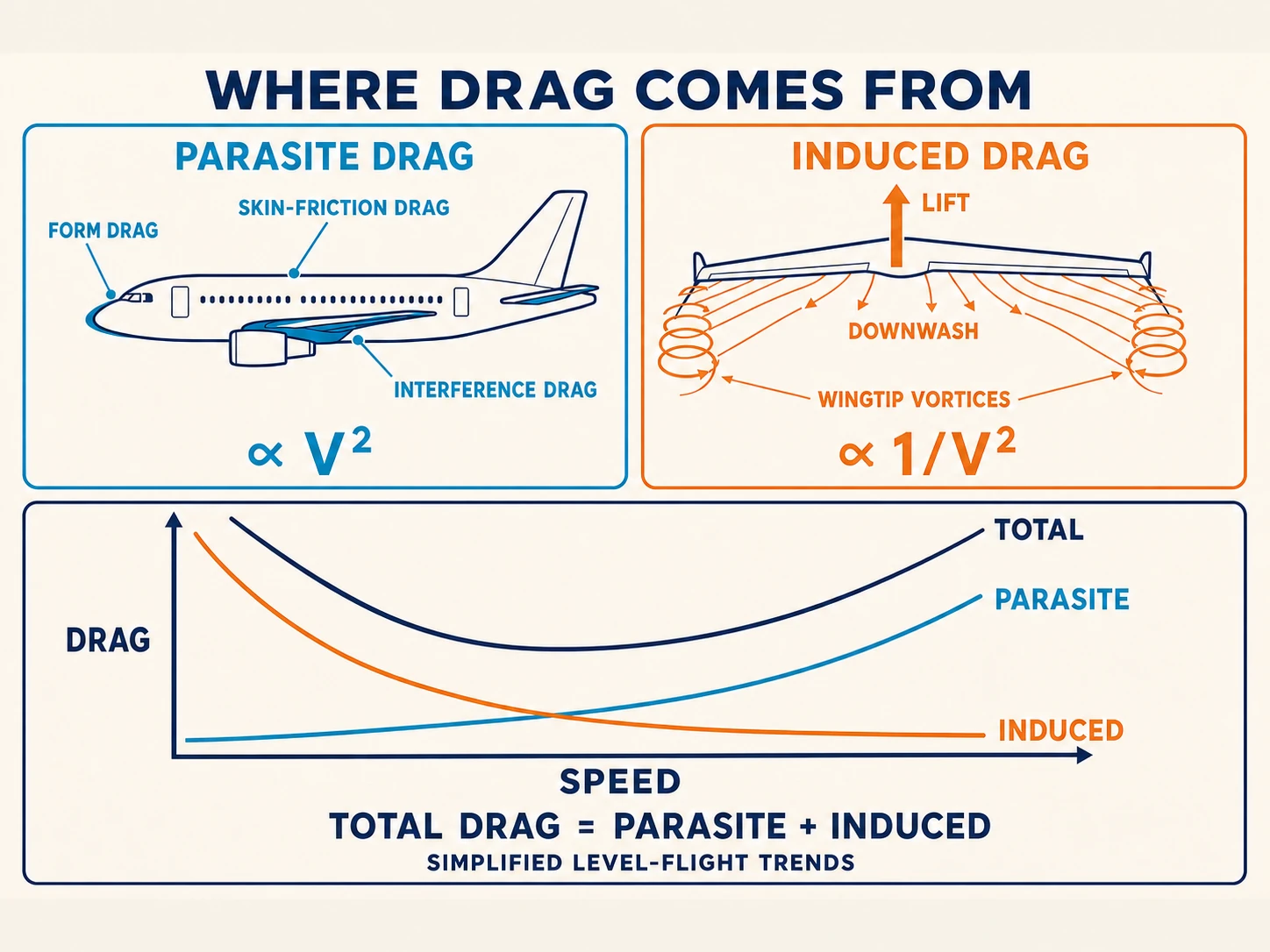
  • Parasite drag: Caused by the aircraft moving through the air. It includes form drag, skin friction, and interference drag. Parasite drag increases with the square of airspeed.
  • Induced drag: Also called lift-induced drag, it results from the generation of lift. It is highest at low speeds and decreases as speed increases.

Total drag is the sum of both:
Total Drag = Parasite Drag + Induced Drag

Induced, Parasite and Total Drag plot

Define angle of attack.

Member-only answer

This is a real airline technical interview question. Unlock the structured, examiner-ready answer used by successful candidates.

Unlock full access
What happens to lift as angle of attack increases?

Member-only answer

This is a real airline technical interview question. Unlock the structured, examiner-ready answer used by successful candidates.

Unlock full access
What happens to airspeed as angle of attack increases?

Member-only answer

This is a real airline technical interview question. Unlock the structured, examiner-ready answer used by successful candidates.

Unlock full access
What happens when you increase thrust on a jet aircraft with engines mounted under the wings?

Member-only answer

This is a real airline technical interview question. Unlock the structured, examiner-ready answer used by successful candidates.

Unlock full access
What happens to lift when airspeed is doubled?

Member-only answer

This is a real airline technical interview question. Unlock the structured, examiner-ready answer used by successful candidates.

Unlock full access
How does extending trailing edge flaps affect the angle of attack?

Member-only answer

This is a real airline technical interview question. Unlock the structured, examiner-ready answer used by successful candidates.

Unlock full access
Explain how lift is generated

Member-only answer

This is a real airline technical interview question. Unlock the structured, examiner-ready answer used by successful candidates.

Unlock full access
Define the high lift devices of an aircraft

Member-only answer

This is a real airline technical interview question. Unlock the structured, examiner-ready answer used by successful candidates.

Unlock full access
How does parasite drag and induced drag vary with speed during level flight?

Member-only answer

This is a real airline technical interview question. Unlock the structured, examiner-ready answer used by successful candidates.

Unlock full access
How do induced drag and parasite drag vary with angle of attack during level flight?

Member-only answer

This is a real airline technical interview question. Unlock the structured, examiner-ready answer used by successful candidates.

Unlock full access
When performing a steep turn at 45° bank while maintaining level flight, how much greater is the induced drag compared to straight and level (1 G) flight?

Member-only answer

This is a real airline technical interview question. Unlock the structured, examiner-ready answer used by successful candidates.

Unlock full access
How to reduce induced drag?

Member-only answer

This is a real airline technical interview question. Unlock the structured, examiner-ready answer used by successful candidates.

Unlock full access
How does weight affect induced drag?

Member-only answer

This is a real airline technical interview question. Unlock the structured, examiner-ready answer used by successful candidates.

Unlock full access
When does an aircraft experience minimum drag?

Member-only answer

This is a real airline technical interview question. Unlock the structured, examiner-ready answer used by successful candidates.

Unlock full access
What happens when flying below the minimum drag speed (on the backside of the drag curve)?

Member-only answer

This is a real airline technical interview question. Unlock the structured, examiner-ready answer used by successful candidates.

Unlock full access
If two aircraft with different weights glide at their respective minimum drag speeds, which one will have a greater glide range (assuming no wind)?

Member-only answer

This is a real airline technical interview question. Unlock the structured, examiner-ready answer used by successful candidates.

Unlock full access
How does aspect ratio affect induced drag?

Member-only answer

This is a real airline technical interview question. Unlock the structured, examiner-ready answer used by successful candidates.

Unlock full access
How does angle of attack affect the center of pressure?

Member-only answer

This is a real airline technical interview question. Unlock the structured, examiner-ready answer used by successful candidates.

Unlock full access

Stall and Stability

Define critical angle of attack.

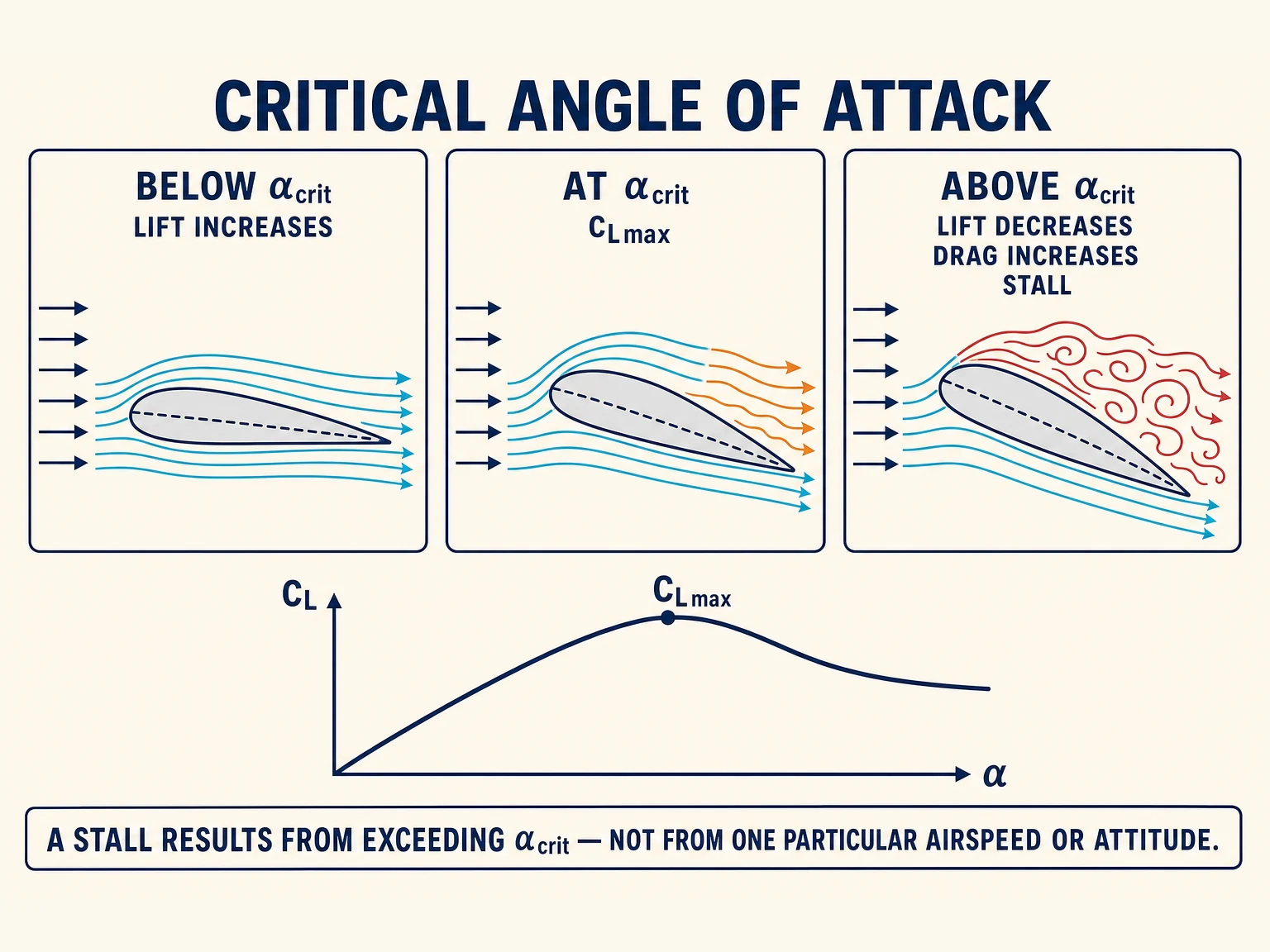
The critical angle of attack is the angle above which aerodynamic stall occurs. At this point, the airflow can no longer remain attached to the upper surface of the wing, leading to a rapid loss of lift.

At the critical angle, the lift coefficient ($C_{L}$) reaches its maximum. Beyond this point, even if the angle of attack increases, the wing can no longer generate sufficient lift to sustain flight.

Image

Note:
- Every aircraft stalls at a specific angle of attack for a given configuration — not at a specific airspeed or attitude.
- The critical angle of attack decreases at high altitude and high Mach numbers due to compressibility effects and aerodynamic limits.
- Airframe icing can also lower the critical angle of attack significantly.
- Wing configuration affects it as well:
- Leading-edge slats and flaps, when extended, tend to increase the critical angle of attack.
- Trailing-edge flaps, on the other hand, generally reduce it.
- For this reason, in most jet aircraft, leading-edge devices extend automatically when trailing-edge flaps are deployed.

How is the term "coffin corner" defined in high-altitude jet operations?

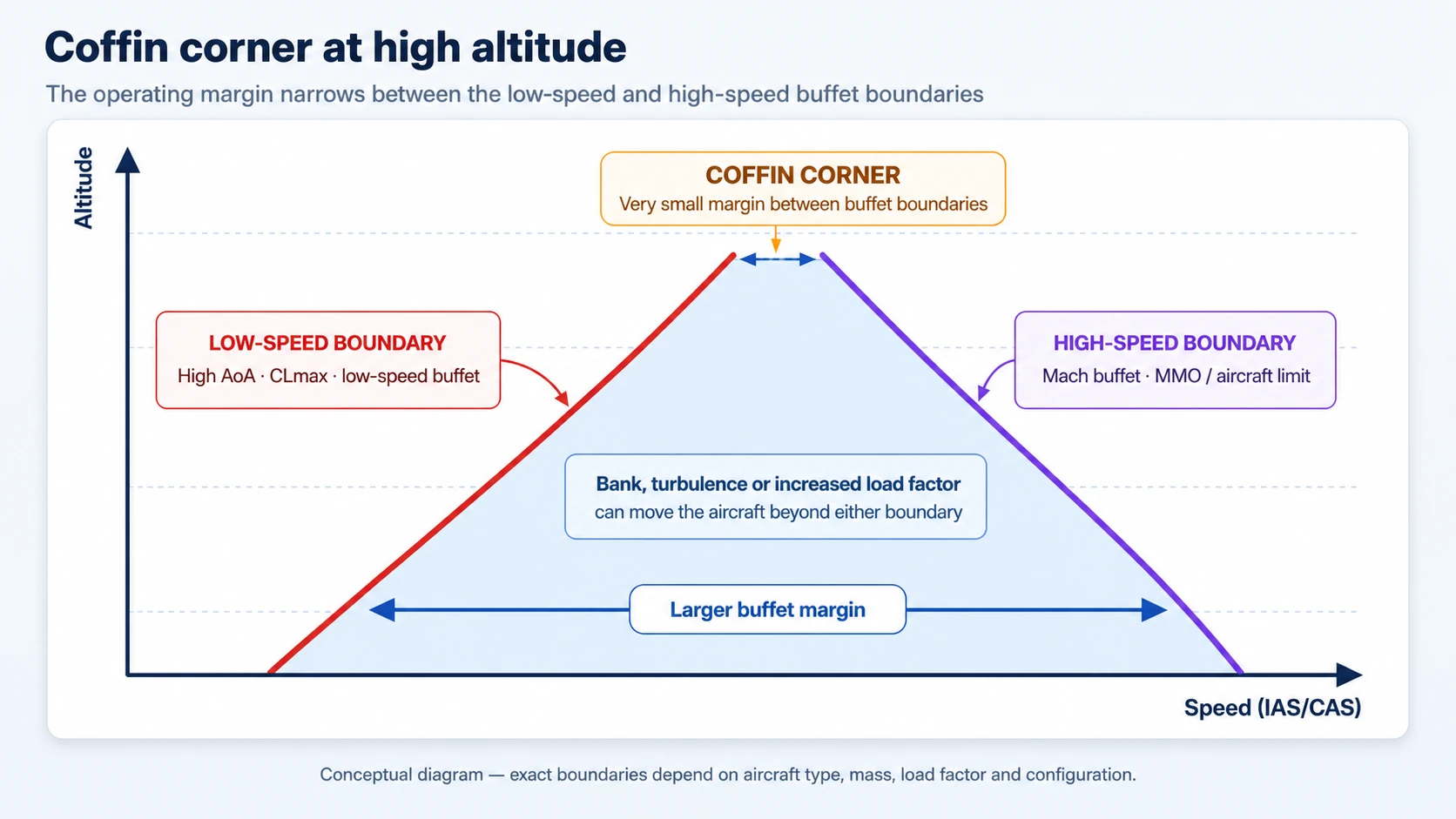
Coffin corner is the altitude at which the aircraft’s stall speed equals its maximum operating speed.
At this point, any decrease in speed will cause a low-speed stall due to airflow separation when the critical angle of attack is exceeded.
On the other hand, any increase in speed will lead to a high-speed stall because airflow deceleration occurs due to shock waves forming on the aircraft’s wings.

Coffin corner illustration

Why does the critical angle of attack decrease when trailing edge flaps are extended?

Member-only answer

This is a real airline technical interview question. Unlock the structured, examiner-ready answer used by successful candidates.

Unlock full access
What is the first action to take at the onset of a stall?

Member-only answer

This is a real airline technical interview question. Unlock the structured, examiner-ready answer used by successful candidates.

Unlock full access
How does stall speed change during a banked turn?

Member-only answer

This is a real airline technical interview question. Unlock the structured, examiner-ready answer used by successful candidates.

Unlock full access
How does weight affect stall speed?

Member-only answer

This is a real airline technical interview question. Unlock the structured, examiner-ready answer used by successful candidates.

Unlock full access
What is the effect of icing on stall speed.

Member-only answer

This is a real airline technical interview question. Unlock the structured, examiner-ready answer used by successful candidates.

Unlock full access
How does extension of trailing edge flaps affect stall speed?

Member-only answer

This is a real airline technical interview question. Unlock the structured, examiner-ready answer used by successful candidates.

Unlock full access
Which part of a swept-back wing tends to stall first, and why?

Member-only answer

This is a real airline technical interview question. Unlock the structured, examiner-ready answer used by successful candidates.

Unlock full access
What are the consequences if the wingtip stalls before the wing root?

Member-only answer

This is a real airline technical interview question. Unlock the structured, examiner-ready answer used by successful candidates.

Unlock full access
Define deep stall (super-stall)

Member-only answer

This is a real airline technical interview question. Unlock the structured, examiner-ready answer used by successful candidates.

Unlock full access

High-Speed Flight

Define Mach number.

Member-only answer

This is a real airline technical interview question. Unlock the structured, examiner-ready answer used by successful candidates.

Unlock full access
Define Mach tuck.

Member-only answer

This is a real airline technical interview question. Unlock the structured, examiner-ready answer used by successful candidates.

Unlock full access
How does wing thickness affect the critical Mach number?

Member-only answer

This is a real airline technical interview question. Unlock the structured, examiner-ready answer used by successful candidates.

Unlock full access
Define critical Mach number ($M_{crit}$).

Member-only answer

This is a real airline technical interview question. Unlock the structured, examiner-ready answer used by successful candidates.

Unlock full access
What is the significance of the critical Mach number ($M_{crit}$)?

Member-only answer

This is a real airline technical interview question. Unlock the structured, examiner-ready answer used by successful candidates.

Unlock full access
Why do most jet aircraft have swept-back wings?

Member-only answer

This is a real airline technical interview question. Unlock the structured, examiner-ready answer used by successful candidates.

Unlock full access
Define Mach buffet.

Member-only answer

This is a real airline technical interview question. Unlock the structured, examiner-ready answer used by successful candidates.

Unlock full access

Powerplant

Define propeller feathering.

Member-only answer

This is a real airline technical interview question. Unlock the structured, examiner-ready answer used by successful candidates.

Unlock full access
Define torque effect in flight on a single-engine propeller aircraft.

Member-only answer

This is a real airline technical interview question. Unlock the structured, examiner-ready answer used by successful candidates.

Unlock full access
Define the P-factor (also known as asymmetric blade effect).

Member-only answer

This is a real airline technical interview question. Unlock the structured, examiner-ready answer used by successful candidates.

Unlock full access
NEWSLETTER CTA

Join Weekly Briefings

Get notified when new articles, new interview questions, and new pilot jobs are published.

Newsletter Coming Soon