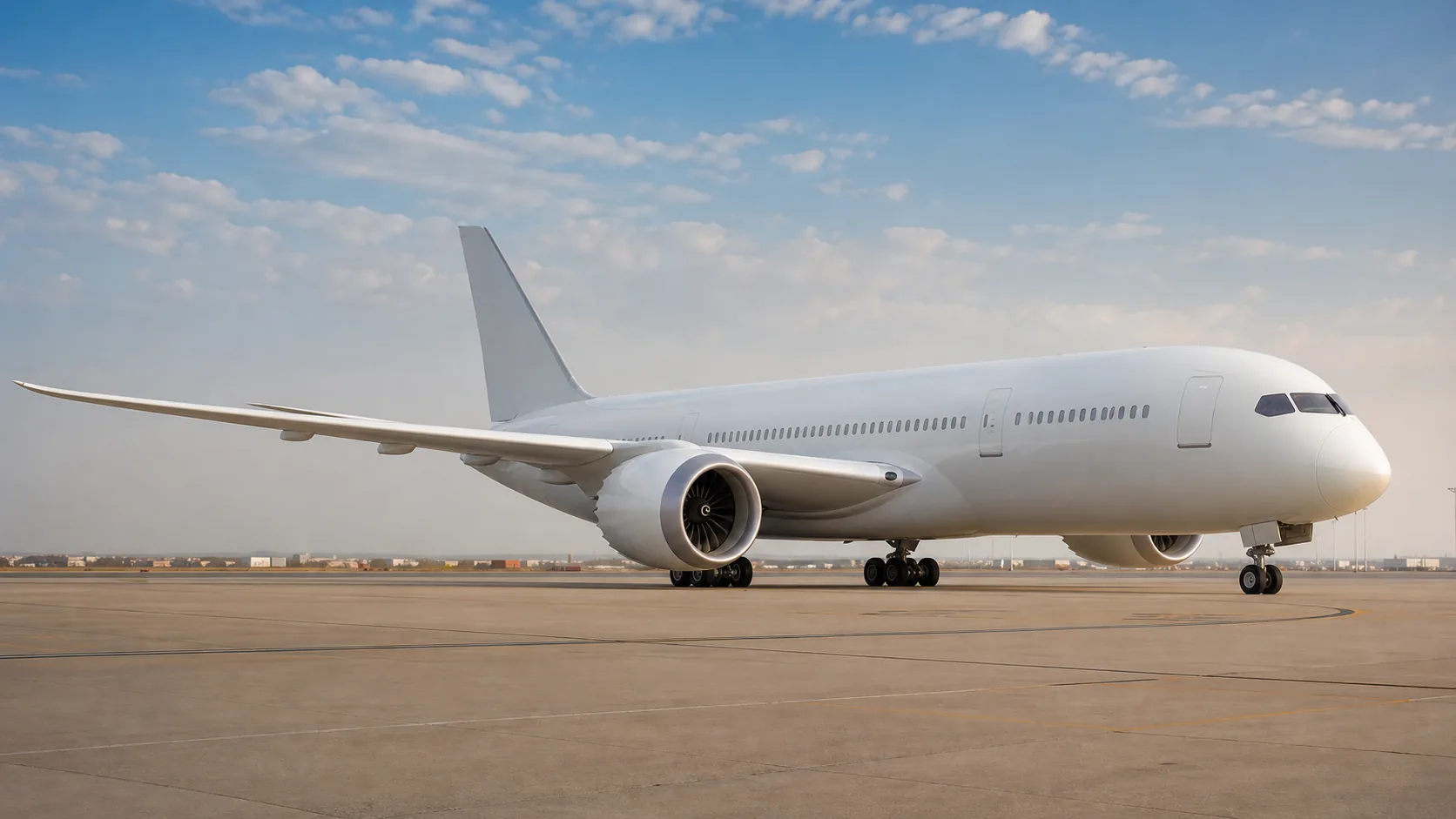
The Boeing 787 Dreamliner is a modern long-haul twin-aisle aircraft built around composite structure, efficient engines, long range and lower trip cost for point-to-point routes.
History and development
Boeing launched the 787 after the Sonic Cruiser concept, shifting from speed to efficiency and route flexibility.
The 787-8 opened the family, the 787-9 became the most flexible long-range variant, and the 787-10 stretched the aircraft for denser medium- and long-haul routes.
Early service was shaped by battery-system scrutiny and production learning, but the aircraft became a major tool for opening thin long-haul markets.
Variant-by-variant breakdown
| Variant | What it is used for |
|---|---|
| 787-8 | Shortest variant, useful for long thin routes with lower capacity. |
| 787-9 | Stretched and highly flexible version, often the family sweet spot. |
| 787-10 | Longest version, higher capacity but shorter range than the -8 and -9. |
| Business/VIP derivatives | Used for government or private long-range missions in low-density layouts. |
Technical specifications
These are manufacturer reference figures, with the variant and assumptions shown where available. Typical layouts, maximum seating and advertised range describe different things. Ranges quoted by different manufacturers are not necessarily calculated on the same payload or reserve basis; use the exact approved documentation for flight planning.
| Variant / reference | Seating / weight | Published reference | Powerplant / layout |
|---|---|---|---|
| 787-8 | 200-275 two-class seats | Up to 8,000 nm | GEnx-1B or Trent 1000 |
| 787-9 | 250-325 two-class seats | Up to 8,300 nm | GEnx-1B or Trent 1000 |
| 787-10 | 300-375 two-class seats | Up to 7,500 nm | GEnx-1B or Trent 1000 |
| 787 family | Twin aisle | 60.1 m wingspan | More-electric architecture |
Cabin, route role and operating profile
| Area | Typical setup | Operational meaning | Notes |
|---|---|---|---|
| Cabin | Twin aisle | Typically 3-3-3 economy | Large windows and higher cabin humidity targets |
| Structure | Composite airframe | Weight and maintenance benefits | Modern long-haul design |
| Mission | Long thin routes | Point-to-point networks | High utilisation widebody |
Design and systems features
- Composite structure and advanced aerodynamics are central to the 787's range and fuel burn story.
- The aircraft uses a more-electric architecture, reducing traditional bleed-air dependence.
- Passenger-facing features include larger windows, lower cabin altitude targets and modern cabin systems.
Typical operations, routes and operators
- Airlines use the 787 on both established long-haul services and lower-demand nonstop city pairs.
- The 787-9 combines seating and advertised range differently from the larger -10; choose the exact variant before comparing missions.
- Network and long-haul low-cost business models can use the same family with very different cabin densities and route economics.
Market presence and replacement context
- The 787 competes with the Airbus A330neo and A350-900 depending on route length, capacity and fleet strategy.
- It replaced many 767 and A330ceo missions while also allowing new nonstop city pairs.
Operational themes for study
- The more-electric design is a useful systems-study topic, alongside electrical-system monitoring and long-haul diversion planning. It does not remove the need for type-specific procedures.
- Study cargo-fire awareness, runway performance and automation through current operator material rather than treating a public product specification as an operating limit.
Comparison with similar aircraft
| Aircraft | Where it competes | Practical difference |
|---|---|---|
| Airbus A350 | Composite-widebody comparison | Compare exact versions, cabin layouts and payload/range assumptions. |
| Airbus A330neo | Widebody alternative | Different airframe and systems architecture; ownership and operating costs depend on the fleet. |
| Boeing 767 | Earlier-generation comparison | The 787 serves many former passenger 767 routes, with different cabin, structure and systems. |
FAQ
Which 787 has the longest advertised range?
Boeing's published comparison gives the 787-9 the highest advertised range of the three variants. The actual payload-range capability depends on the aircraft's weight option, cabin, reserves and conditions.
What makes the 787 different?
Extensive composite structure, its engine options and more-electric systems distinguish it from earlier Boeing widebodies.
Is the 787-10 long range?
Yes. In Boeing's reference comparison it has more seats and less advertised range than the -8 and -9. That is a capacity/range trade-off, not a universal limit for every route.
Check your understanding
- Which variant has the highest advertised range in Boeing's comparison, and which has the most seats?
- What does more-electric describe, and why does it still require type-specific systems study?
Continue your preparation
- Airbus A350 explained: the composite long-haul Airbus widebody
- Airbus A330 explained: the versatile twin-aisle workhorse
- Boeing 757 and 767 explained: the twinjet pair that bridged narrowbody and widebody flying
- Browse all aircraft profiles
- Explore interview preparation topics
Public sources and disclaimer
Manufacturer references checked on 18 October 2026.
This article is an editorial aircraft profile. It is not official aircraft training material and must not replace an AFM, POH, FCOM, QRH, MEL, operator SOP, maintenance manual, regulator document or current type certificate data sheet.
- Boeing 787 model-by-model specifications
- Boeing 787 design overview
- Boeing airport planning manuals; 787-8/-9/-10