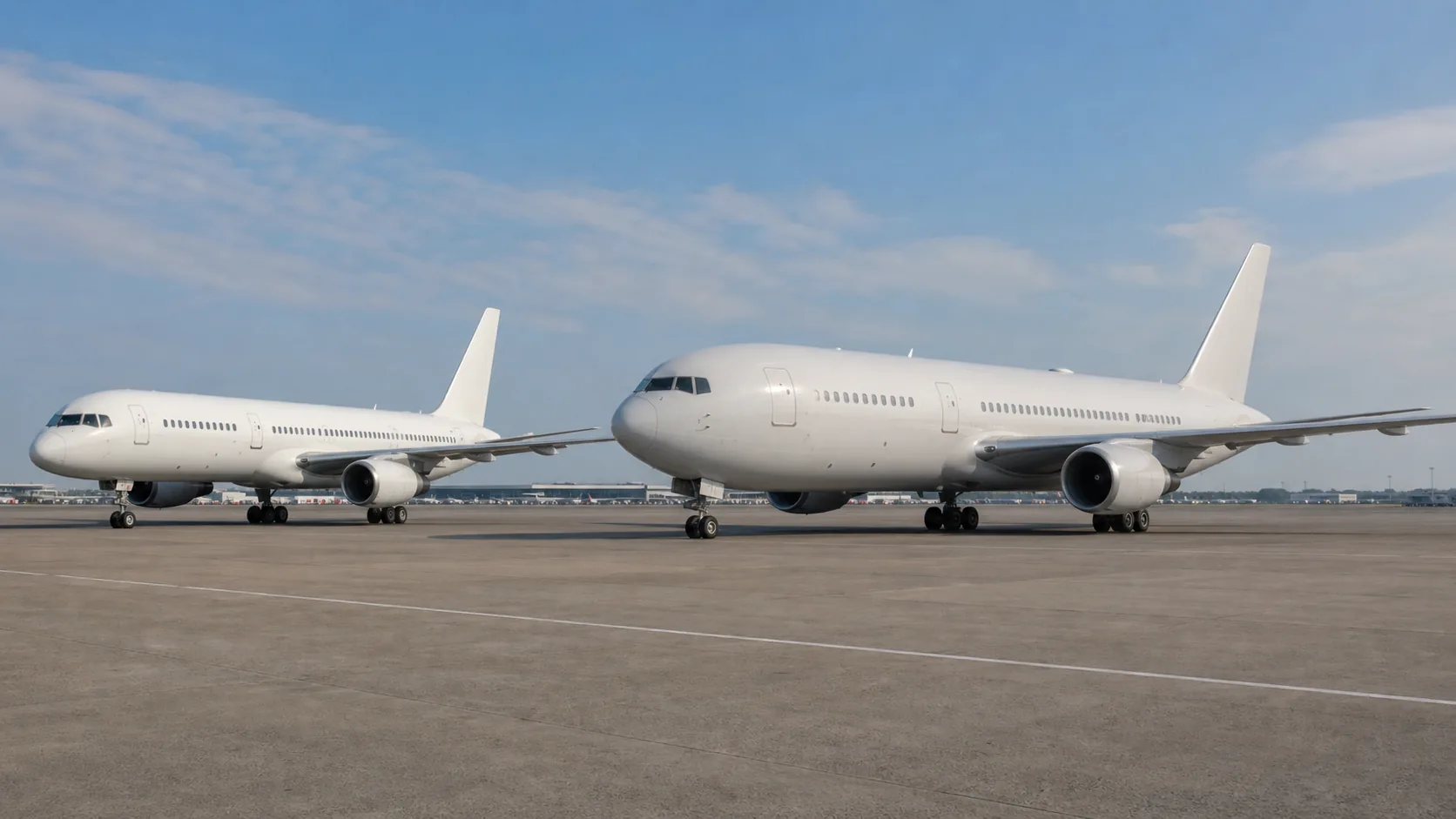
The Boeing 757 and 767 were developed in the same era with cockpit commonality but different missions: the 757 as a high-performance narrowbody and the 767 as a medium-size widebody.
History and development
Boeing launched the 757 and 767 to replace older 727, 707, DC-8 and early widebody missions with more efficient two-pilot twinjets.
The 757 became famous for thrust, runway performance and transcontinental capability. The 767 became a key ETOPS aircraft for North Atlantic and medium-long-haul routes.
Both aircraft now have major cargo roles, while passenger replacement has shifted toward A321neo/XLR, 787 and A330neo depending on mission.
Variant-by-variant breakdown
| Variant | What it is used for |
|---|---|
| 757-200 | Core passenger and freighter conversion variant, known for performance and range. |
| 757-300 | Stretched high-capacity variant with fewer operators. |
| 767-300ER | Most important passenger long-range 767 variant and a major cargo conversion platform. |
| 767F / KC-46 | Factory and military derivatives keep the 767 production line relevant. |
Technical specifications
These are manufacturer reference figures, with the variant and assumptions shown where available. Typical layouts, maximum seating and advertised range describe different things. Ranges quoted by different manufacturers are not necessarily calculated on the same payload or reserve basis; use the exact approved documentation for flight planning.
| Variant / reference | Seating / weight | Published reference | Powerplant / layout |
|---|---|---|---|
| 757-200 | Single aisle; six-abreast economy | Core 757 passenger/freighter platform; range varies with weight and payload | Rolls-Royce RB211 or Pratt & Whitney PW2000 |
| 757-300 | Stretched single-aisle passenger variant | Higher seating capacity than the -200 | Rolls-Royce RB211 or Pratt & Whitney PW2000 |
| 767-300ER | Twin aisle; commonly seven-abreast economy | Extended-range passenger variant; different payload/range basis from a 757 | GE CF6, PW4000 or RB211, depending on version |
| 767-300F | Factory-built widebody freighter | Cargo-specific payload, loading and operating-weight data | GE CF6-80C2 |
Cabin, route role and operating profile
| Area | Typical setup | Operational meaning | Notes |
|---|---|---|---|
| 757 cabin | Single aisle | Six-abreast economy | High-performance narrowbody |
| 767 cabin | Twin aisle | Often 2-3-2 economy | Comfortable medium widebody layout |
| Fleet logic | Shared cockpit generation | Crew commonality | Different capacity bands |
Design and systems features
- The 757's high thrust-to-weight ratio makes it unusually capable from hot, high or short runways for a narrowbody.
- The 767 helped normalise long overwater twin-engine operations through ETOPS route development.
- Cockpit commonality allowed operators to link narrowbody and widebody training in a way that was commercially valuable.
Typical operations, routes and operators
- 757s still appear in cargo, charter, premium transcontinental and thinner long-range narrowbody missions.
- 767s remain important for cargo carriers, military tanker derivatives and some passenger long-haul fleets.
- The 757/767 pair is especially relevant in North Atlantic history, express cargo and fleet replacement discussions.
Market presence and replacement context
- A321LR/XLR aircraft replace many passenger 757 missions; no exact one-for-one 757 successor exists for every route.
- The 787 replaced many passenger 767 missions, while 767 freighters remain valuable because of cargo economics and availability.
Operational themes for study
- Long-haul diversion planning, cargo-fire protection and runway assumptions are relevant themes, but they must be studied for the actual variant and operation.
- Airframe age alone is not a safety ranking. Maintenance programmes, configuration and approved operating procedures remain aircraft-specific.
Comparison with similar aircraft
| Aircraft | Where it competes | Practical difference |
|---|---|---|
| Airbus A321LR/XLR | Narrowbody mission comparison | Overlapping passenger missions with different runway and payload/range characteristics. |
| Boeing 787 | Widebody mission comparison | Different structural and systems generation from the 767. |
| Airbus A330 | Widebody cabin comparison | Eight-abreast economy is common on A330s versus seven-abreast on many 767s. |
FAQ
Why combine 757 and 767?
They share development era and cockpit commonality but cover different mission sizes.
Why is the 757 still valued?
Its performance, range and cargo conversion potential remain hard to replace exactly.
Is the 767 still produced?
Passenger production ended, but freighter and military derivative production/support remain important.
Check your understanding
- How do the 757 and 767 differ in fuselage and typical economy-cabin layout?
- Why do passenger, factory-freighter and converted-freighter variants require separate references?
Continue your preparation
- Boeing 787 Dreamliner explained: composite long-haul efficiency
- Airbus A330 explained: the versatile twin-aisle workhorse
- Boeing 737 explained: Classic, NG and MAX family guide
- Browse all aircraft profiles
- Explore interview preparation topics
Public sources and disclaimer
Manufacturer references checked on 18 October 2026.
This article is an editorial aircraft profile. It is not official aircraft training material and must not replace an AFM, POH, FCOM, QRH, MEL, operator SOP, maintenance manual, regulator document or current type certificate data sheet.
- Boeing 757 airport planning manual, revision H
- Boeing 767 airport planning manual, revision K
- Boeing airport planning manual index and revision dates