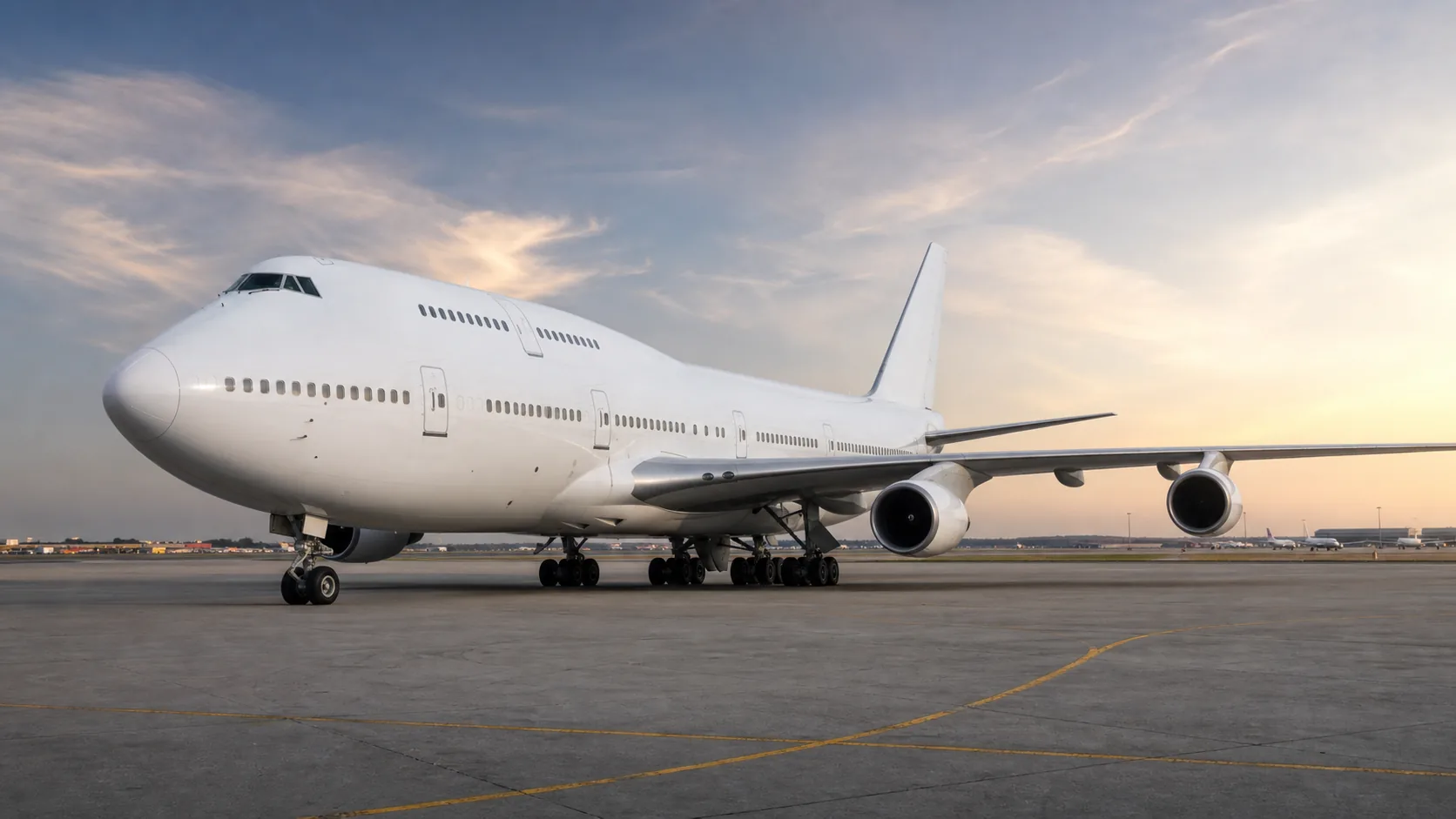
The Boeing 747 is the original high-capacity twin-aisle jumbo jet, instantly recognisable by its upper-deck hump and four engines. It transformed long-haul travel and later became one of the most important freighters in aviation.
History and development
The 747 was developed in the 1960s for high-capacity long-haul travel and entered service with Pan Am in 1970.
The 747-400 introduced a two-pilot glass flight deck to the family; its winglets distinguish it from the raked-wingtip 747-8.
The 747-8 was the final generation, with new engines and a stretched fuselage. The final aircraft left the factory in December 2022 and was delivered to Atlas Air on 31 January 2023.
Variant-by-variant breakdown
| Variant | What it is used for |
|---|---|
| 747-100/200/SP | Early long-haul jumbo variants, including the shorter ultra-long-range SP. |
| 747-300 | Stretched upper deck before the major -400 update. |
| 747-400 | Defining modern passenger and freighter version with global airline use. |
| 747-8I/8F | Final passenger and freighter generation, larger and more efficient than the 747-400. |
Technical specifications
These are manufacturer reference figures, with the variant and assumptions shown where available. Typical layouts, maximum seating and advertised range describe different things. Ranges quoted by different manufacturers are not necessarily calculated on the same payload or reserve basis; use the exact approved documentation for flight planning.
| Variant / reference | Seating / weight | Published reference | Powerplant / layout |
|---|---|---|---|
| 747-400 | Passenger and factory-freighter versions | Two-pilot glass flight deck; winglets | Four engines: PW4000, GE CF6 or RB211, depending on version |
| 747-8 passenger | Stretched passenger version with an extended upper deck | Raked wingtips; two-pilot flight deck | Four GEnx-2B engines |
| 747-8F | Factory freighter with a shorter upper deck than the passenger -8 | Nose cargo door and side cargo door | Four GEnx-2B engines |
| 747 freighter conversions | Configuration depends on the conversion programme | A passenger-to-freighter conversion does not automatically provide a nose cargo door | Use the exact conversion documentation |
Cabin, route role and operating profile
| Area | Typical setup | Operational meaning | Notes |
|---|---|---|---|
| Cabin | Twin aisle plus upper deck | High-capacity long haul | Iconic premium upper deck |
| Cargo | Nose door on freighters | Oversize cargo capability | Major logistics role |
| Mission | Long-haul trunk routes | Passenger decline, cargo strength | Replaced by large twinjets |
Design and systems features
- The upper-deck hump originally supported freight loading concepts and became the aircraft's visual signature.
- Four-engine redundancy once mattered for long overwater routes before modern ETOPS twinjets changed the economics.
- The 747 freighter's nose-loading capability remains difficult to replace for outsized cargo.
Typical operations, routes and operators
- Passenger 747s served dense intercontinental trunk routes, prestige flag-carrier services and high-demand leisure markets.
- Cargo 747s remain important for express, heavy freight, charter and outsized cargo missions.
- Passenger fleets declined as 777, 787 and A350 twinjets offered lower fuel burn and easier capacity matching.
Market presence and replacement context
- Passenger 747 missions have increasingly moved to large twinjets such as the 777-300ER and A350-1000. Newer development programmes should not be described as having replaced aircraft before airline entry into service.
- Factory-built 747 freighters have a distinct loading arrangement; nose-door capability must not be assumed for every converted 747.
Operational themes for study
- Distinguish the crew and systems arrangements of older 747 generations from the two-pilot -400 and -8 flight decks.
- Freighter fire/smoke procedures, loading limits and airport compatibility require exact aircraft and operator documentation; a family overview cannot supply them.
Comparison with similar aircraft
| Aircraft | Where it competes | Practical difference |
|---|---|---|
| Airbus A380 | Very-large passenger comparison | A380 has two full passenger decks; the 747 has a partial upper deck. |
| Boeing 777-300ER | Twinjet mission comparison | High-capacity long-haul passenger missions overlap, with a different engine count. |
| Factory freighter versus conversion | Loading comparison | Check nose-door availability and approved load envelopes on the exact airframe. |
FAQ
Is the 747 still flying?
Yes, mainly as freighters, VIP aircraft and a shrinking number of passenger/special mission aircraft.
Why did passenger 747s disappear?
Large twinjets became more efficient and easier to fill year-round.
What makes the 747 freighter special?
The nose door and large cargo volume allow loads that many other freighters cannot handle.
Check your understanding
- Which generations use a three-person flight deck and which use two pilots?
- Why should a converted freighter not automatically be described as having a nose cargo door?
Continue your preparation
- Boeing 777 explained: the twin-engine widebody that reshaped long haul
- Airbus A350 explained: the composite long-haul Airbus widebody
- Boeing 757 and 767 explained: the twinjet pair that bridged narrowbody and widebody flying
- Browse all aircraft profiles
- Explore interview preparation topics
Public sources and disclaimer
Manufacturer references checked on 18 October 2026.
This article is an editorial aircraft profile. It is not official aircraft training material and must not replace an AFM, POH, FCOM, QRH, MEL, operator SOP, maintenance manual, regulator document or current type certificate data sheet.
- Boeing 747 programme history
- Boeing final 747 factory rollout, December 2022
- Boeing airport planning manuals; 747 generations and freighter arrangements