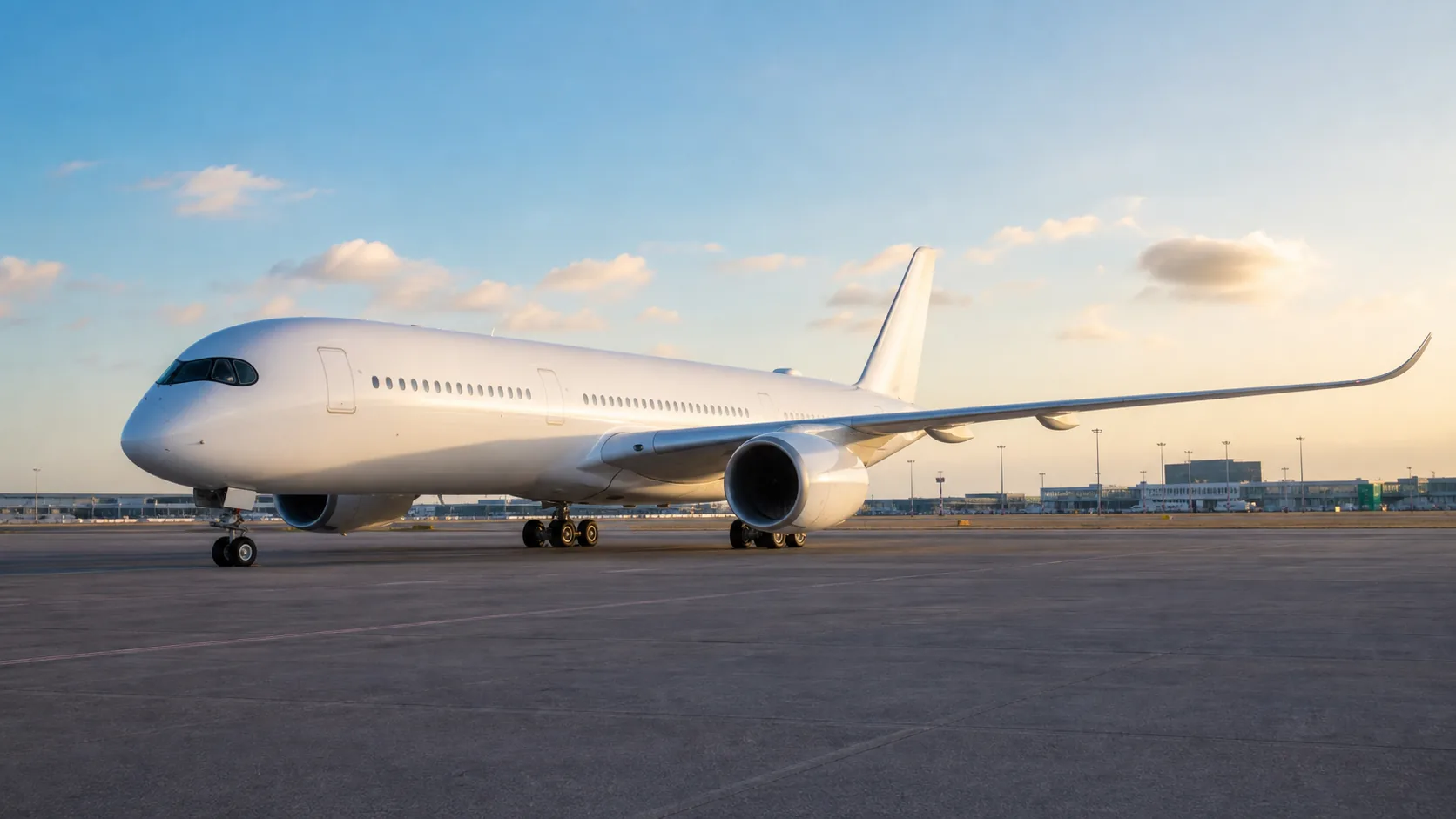
The Airbus A350 is Airbus's modern long-haul twin-aisle family, built around composite structure, efficient Rolls-Royce Trent XWB engines and a wide cabin for premium intercontinental missions.
History and development
The original A350 concept began as an A330-based response to the Boeing 787, but Airbus shifted to a cleaner-sheet A350 XWB design after market feedback.
The A350-900 entered service in 2015, followed by the larger A350-1000 in 2018.
The aircraft now sits above the A330neo and below the A380 in Airbus long-haul history, effectively replacing many A340 and older 777 missions.
Variant-by-variant breakdown
| Variant | What it is used for |
|---|---|
| A350-900 | Core variant, typically around 300-350 seats in standard long-haul layouts. |
| A350-900ULR | Ultra-long-range version associated with very long sectors such as Singapore-New York style missions. |
| A350-1000 | Stretched higher-capacity variant for dense long-haul and 777-300ER replacement roles. |
| A350F | Freighter programme designed for large cargo missions with modern twin-engine economics. |
Technical specifications
These are manufacturer reference figures, with the variant and assumptions shown where available. Typical layouts, maximum seating and advertised range describe different things. Ranges quoted by different manufacturers are not necessarily calculated on the same payload or reserve basis; use the exact approved documentation for flight planning.
| Variant / reference | Seating / weight | Published reference | Powerplant / layout |
|---|---|---|---|
| A350-900 | 332-352 passengers in Airbus's typical three-class example | Maximum seating reference: 440 | Rolls-Royce Trent XWB-84 |
| A350-1000 | 375-400 passengers in Airbus's typical three-class example | Maximum seating reference: 480 | Rolls-Royce Trent XWB-97 |
| A350-900 ULR | Specialist ultra-long-range configuration | Passenger load, cabin and fuel/weight options determine the mission | Part of the A350-900 family |
| A350F | Freighter programme, not a passenger seating configuration | Use freighter-specific payload/range information | Trent XWB engine family |
Cabin, route role and operating profile
| Area | Typical setup | Operational meaning | Notes |
|---|---|---|---|
| Cabin | Twin aisle | Usually 3-3-3 economy | Widebody comfort focus |
| Structure | Composite fuselage/wing | Lower weight and corrosion benefits | Modern maintenance profile |
| Mission | Long-haul | Premium network routes | Ultra-long-range variants possible |
Design and systems features
- The A350 uses extensive carbon-fibre reinforced structure to reduce weight and support long-range efficiency.
- The Trent XWB engine family is central to the aircraft's fuel burn and range performance.
- A modern Airbus cockpit, large displays and fly-by-wire philosophy connect it to the wider Airbus long-haul ecosystem.
Typical operations, routes and operators
- A350s are used by global network airlines on premium long-haul routes, high-utilisation intercontinental sectors and ultra-long-haul services.
- The A350-1000 is particularly relevant as a replacement for older 777-300ER and A340-600 aircraft.
- The type is common on routes where fuel burn, cargo, range and passenger comfort all matter.
Market presence and replacement context
- The A350 competes with the Boeing 787 at the smaller end and Boeing 777/777X at the larger end.
- Its strongest niche is long-haul efficiency with enough cabin and cargo capacity for major network routes.
Operational themes for study
- Understand the relevant automation, flight-control and long-haul planning concepts through the operator's approved training material.
- An aircraft's design capability does not establish an individual operator's route or extended-diversion approval.
Comparison with similar aircraft
| Aircraft | Where it competes | Practical difference |
|---|---|---|
| Boeing 787 | Widebody comparison | Both use extensive composites; compare the actual passenger layout and variant. |
| Boeing 777 / 777X | Large-widebody comparison | Distinguish the GE90-powered service fleet from GE9X-powered development-generation data. |
| Airbus A330neo | Airbus alternative | Different structure and engine family despite shared Airbus design conventions. |
FAQ
What are the main A350 variants?
The A350-900 and A350-1000 are the main passenger variants, with ULR and freighter versions for specialist missions.
Is the A350 composite?
Yes. It uses extensive carbon-fibre reinforced material in the fuselage and wing.
What does A350 XWB mean?
XWB stands for Extra Wide Body, referring to the cabin and fuselage design.
Check your understanding
- How do the -900 and -1000 differ in seating references and engine designation?
- What additional approvals and operating information are needed beyond an advertised ultra-long-range capability?
Continue your preparation
- Boeing 777 explained: the twin-engine widebody that reshaped long haul
- Boeing 787 Dreamliner explained: composite long-haul efficiency
- Airbus A330 explained: the versatile twin-aisle workhorse
- Browse all aircraft profiles
- Explore interview preparation topics
Public sources and disclaimer
Manufacturer references checked on 18 October 2026.
This article is an editorial aircraft profile. It is not official aircraft training material and must not replace an AFM, POH, FCOM, QRH, MEL, operator SOP, maintenance manual, regulator document or current type certificate data sheet.
- Airbus A350-900 configuration and key figures
- Airbus A350-1000 configuration and key figures
- Airbus A350 freighter programme