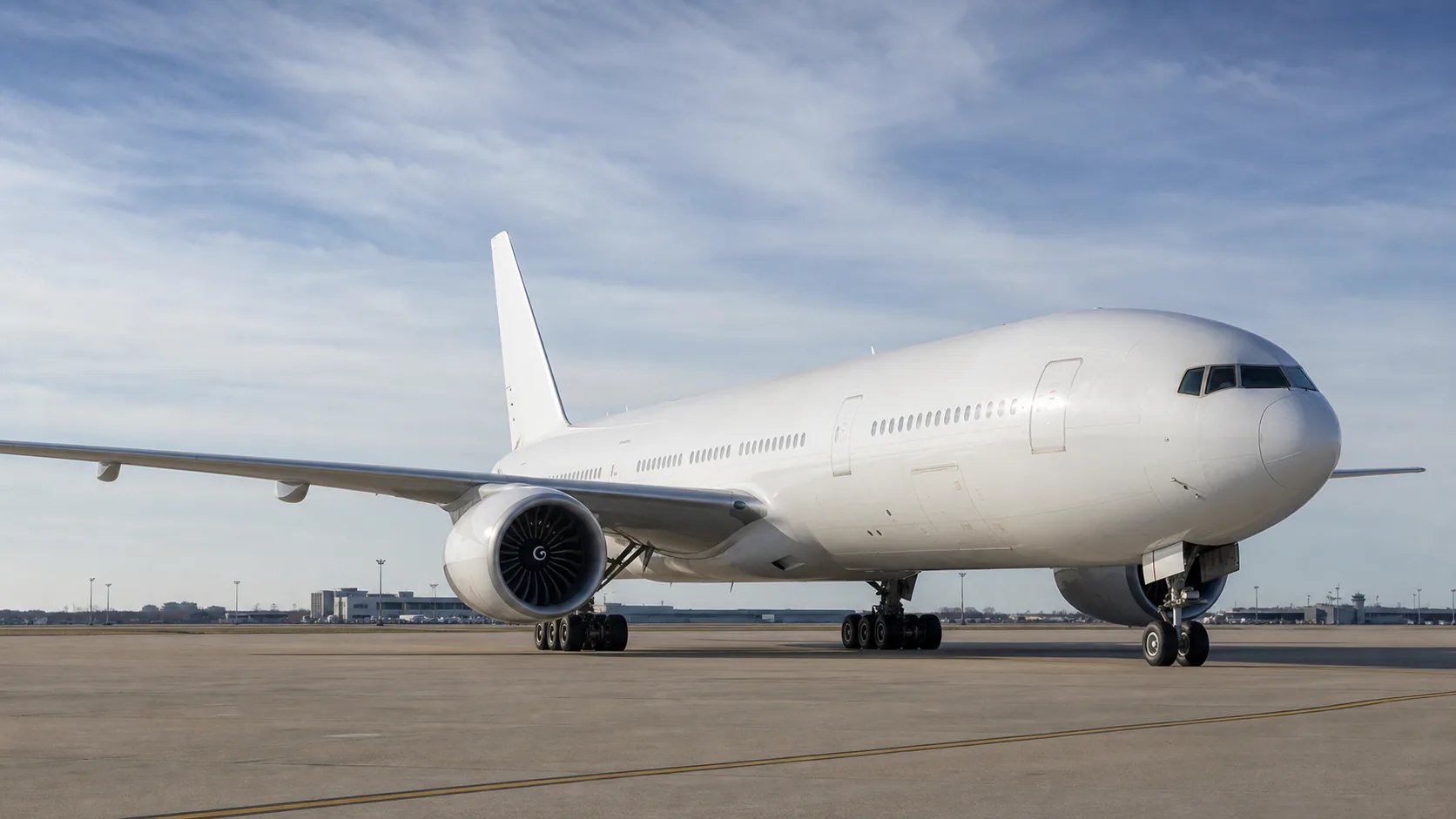
The Boeing 777 is the large twin-engine widebody that helped replace older trijets and four-engine long-haul aircraft. It is central to global long-haul passenger and cargo networks.
History and development
Boeing developed the 777 to sit between the 767 and 747, using a large twin-engine layout and extensive airline input during design.
The 777-200ER and 777-300ER became long-haul mainstays, with the -300ER particularly important for replacing 747s and A340s.
The 777F extended the platform into cargo, while the 777X updates the family with new engines, composite wing technology and folding wingtips.
Variant-by-variant breakdown
| Variant | What it is used for |
|---|---|
| 777-200/200ER | Original and extended-range passenger versions, with different engine and weight options. |
| 777-200LR | Longer-range passenger derivative; distinguish it from the -200ER and the 777F. |
| 777-300/300ER | Stretched passenger variants. The -300ER uses GE90 engines; the original -300 has a different set of engine options. |
| 777F | Factory freighter in the GE90-powered 777 generation, with cargo-specific structure and payload/range data. |
| 777X | A separate major development generation including the 777-8, 777-9 and 777-8F programmes, with GE9X engines and a composite wing. Product targets are not evidence of certification or airline service. |
Technical specifications
These are manufacturer reference figures, with the variant and assumptions shown where available. Typical layouts, maximum seating and advertised range describe different things. Ranges quoted by different manufacturers are not necessarily calculated on the same payload or reserve basis; use the exact approved documentation for flight planning.
| Variant / reference | Seating / weight | Published reference | Powerplant / layout |
|---|---|---|---|
| 777-200ER | 300-375 seats, Boeing two-class reference | Manufacturer advertised range up to 7,500 nm | GE90, PW4000 or Trent 800, depending on version |
| 777-200LR | 300-375 seats, Boeing two-class reference | Manufacturer advertised range up to 8,500 nm | GE90 |
| 777-300ER | 350-425 seats, Boeing two-class reference | Manufacturer advertised range up to 7,500 nm | GE90 |
| 777F | Cargo payload reference: 102,010 kg | Published range: 4,970 nm at the stated payload | GE90; freighter-specific data |
| 777-8, 777X programme | 350-425 seats, manufacturer two-class design reference | Manufacturer advertised design range up to 9,500 nm | GE9X |
| 777-9, 777X programme | 375-450 seats, manufacturer two-class design reference | Manufacturer advertised design range up to 8,000 nm | GE9X |
Cabin, route role and operating profile
| Area | Typical setup | Operational meaning | Notes |
|---|---|---|---|
| Cabin | Twin aisle | 9 or 10 abreast economy | High passenger and cargo volume |
| Mission | Long-haul | Hub-to-hub and cargo trunk routes | Heavy payload capability |
| Fleet role | 747/A340 replacement | Cargo and passenger | Large twinjet economics |
Design and systems features
- The 777 was Boeing's first fly-by-wire commercial aircraft, though with Boeing control philosophy.
- The 777-300ER combined high thrust GE90 engines with strong range and capacity, making it a long-haul benchmark.
- The 777X adds a composite wing and folding wingtips to fit airport gates while improving aerodynamic efficiency.
Typical operations, routes and operators
- 777s fly dense intercontinental passenger routes, long cargo sectors and high-yield hub-to-hub services.
- The 777-300ER is common among Gulf, Asian, European and North American network airlines.
- The 777F is a major cargo aircraft for express, general freight and long-haul logistics operators.
Market presence and replacement context
- The 777-300ER competed heavily with the A340-600 and later the A350-1000.
- The 777X is Boeing's answer to the need for more efficient very large twinjets after the decline of the 747 and A380 passenger market.
Operational themes for study
- Distinguish the engines, wing, weight options and systems of the exact 777 generation before discussing operational capability.
- Ground manoeuvring, runway planning and long-haul diversion preparation are useful study themes; this is not a comparative safety assessment.
Comparison with similar aircraft
| Aircraft | Where it competes | Practical difference |
|---|---|---|
| Airbus A350-1000 | Large-widebody alternative | Different structure, wing and engines; neither a fleet-wide weight nor a cost ranking follows from the name. |
| Boeing 787 | Different capacity band | A different wing, fuselage and systems architecture, used on overlapping but distinct missions. |
| Boeing 747 | Four-engine comparison | Twin-engine 777 generations replaced many passenger routes formerly operated by 747s. |
FAQ
What is the most important 777 passenger variant?
The 777-300ER became the dominant high-capacity long-haul passenger variant.
Is the 777X in the same family?
Yes, but it is a major new generation with new engines and wing technology.
Why is the 777 popular for cargo?
It combines twin-engine efficiency, range and large payload capability.
Check your understanding
- How do the -200ER, -200LR, -300ER and 777F roles differ?
- Why must GE90-powered 777 references be kept separate from GE9X-powered 777X programme data?
Continue your preparation
- Airbus A350 explained: the composite long-haul Airbus widebody
- Boeing 787 Dreamliner explained: composite long-haul efficiency
- Boeing 747 explained: the Queen of the Skies from 747-100 to 747-8
- Browse all aircraft profiles
- Explore interview preparation topics
Public sources and disclaimer
Manufacturer references checked on 18 October 2026.
This article is an editorial aircraft profile. It is not official aircraft training material and must not replace an AFM, POH, FCOM, QRH, MEL, operator SOP, maintenance manual, regulator document or current type certificate data sheet.
- Boeing 777 passenger and freighter specifications
- Boeing 777X programme specifications
- Boeing airport planning manuals; select the exact 777 generation