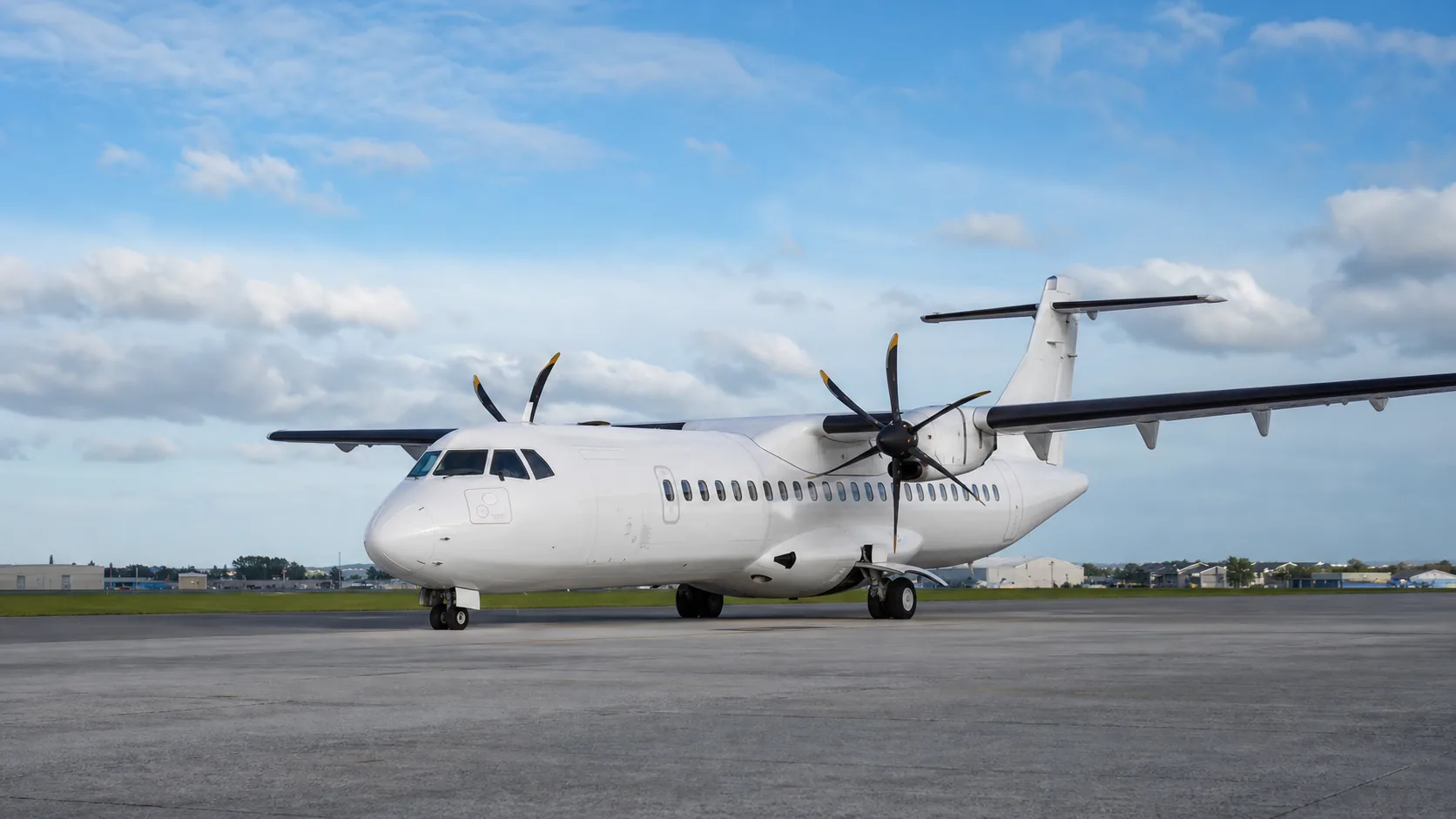
The ATR 72 is a twin-turboprop regional aircraft designed for short sectors where fuel burn, runway performance and trip cost matter more than jet speed. It is common on island networks, regional feeder routes, thin domestic sectors and airports where a jet would be too expensive or too large.
History and development
ATR developed the ATR 72 as a stretched derivative of the ATR 42, adding capacity while keeping the same broad regional turboprop mission.
The ATR 72-500 modernised engines and equipment for wider airline use. The ATR 72-600 brought a newer avionics suite and cabin improvements while preserving the aircraft's short-haul economics.
The family remains relevant because many regional routes cannot support a 100-seat jet but still need airline-standard reliability and economics.
Variant-by-variant breakdown
| Variant | What it is used for |
|---|---|
| ATR 72-200/210 | Early production variants that established the 70-seat turboprop role. |
| ATR 72-500 | Improved performance and systems, widely used by regional airlines and cargo operators. |
| ATR 72-600 | Current main passenger variant with updated avionics, cabin and Pratt & Whitney Canada PW127-series engines. |
| ATR 72 Freighter | Cargo versions support express parcel and regional freight where runway length and operating cost are critical. |
Technical specifications
These are manufacturer reference figures, with the variant and assumptions shown where available. Typical layouts, maximum seating and advertised range describe different things. Ranges quoted by different manufacturers are not necessarily calculated on the same payload or reserve basis; use the exact approved documentation for flight planning.
| Variant / reference | Seating / weight | Published reference | Powerplant / layout |
|---|---|---|---|
| ATR 72-500 | Typically around 70 passengers | Earlier -500 generation; configuration-dependent | PW127-series turboprops |
| ATR 72-600 | 72-seat reference layout; up to 78 seats | Manufacturer max-passenger range: 740 nm / 1,370 km | PW127XT series on current production; earlier engines vary |
| ATR 72-600 | MTOW reference: 23,000 kg | Take-off distance: 1,315 m at MTOW, ISA, sea level | Six-blade propellers |
| ATR 72-600 | Landing at maximum landing weight, sea level | Published landing distance: 915 m | Reference figures, not dispatch calculations |
Cabin, route role and operating profile
| Area | Typical setup | Operational meaning | Notes |
|---|---|---|---|
| Cabin | Single aisle turboprop | Usually 68-72 seats | 2-2 seating |
| Airport fit | Short runways | Regional aprons | Low ground infrastructure demands |
| Mission | Short-haul | Island and feeder routes | Cargo conversion potential |
Design and systems features
- The ATR 72 trades jet cruise speed for a turboprop design aimed at frequent, short sectors. Whether that improves a route's economics depends on the operator and mission.
- Its high wing, six-blade propellers on the -500/-600 and regional-airport design distinguish it from rear-engined regional jets.
- The -600 introduces a different avionics generation from earlier ATR 72s; an aircraft-family overview does not establish interchangeability of systems or procedures.
Typical operations, routes and operators
- ATR 72s are common in Europe, Asia-Pacific, India, Africa, island regions and remote communities that need frequency more than jet speed.
- Cargo operators use the type for parcels and feeder freight where load size does not justify a larger jet.
- The aircraft is especially relevant where runway length, passenger volume or fuel price makes regional jets less attractive.
Market presence and replacement context
- The ATR 72 and Dash 8-400 overlap in regional airline service, but their cruise speeds, seating options and performance references differ.
- Assess a short-sector business case using the actual block time, payload, fuel, maintenance and ownership costs; a turboprop label alone does not establish a cost advantage.
Operational themes for study
- Useful study areas include ice-protection concepts, regional weather decisions and runway-performance assumptions. Use the applicable AFM and operator material for limitations.
- A short-runway design capability does not by itself establish that a particular runway, weather condition or loading is suitable.
Comparison with similar aircraft
| Aircraft | Where it competes | Practical difference |
|---|---|---|
| Dash 8-400 | Regional turboprop alternative | Higher published cruise speed and optional seating capacity; economics depend on the mission. |
| Embraer E-Jets | Jet alternative | Different cruise-speed, cabin and runway-planning characteristics. |
| ATR 42 | Smaller family member | Lower passenger capacity, serving a different demand band. |
FAQ
Why do airlines choose the ATR 72?
It offers low trip cost, short-field capability and enough seats for many regional markets.
Is the ATR 72 slow?
It is slower than a jet, but on short sectors the block-time difference can be commercially acceptable.
What is the current ATR 72 variant?
The ATR 72-600 is the current main passenger version, with updated avionics and cabin features.
Check your understanding
- What changes between the -500 and current-production -600 engine/avionics references?
- Which weight and atmospheric assumptions accompany the quoted take-off distance?
Continue your preparation
- Dash 8 and Q400 explained: De Havilland's high-capacity turboprop
- Bombardier CRJ Series explained: from CRJ200 to CRJ1000
- Embraer E190 and E195 explained: E-Jet capacity with mainline comfort
- Browse all aircraft profiles
- Explore interview preparation topics
Public sources and disclaimer
Manufacturer references checked on 18 October 2026.
This article is an editorial aircraft profile. It is not official aircraft training material and must not replace an AFM, POH, FCOM, QRH, MEL, operator SOP, maintenance manual, regulator document or current type certificate data sheet.