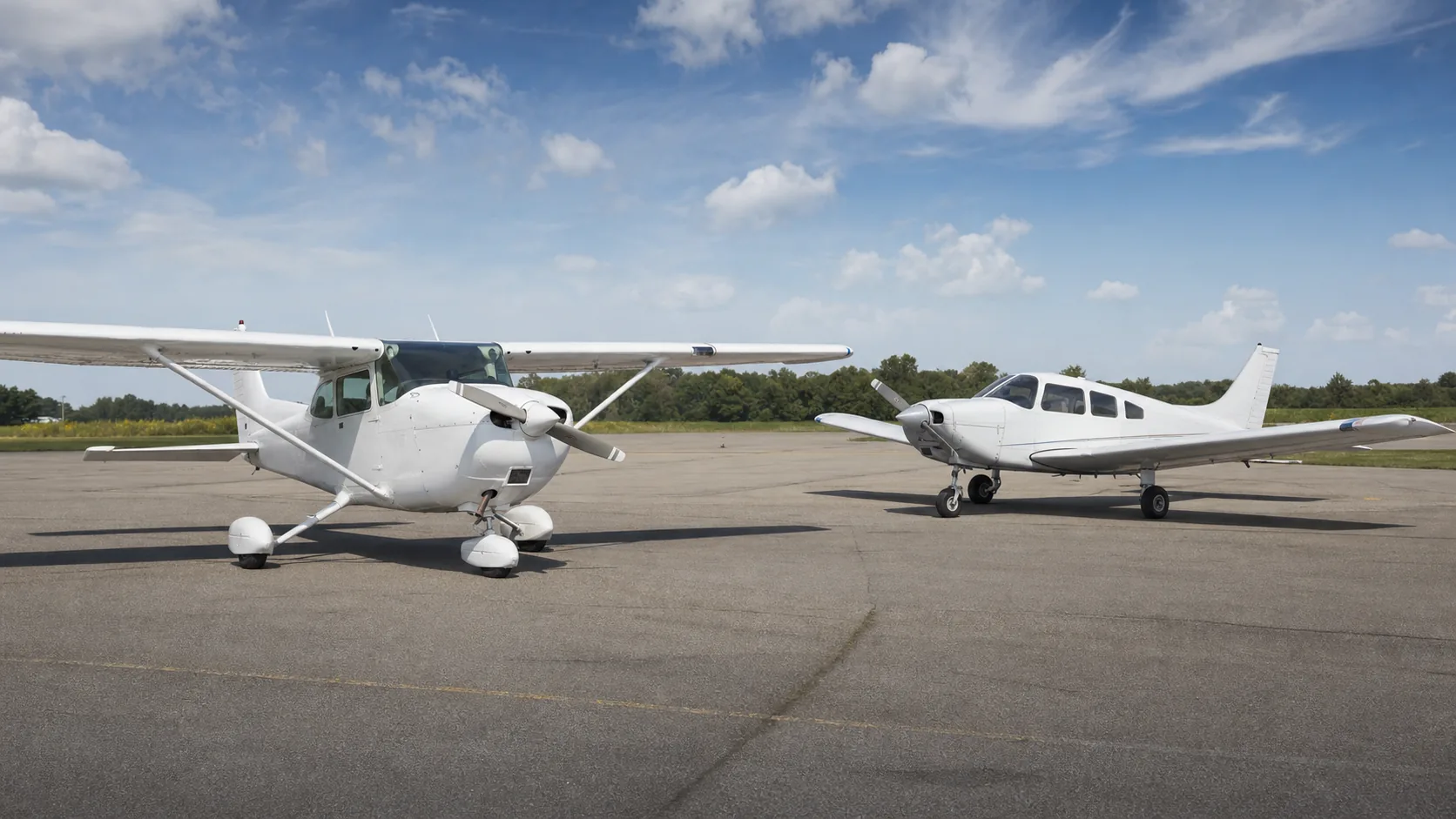
The Cessna 172 and Piper PA-28 are two of the most important single-engine piston training aircraft. One is a high-wing Cessna, the other a low-wing Piper, and together they define much of ab-initio flight training.
History and development
The Cessna 172 first flew in the 1950s and became one of the most produced aircraft in history, helped by forgiving handling and training suitability.
The Piper PA-28 Cherokee family also became a flight-school staple, with variants such as Warrior, Archer and Arrow covering basic training, touring and complex-aircraft instruction.
Modern versions often include Garmin glass cockpits, but the basic training value remains rooted in simple piston-aircraft fundamentals.
Variant-by-variant breakdown
| Variant | What it is used for |
|---|---|
| Cessna 172 Skyhawk | Four-seat high-wing trainer with tricycle landing gear and broad flight-school use. |
| Piper PA-28 Warrior | Lower-powered training-focused PA-28 variant common in clubs and schools. |
| Piper PA-28 Archer | 180 hp PA-28 variant used for training and private touring. |
| Piper Arrow | Retractable-gear PA-28 derivative used for complex aircraft training. |
Technical specifications
These are manufacturer reference figures, with the variant and assumptions shown where available. Typical layouts, maximum seating and advertised range describe different things. Ranges quoted by different manufacturers are not necessarily calculated on the same payload or reserve basis; use the exact approved documentation for flight planning.
| Variant / reference | Seating / weight | Published reference | Powerplant / layout |
|---|---|---|---|
| Cessna 172S / Skyhawk | Four seats; MTOW reference 2,550 lb / 1,157 kg | Manufacturer useful-load example: 878 lb; actual aircraft equipment changes this | Lycoming IO-360-L2A, 180 hp |
| Cessna Skyhawk fuel reference | 53 US gallons / 201 litres usable | Fuel capacity is not an endurance or dispatch-fuel calculation | High-wing, fixed landing gear |
| Piper Archer LX | Four seats; 180 hp Lycoming engine | Piper advertises 522 nm range for the LX; use the exact POH for planning | Low-wing, fixed landing gear |
| PA-28 family | Warrior, Archer and Arrow are different variants | Power, fuel capacity, weight limits and landing gear vary | Do not apply one Archer specification to every PA-28 |
Cabin, route role and operating profile
| Area | Typical setup | Operational meaning | Notes |
|---|---|---|---|
| C172 | High wing | Wing can obstruct the view above or into a turn; downward view differs from a low-wing aircraft | Two cabin doors |
| PA-28 | Low wing | Wing affects downward visibility; fuel-system details depend on the model | Many variants have a right-side cabin door |
| Training role | VFR/IFR fundamentals | Four seats do not guarantee a full-seat, full-fuel loading | Use the exact POH, equipment list and weight-and-balance record |
Design and systems features
- A high wing and a low wing produce different sight pictures in the circuit and during visual navigation; wing position alone does not determine handling quality.
- The PA-28 family includes different engines, fuel systems and landing-gear arrangements. An Arrow is not an Archer with an interchangeable checklist.
- Modern avionics do not remove the need to know the particular aircraft's fuel, weight-and-balance and performance documentation.
Typical operations, routes and operators
- Flight schools use both types for private pilot, instrument, hour-building and instructor training.
- Private owners use them for local flying, touring and club operations.
- Glass-cockpit versions introduce avionics management, but basic stick-and-rudder, weather and fuel decisions remain central.
Market presence and replacement context
- The C172 is often the default global trainer; the PA-28 is the classic low-wing alternative.
- Diamond DA40, Tecnam and other modern trainers compete with newer materials and avionics, but 172/PA-28 fleets remain enormous.
Operational themes for study
- Study fuel planning, weight and balance, weather judgement and traffic awareness using the actual aircraft POH and training syllabus.
- Stall, forced-landing and other flight exercises require the appropriate instruction and aircraft-specific procedures; this comparison is a reading guide.
Comparison with similar aircraft
| Aircraft | Where it competes | Practical difference |
|---|---|---|
| Diamond DA40 | Training-aircraft alternative | Different structure, cockpit and engine options; use model-specific documentation. |
| Cessna 152 | Smaller trainer | A two-seat aircraft with different loading and performance limits. |
| Piper Archer versus C172 | Wing-layout comparison | Low-wing versus high-wing sight pictures; fuel-system and handling details are aircraft-specific. |
FAQ
Which is better, C172 or PA-28?
Neither universally. The C172 is the high-wing default; the PA-28 is a strong low-wing trainer and touring aircraft.
Are these aircraft still produced?
The Cessna Skyhawk and Piper Archer remain available in modern forms.
Can public specs replace the POH?
No. Weight, balance, performance and limitations must come from the exact aircraft POH and current equipment list.
Check your understanding
- How do high-wing and low-wing layouts affect the sight picture?
- Why do four seats and a published fuel capacity not establish an acceptable full-seat, full-fuel loading?
Continue your preparation
- ATR 72 explained: the regional turboprop built for short routes
- Dash 8 and Q400 explained: De Havilland's high-capacity turboprop
- Airbus A320 Family explained: A318, A319, A320 and A321
- Browse all aircraft profiles
- Explore interview preparation topics
Public sources and disclaimer
Manufacturer references checked on 18 October 2026.
This article is an editorial aircraft profile. It is not official aircraft training material and must not replace an AFM, POH, FCOM, QRH, MEL, operator SOP, maintenance manual, regulator document or current type certificate data sheet.
- Cessna Skyhawk official specifications
- Piper Archer LX official information
- FAA type certificate data sheets