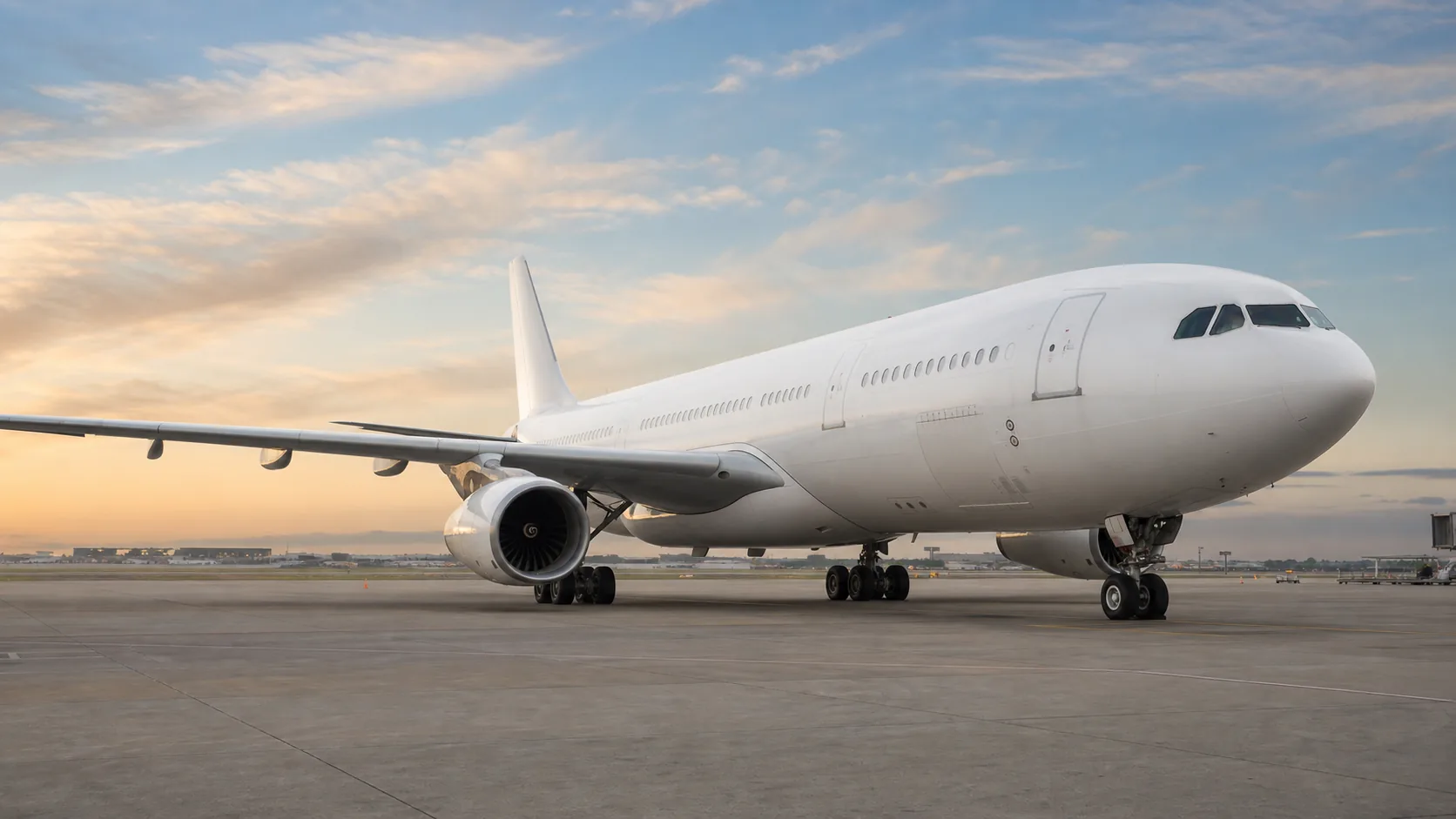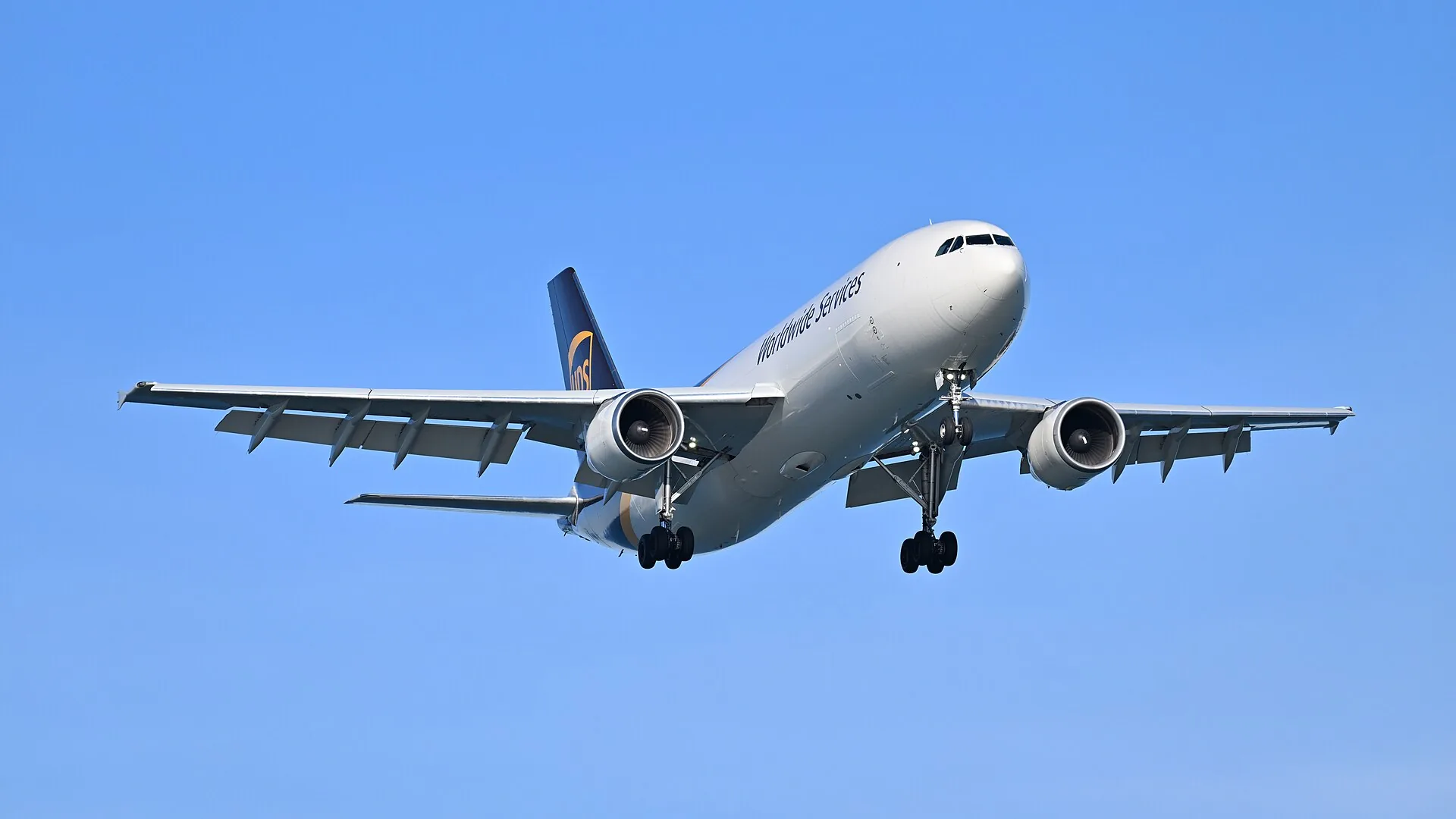
The A300 was built around a useful combination: a wide passenger cabin, two engines and space for standard freight containers below the floor. An airline could use a widebody on a busy regional route without buying the capacity of a 747 or carrying a third engine. The shape of the fuselage mattered as much as the number of engines.
There are two main chapters to its story. The early A300B2 and B4 established the aircraft; the A300-600 brought a different cockpit, rear fuselage and engine choices. The -600R then extended the later aircraft's range. Their names are close enough to cause confusion, while their weights and equipment can be substantially different.
From the A300B1 to an airline aircraft
The first A300B1 flew at Toulouse on 28 October 1972. Airbus had reduced its original, larger proposal to meet airline requirements, selecting a fuselage that accommodated eight seats abreast and two LD3 containers side by side beneath the cabin. Raising the cabin floor slightly helped make those two arrangements fit within the same cross-section. Airbus describes that design decision in its first-flight retrospective.
The production B2 was longer than the B1. The B4 added fuel and weight capability, extending the aircraft's usefulness beyond the shortest trunk routes. Air France introduced the A300 in 1974, initially between Paris and London, as recorded in Airbus's historical chronology. These customers were buying a means of moving substantial passenger loads over sectors that did not necessarily need an intercontinental aircraft. Airbus's technical history follows the progression into later passenger and freight aircraft.
The fuselage cross-section outlived the original programme. It appears in the shorter A310 and the larger A330. That common width did not make their wings, flight controls or range interchangeable.
A300 variants: what actually changed?
| Branch | Main change | Engine examples tied to actual models |
|---|---|---|
| A300B1 | Initial short development aircraft | CF6-50A |
| A300B2 | Longer production fuselage; initial short-range role | B2-1A: CF6-50A; B2-1C: CF6-50C |
| A300B4 | Centre-wing fuel tank, increased weights and wing-root Krüger flaps | B4-203: CF6-50C2; B4-220: JT9D-59A |
| A300-600 | A310-derived rear-fuselage changes and two-pilot cockpit | B4-601: CF6-80C2A1; B4-620: JT9D-7R4H1; B4-622: PW4158 |
| A300-600R | Longer-range development, including trim-tank capability | B4-605R: CF6-80C2A5; B4-622R: PW4158 |
| Freighter and convertible branches | Main-deck freight loading, with configuration-specific floors, doors and restraint systems | Engine and weight depend on the particular model or conversion |
These examples come from EASA's A300/A310 type-certificate data sheet, which also lists further approved engine alternatives and modifications. A CF6-50 on an early B4 and a CF6-80C2 on a -600 belong to different engine generations. Calling both simply “CF6-powered” loses a useful distinction.
The original cockpit generally required two pilots and a flight engineer. Certain early aircraft identified as forward-facing, or FF, had two-pilot approval; the -600's minimum flight crew was two pilots. This transition preceded the A320. A two-pilot electronic flight deck does not imply the sidesticks and primary digital fly-by-wire controls of the later A320 family.
The Beluga A300-600ST is a specialised outsize transport derived from this family. Its enlarged upper fuselage is a different cargo solution, rather than another passenger-cabin option.
Specifications with the weight variant attached
The table deliberately uses identifiable reference configurations. It shows how the family developed without presenting the highest number found anywhere in the programme as a property of every aircraft.
| Item | A300B2-100, basic WV00 | A300B4-200, basic WV06 | A300-600, basic WV00 | A300-600R, basic WV00 |
|---|---|---|---|---|
| Maximum takeoff mass | 137,000 kg | 165,000 kg | 165,000 kg | 170,500 kg |
| Maximum landing mass | 127,500 kg | 134,000 kg | 138,000 kg | 140,000 kg |
| Maximum zero-fuel mass | 116,500 kg | 124,000 kg | 130,000 kg | 130,000 kg |
| Flight-deck generation | Original, with FF exceptions | Original, with FF exceptions | Two-pilot | Two-pilot |
EASA records these weights and their modification dependencies. Certain -600R weight variants reached 171,700 kg takeoff mass; that figure should not replace 170,500 kg in a description of the basic weight variant. The earlier B4 and the -600 can both have a 165-tonne takeoff limit while having different landing and zero-fuel limits.
For dimensions, Airbus's historical family comparison gives the later passenger aircraft as approximately 54.1 m long with a 44.8 m span. Its A300-600 airport-planning manual uses 274 seats as the standard single-class B4-600 layout. EASA separately records a maximum of 361 passenger seats for the applicable -600 cabin and exit configuration. Neither figure describes a freighter.
How far could it fly?
One particularly useful manufacturer reference is the A300-600 with CF6-80C2A1 engines, 165-tonne MTOW and an assumed operating empty mass of 86,727 kg. The planning graph shows approximately 3,500 nautical miles with about 26 tonnes of payload. This is a reading of a graph, rounded accordingly.
Its basis is ISA conditions, long-range cruise at 31,000/35,000 ft, and international reserves covering 10% en-route flight time, an overshoot, a 200 nm diversion, a 30-minute hold at 1,500 ft, approach and landing. At maximum structural payload, roughly 43 tonnes in this reference case, the same graph reaches only about 2,200 nm. Airbus, chapter 3.2, page 2.
That is a concrete example of the aircraft's route trade-off. A dense regional cargo load and a much lighter load carried farther are both plausible A300 missions, but they occupy different places on the payload-range curve. The graph's long-range-cruise schedule is also distinct from the -600's Mach 0.82 maximum operating limit recorded by EASA.
Why the lower hold was central to the design
An LD3 is shaped to use the lower portion of a widebody's curved fuselage. Carrying two abreast allowed the A300 to exchange containers with other compatible widebodies. That reduced the need to unpack freight into loose loads when it transferred between aircraft.
The benefit depended on more than the volume of an empty hold. Cargo doors had to admit the containers, the floor had to carry their loads and the loading system had to position and restrain them. The A300-600 planning manual devotes separate drawings to passenger cross-sections, lower-hold containers and main-deck freighter pallets because they answer different loading questions.
Consider a parcel flight and a machinery shipment. Parcels may fill the available container volume well before reaching the structural payload limit. Machinery can reach a floor or position limit while much of the hold remains visibly empty. The A300's freight suitability came from the combination of usable geometry and structural capability, rather than a single tonnage figure. A main-deck cargo door and approved freighter floor expanded that capability further.
Airbus's 2001 reference document records the purpose-built A300-600 Freighter in Federal Express service from 1994. Passenger-to-freighter conversions form another branch. Their loading systems and approved limits need to be identified as conversions; the passenger version's seating table cannot describe them.
Common A300 questions
Was the A300 the first twin-engine widebody?
Yes. The A300B was the first twin-engine widebody commercial airliner. Its first flight was in October 1972. The distinction combines a twin-aisle fuselage with two engines; earlier twin-engine narrowbodies were already in service.
What is the difference between the A300B4 and A300-600?
The -600 incorporated a two-pilot cockpit and changes developed with the A310, including the rear-fuselage arrangement, as well as later engine choices. A B4-203 with CF6-50C2 engines is an earlier aircraft than a B4-601 with CF6-80C2A1s, despite both model designations beginning with B4.
How many passengers could an A300 carry?
Airbus's A300-600 planning layout uses 274 seats in single class. The applicable -600 certification record permits up to 361 in a particular approved cabin and exit arrangement. Airline cabins traded some capacity for class divisions, seat pitch and service space; freighter models had no passenger cabin of that kind.
Did every A300 require a flight engineer?
No. The early aircraft normally used a three-person flight crew, with approved forward-facing two-pilot exceptions. The A300-600 was a two-pilot aircraft. The precise generation matters more than the A300 name alone.
Why did the A300 become a freighter?
Its broad fuselage and container-compatible lower hold were useful starting points. Dedicated freight models and conversions added the main-deck loading capability needed for that work. The resulting aircraft could combine substantial volume with payload capacity on regional and medium-range cargo sectors.