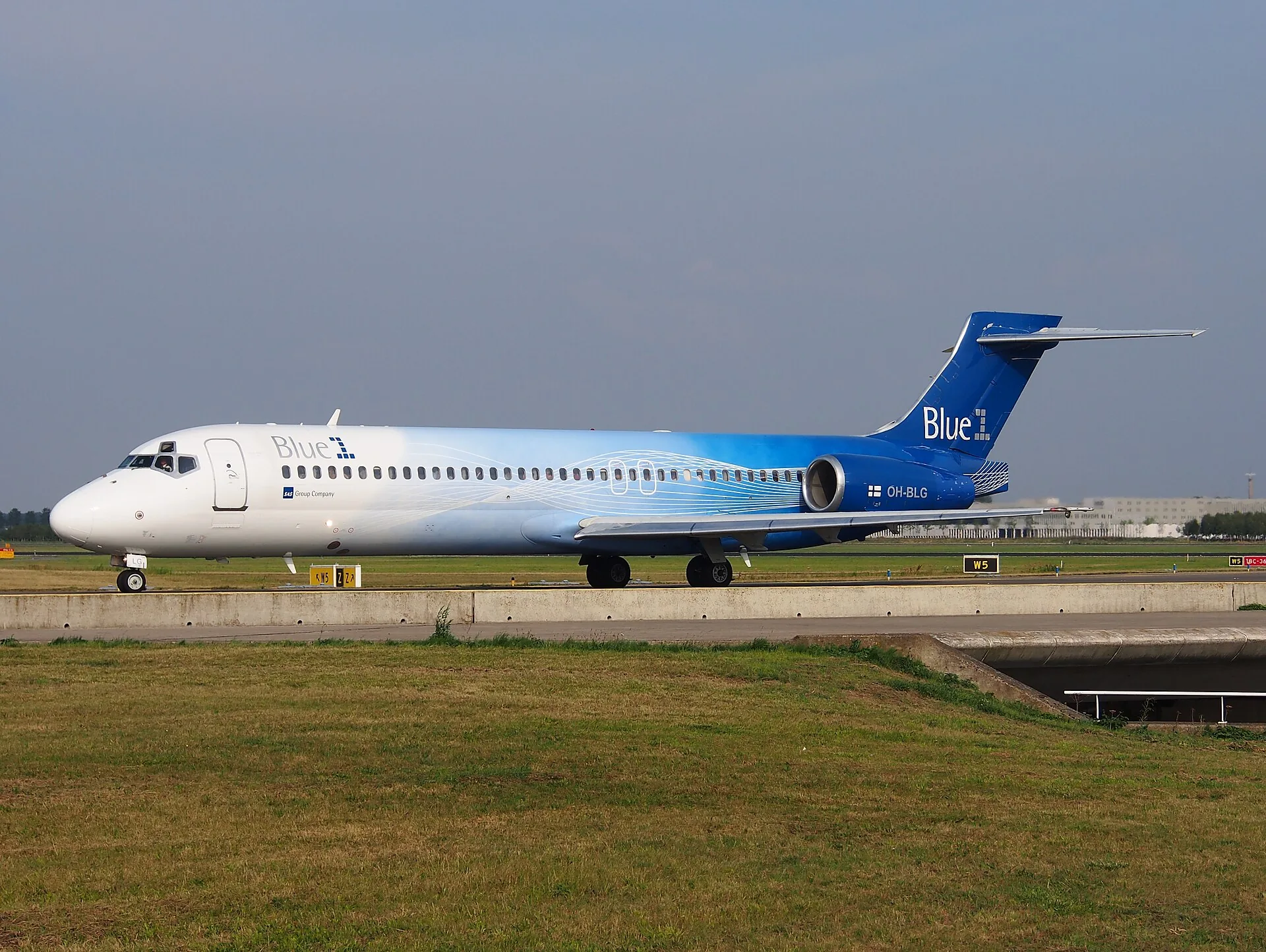
A Boeing number can hide a Douglas family resemblance. The 717's rear-mounted engines, T-tail and five-abreast cabin came from the DC-9 line. Its programme began as the MD-95, then acquired the Boeing name after the 1997 merger with McDonnell Douglas.
The aircraft was designed around frequent departures with roughly 100 passengers. Its BR715 engines and updated two-pilot flight deck were new equipment for that job, while the cabin cross-section and general arrangement followed a familiar Douglas pattern. The result was a smaller aircraft than the six-abreast 737, with a distinct operating role and a production history of its own.
The MD-95 became the 717-200
McDonnell Douglas launched the MD-95 in October 1995. Boeing's June 1998 rollout announcement records the redesignation following the merger and describes a two-pilot cockpit built around six liquid-crystal displays. The cabin used five-across economy seating, normally arranged 2-3.
AirTran was the launch customer. Boeing handed over the first 717 to AirTran in September 1999. The airline began revenue service on 12 October 1999, between Atlanta and Washington, DC. That route is a better illustration of the original brief than a maximum-range headline: a modest-size jet could provide frequent service between cities without filling a larger cabin on each departure. Boeing's first-year service account.
Production ended after 156 aircraft. The final pair went to Midwest Airlines and AirTran on 23 May 2006, closing the commercial-aircraft production chapter at Long Beach. Those are final-delivery facts, rather than a retirement date for the aircraft already in airline service. Boeing's final-delivery announcement.
There was one production model, the 717-200. Its suffix does not mean a 717-100 preceded it in airline service. Within that model, Boeing offered different weights and fuel arrangements. Those configurations deserve separating even though the fuselage length stayed the same.
Dimensions, engines and actual seat counts
| Item | 717-200 reference |
|---|---|
| Length | 37.81 m |
| Wingspan | 28.45 m |
| Height | 8.88 m in the certification data |
| Wing area | 92.97 m² |
| Engines | Two Rolls-Royce BR700-715A1-30 or BR700-715C1-30 |
| Minimum flight crew | Two pilots |
| Maximum certified passenger seating | 134, with the applicable approved interior |
| Boeing planning cabin | 106 seats in mixed class |
| Delta cabin, checked 14 November 2026 | 110 seats: 12 First, 25 Comfort and 73 Main |
The geometry, exact engine designations and certification seating are from EASA IM.A.211, issue 3, July 2025. Boeing's airport-planning manual supplies the 106-seat reference. Delta's own seat map supplies the actual airline layout. These are three different answers to three different seating questions.
Five abreast gives the cabin a different geometry from the 737 family. There is only one middle seat in a complete economy row, rather than two in a 3-3 arrangement. Seat pitch, cabin class and the number of rows still depend on the operator. A smaller cross-section also constrains the space available beneath the cabin, which becomes relevant when extra fuel tanks occupy part of the hold.
The higher-weight aircraft trades hold volume for fuel
Boeing's general-characteristics table compares several basic takeoff weights with a high-gross-weight configuration. The two endpoints below make the change easy to see. Pounds are retained from the manufacturer's table to avoid false precision from rounding conversions.
| Boeing planning item | Basic 110,000 lb case | High-gross-weight 121,000 lb case |
|---|---|---|
| Maximum takeoff weight | 110,000 lb, about 49.9 t | 121,000 lb, about 54.9 t |
| Maximum landing weight | 100,000 lb | 110,000 lb |
| Maximum zero-fuel weight | 94,000 lb | 100,500 lb |
| Reference operating empty weight | 67,500 lb | 68,500 lb |
| Maximum structural payload in that reference | 26,500 lb | 32,000 lb |
| Usable fuel capacity | 3,673 US gal | 4,403 US gal |
| Lower-hold volume | 935 ft³, 26.5 m³ | 730 ft³, 20.7 m³ |
Boeing's reference with auxiliary tanks has 460 US gallons forward and 270 aft, adding 730 gallons of usable fuel. In that configuration, the lower hold has approximately 5.8 m³ less volume than the basic reference. Boeing, general characteristics, printed page 7.
This is a tangible configuration trade. More fuel capability can extend the missions available, but the tanks occupy space that might otherwise accommodate baggage or freight. The increased weight limits also change how much mass can be carried. Tank volume, payload weight and hold volume are separate constraints, and none disappears merely because the other has increased.
The table's maximum payload follows directly from zero-fuel weight minus its assumed empty weight. For the high-weight example, 100,500 minus 68,500 equals 32,000 lb. That arithmetic describes the published reference aircraft; a different interior or installed equipment changes the empty-weight side of the calculation.
Speed and range: keep the units visible
Delta publishes a cruising speed of 504 mph, or 811 km/h, and a range of 1,510 statute miles, or 2,430 km, for its 717. The range converts to roughly 1,310 nautical miles. The airline does not state a payload or reserve basis alongside those figures, so they are best treated as an operator summary. Delta aircraft specifications.
Boeing's planning chart gives a more explicit reference: standard day, zero wind, BR715 engines, long-range cruise and reserves based on a 200 nm alternate. At 100,500 lb zero-fuel weight and 121,000 lb brake-release weight, its plotted range is approximately 1,150 nm. This rounded graph reading is useful for ground study and interview preparation. Flight planning requires the approved data and procedures for the specific aircraft and operator. Boeing payload-range chart, printed page 22.
Lighter payloads move the reference aircraft to a different part of the same chart. Extra fuel capacity and a maximum structural payload cannot simply be combined into a new range claim: the aircraft still has a takeoff-weight limit.
What the BR715 changed
Rolls-Royce describes the BR715 as a two-shaft, high-bypass turbofan. It shares the BR700 core lineage with the BR710, including a ten-stage high-pressure compressor and two-stage high-pressure turbine. Its low-pressure system is tailored to the 717, with a 58-inch fan, two-stage booster and three-stage low-pressure turbine. Rolls-Royce BR715 technical description.
The core sustains combustion and the high-pressure cycle; the low-pressure turbine drives the fan system. Related core technology therefore does not mean the complete BR710 and BR715 installations are interchangeable. Nor does the 717's DC-9 ancestry mean it retained the earlier aircraft's JT8D engines.
Rolls-Royce specifically identifies high-cycle operation as part of the engine's purpose. Consider a hypothetical day with eight 35-minute airborne sectors. Those sectors add up to 4 hours 40 minutes airborne, eight takeoffs and eight landings. One sector with the same total airborne time involves one takeoff and one landing. This ground-study example illustrates why sector count matters alongside time airborne.
That distinction helps explain why a short-haul aircraft is designed and maintained around both hours and cycles. It also explains why a cruise-efficiency comparison alone says relatively little about an aircraft that spends much of its working day starting, climbing, descending and turning around at a gate.
Where the aircraft fits among smaller jets
The 717 occupied a useful step between many regional jets and larger narrowbodies. A five-abreast cabin gave it room for more passengers than smaller Embraer ERJ models, while its frequent-service role overlapped the E170 and E175. The aircraft type library includes other short-haul designs. Actual airline choices also involved fleet support, acquisition cost and the number of departures a route could sustain.
Its updated displays reduced neither the aircraft's need for systems knowledge nor its Douglas heritage. Rear-mounted engines leave the wing free of engine pylons, but place their mass and structural attachments at the aft fuselage. The T-tail, cabin and engine arrangement have to be understood as one design, rather than judged by the appearance of a clean wing alone.
Common questions about the 717
Is the Boeing 717 a renamed DC-9?
It is a later development of the DC-9 line, launched as the MD-95. It combined that general layout with BR715 engines, a new cabin and an updated electronic flight deck. The Boeing designation followed the McDonnell Douglas merger.
How many seats does it have?
Delta's published layout has 110. Boeing's mixed-class planning reference has 106, while EASA records a certified maximum of 134 with the applicable interior approval. An airline seat count should be identified by operator and layout.
Is there a Boeing 717-100?
No 717-100 entered production airline service. The production airliner was the 717-200. Its basic and higher-weight configurations were variations within that model.
How far can a 717 fly?
Delta publishes 1,510 statute miles, about 1,310 nm, without an adjacent payload/reserve definition. Boeing's planning chart gives different ranges for specified zero-fuel and brake-release weights. At maximum reference zero-fuel weight and 121,000 lb brake-release weight, the chart indicates about 1,150 nm under its stated conditions.
When did Boeing stop building it?
The final two were delivered on 23 May 2006. Boeing reports total production of 156 aircraft. Airline use continued after the production line closed.