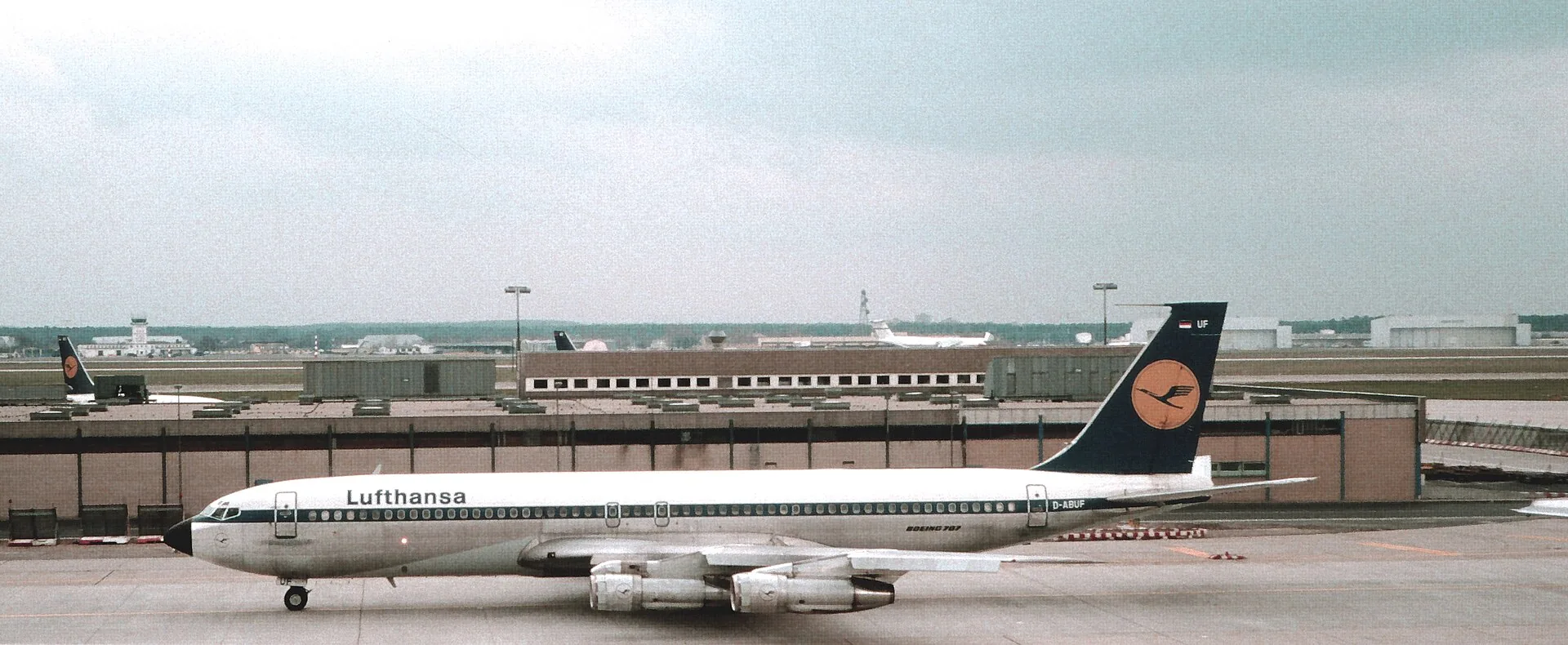
Four engines and a swept wing made the 707 easy to recognise. Its model numbers are less straightforward. A 707-120 turbojet, a turbofan-powered -120B and a long-range -320C differ in much more than cabin length. The related 720 then pursued a lighter aircraft for shorter routes, rather than the largest possible intercontinental load.
Those distinctions explain both the family's commercial development and some of its handling characteristics. Engine generation, wing geometry and longitudinal controls each deserve a closer look than a single line headed “Boeing 707 specifications”.
From the Dash 80 to the airline aircraft
The production 707 first flew on 20 December 1957. Weather cut the initial flight to seven minutes; a second flight that day lasted 71 minutes. Its ancestor, the Boeing 367-80 demonstrator, had established the concept but never entered commercial service. Production aircraft received a larger cabin and further changes.
Pan American ordered 20 707-120s in October 1955, becoming the first customer. Boeing subsequently developed a larger intercontinental branch. In May 1959, a 707-320 flew non-stop from Seattle to Rome in 11 hours 6 minutes. That demonstration showed what the longer-range design could achieve; it was a particular flight, rather than a full-cabin scheduled-service range guarantee. Boeing's first-flight history.
The Douglas DC-8 developed alongside it. Both families later acquired turbofans, longer bodies and freight roles. Their histories make more sense as a sequence of changing airframes and installations than as a contest between two fixed aircraft.
The engine and variant map
| Branch | Engine family in Boeing's planning documents | Principal distinction |
|---|---|---|
| 707-120 | Pratt & Whitney JT3C turbojet | Original short-body production branch |
| 707-120B | Pratt & Whitney JT3D turbofan | Fan-powered development of the short-body aircraft |
| 707-220 | Pratt & Whitney JT4A turbojet | Higher-powered special-purpose development |
| 707-320 | Pratt & Whitney JT4A turbojet | Longer body, larger wing and intercontinental role |
| 707-420 | Rolls-Royce Conway, identified as R.Co.12 | Rolls-Royce-powered intercontinental aircraft |
| 707-320B | Pratt & Whitney JT3D turbofan | Fan-powered intercontinental branch |
| 707-320C | Pratt & Whitney JT3D turbofan | Convertible passenger/cargo and freight configurations |
| 720 | Pratt & Whitney JT3C turbojet | Shortened, lighter derivative with additional leading-edge devices |
| 720B | Pratt & Whitney JT3D turbofan | Fan-powered 720 development |
These are engine families, not a claim that each submodel used one identical rating. For example, Boeing's 707-120B range graph uses JT3D-3s, while its 720B graph uses JT3D-1s. 707 planning manual, introduction and family comparison, 720 planning manual, introduction, 720B payload/range graph.
The B suffix is therefore valuable evidence about these particular variants, but it is not an interchangeable specification across the family. Nor is a -320 merely a -120 with different engines: the larger wing and longer body are central to its mission.
Four useful planning references
The following values retain the manufacturer documents' pound-based weight references. Metric takeoff masses are rounded conversions. The passenger 707-320C column is deliberately separate from the manual's all-cargo columns.
| Reference | 707-120B | 707-320C passenger | 720 | 720B |
|---|---|---|---|---|
| Overall length | 44.22 m | 46.61 m | 41.50 m | 41.68 m |
| Wingspan | 39.88 m | 44.42 m | 39.88 m | 39.88 m |
| Maximum takeoff weight | 257,340 lb / 116.7 t | 333,600 lb / 151.3 t | 229,300 lb / 104.0 t | 234,300 lb / 106.3 t |
| Maximum landing weight | 190,000 lb | 247,000 lb | 175,000 lb | 175,000 lb |
| Maximum zero-fuel weight | 170,000 lb | 230,000 lb | 139,000 lb | 156,000 lb |
| Maximum seating in reference | 174 | 194 | 149, or 156 with exit option | 149, or 156 with exit option |
| Usable fuel | 17,330 US gal | 23,855 US gal | 16,060 US gal | 16,130 US gal |
For the 720 and 720B, 156 seats require the optional pair of additional Type III exits. It is not simply a matter of installing another row. The 720 dimensions above follow its dedicated manual; the 707 family comparison gives a different metric length for the original 720. Boeing also lists 335,000 lb for the passenger -320C with wet thrust. 707 dimensions, printed page 6, 707 weights and seating, printed page 9, 720 dimensions, printed page 4, 720 weights and seating, printed page 7.
What the 720 changed
The 720 kept the familiar cross-section and four-engine arrangement while reducing fuselage length, structural weight and fuel capacity. Boeing also describes additional leading-edge flaps. These changes addressed takeoff and short-to-medium-route performance, where carrying the structure and fuel provision of a larger long-range aircraft would be a burden.
Leading-edge devices matter because a swept wing designed for fast cruise must also produce sufficient lift at takeoff and landing speeds. Deploying the devices changes the wing's low-speed aerodynamic behaviour. Shortening the fuselage alone would not achieve that result.
The fan-powered 720B then altered the balance again: more engine capability, a slightly different overall length and higher weight provision. Its planning maximum zero-fuel weight is 17,000 lb higher than the turbojet 720 reference, while both have the same 175,000 lb landing-weight reference. The development therefore cannot be described adequately as an engine swap with otherwise identical limits.
The later Boeing 727 attacked shorter-route airline work with a different three-engine layout and a much more elaborate high-lift wing. Comparing the two shows how rapidly the requirements for regional jet service evolved.
Cruise speed and a range case with an identifiable aircraft
A NASA presentation uses Mach 0.82 as a representative 707 cruise figure. It is a broad historical comparison, without a named customer variant or altitude, rather than a speed to apply to every mission. Boeing's detailed planning charts instead describe their cruise method and payload assumptions. NASA, subsonic transport comparison.
For a concrete example, the 707-120B domestic graph gives approximately 3,600 nm at the intersection of its 137-passenger-and-baggage line and the 257,340 lb takeoff-weight curve. This is a rounded reading, not a calculated result to the nearest mile. The case uses JT3D-3 engines, 127,500 lb operating empty weight, standard-day conditions, zero wind, long-range step-climb cruise and ATA domestic reserves including a 200 nm alternate. Boeing payload/range graph, printed page 30.
The plotted passenger line is below maximum structural payload. The graph distinguishes the specified passenger load from the structural payload limit. A 174-seat planning maximum should not be substituted into the 137-passenger case without changing the load.
Elevator tabs, trim and a documented lesson
The 707/720's longitudinal controls are particularly instructive. The control column moves elevator tabs; aerodynamic forces then help move the elevators. The trimmable stabilizer changes the tail's balancing load through a separate mechanism. Those two paths affect the same aircraft motion but are not equivalent controls.
The FAA's account of Northwest Flight 705, a 720B lost on 12 February 1963, describes a strong updraft during climbout. Investigators attributed the upset to the interaction of severe vertical air currents and large longitudinal control inputs. Their reconstruction indicates nose-down elevator and stabilizer inputs, though the precise timing of those inputs was uncertain. Later, high loads stalled the electric trim drive and prevented nose-up retrimming. At that stage, the available elevator authority could not counter the nose-down stabilizer setting. The crew did not recover. FAA accident and control-system account, Civil Aeronautics Board accident report.
The useful distinction is between moving a hinged elevator and changing the incidence of the horizontal stabilizer. A change that relieves sustained control force also changes the aircraft's underlying balance. Combining large inputs through both mechanisms can produce a substantially different response from either input alone. Use the case in ground study to explain how elevator authority and stabilizer position interacted on this aircraft. In an interview, distinguish the investigators’ reconstruction from the mechanism documented for the 707/720.
Common questions about the 707 and 720
Was the Dash 80 the first production 707?
No. It was the 367-80 demonstrator that preceded the production family. The production 707 had a larger cabin and other changes, and first flew on 20 December 1957. Confusing them loses an important step between demonstrating a jet transport and building an airline product.
What is the main difference between a 707 and a 720?
The 720 was a shortened, lighter derivative aimed at shorter routes and better runway performance. It retained four engines and the family cross-section, but changed weight, fuel provision and leading-edge equipment. The 720B then introduced JT3D turbofans.
Did every 707 have turbofan engines?
No. The original -120 used JT3C turbojets and the -320 used JT4As. The -120B and -320B/C used JT3D turbofans. The -420 had Rolls-Royce Conway engines. Engine type must remain attached to the model being discussed.
How many passengers could it carry?
Boeing's cited references give 174 for the -120B and 194 for the passenger -320C. The 720/720B reference is 149, with 156 dependent on additional exits. Airline interiors could carry fewer passengers through different class, seat-spacing and service-area choices.
How far could a 707 fly?
There is no single family-wide value. One defined -120B planning case gives about 3,600 nm with 137 passengers and baggage under the stated conditions. The larger intercontinental variants use different engines, wings, fuel quantities and payload-range curves. For more examples of how specifications change by variant, browse the aircraft library.