Performance
Core performance topics used in technical interviews.
Core performance topics used in technical interviews.
Member-only answer
This is a real airline technical interview question. Unlock the structured, examiner-ready answer used by successful candidates.
Unlock full accessMember-only answer
This is a real airline technical interview question. Unlock the structured, examiner-ready answer used by successful candidates.
Unlock full accessMember-only answer
This is a real airline technical interview question. Unlock the structured, examiner-ready answer used by successful candidates.
Unlock full accessMember-only answer
This is a real airline technical interview question. Unlock the structured, examiner-ready answer used by successful candidates.
Unlock full accessMember-only answer
This is a real airline technical interview question. Unlock the structured, examiner-ready answer used by successful candidates.
Unlock full accessOn landing with a strong crosswind from the right on a slippery runway, two main forces tend to push the aircraft toward the left (downwind side):
– the crosswind, which acts on the aircraft’s tail, causing the nose to yaw right
– and the reverse thrust, which acts opposite to the aircraft’s heading and reinforces the sideways force
In this scenario, the aircraft is pointing slightly to the right (into the wind), so the reverse thrust vector pushes further toward the left, combining with the crosswind to degrade directional control.
To regain control, we need to reduce the forces pushing us downwind. Since we cannot act on the wind, the best option is to:
– reduce reverse thrust to idle (not cancel it entirely)
– release the brakes to regain tire traction
– use rudder and differential braking as needed to steer back to the centerline
Once directional control is restored, reverse thrust and braking can be reapplied as appropriate.
[Image:/Images-Ressources/skidding.png]
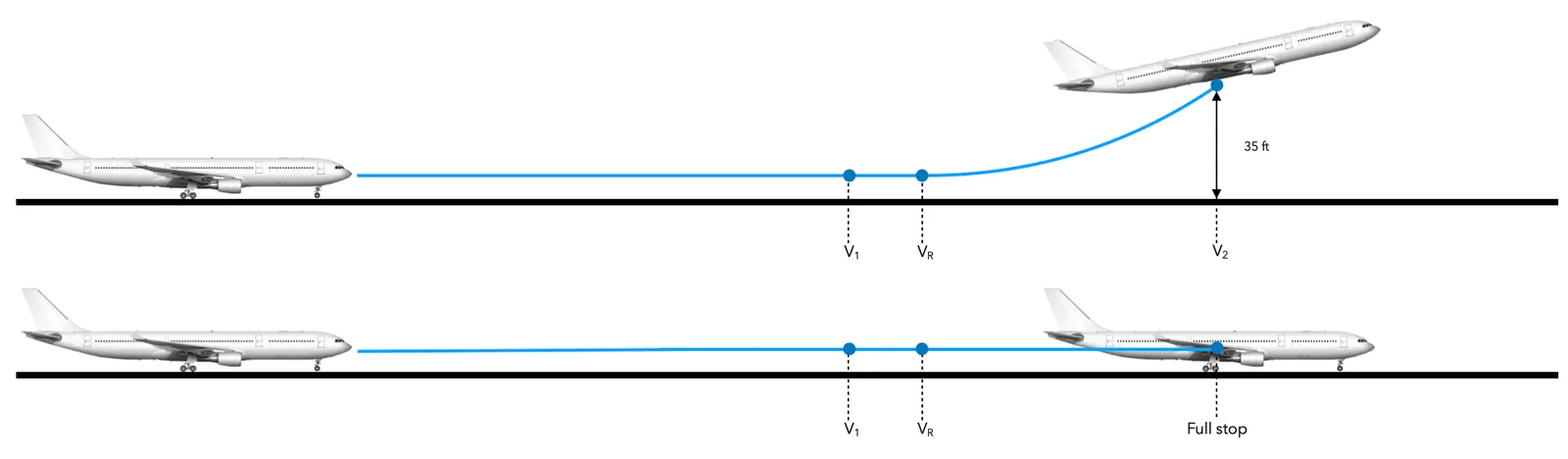
Balanced V₁ is the takeoff decision speed at which the Take-Off Distance Required (TODR) equals the Accelerate-Stop Distance Required (ASDR).
At this speed, if an engine fails just before $V_{1}$, the aircraft can either:
This condition defines the balanced field length, which is the minimum runway length required for a given aircraft weight.
Choosing a lower $V_{1}$ increases TODR, since the aircraft needs more distance to accelerate to $V_{2}$ with one engine inoperative.
Choosing a higher $V_{1}$ increases ASDR, as more energy must be absorbed by the brakes in case of a rejected takeoff.
In essence, balanced $V_{1}$ optimizes field-length-limited takeoff performance.
Note: The field length may be limited by:
- ASDR
- TODR
- 115% of all-engine TODR
Reminder: If an engine fails exactly at $V_{1}$, the aircraft may not be able to stop within ASDR, due to the reaction time required to recognize the failure and initiate a rejected takeoff (RTO).
That’s why $V_{1}$ is the latest point to initiate the RTO, not to complete it.
When using a balanced V₁ (i.e. when TODR = ASDR), the maximum takeoff weight (TOW) is achieved for a given field length.
On a runway without clearway or stopway, TODA = ASDA.
In such a case, for a field length limited takeoff:
- Balanced V₁ results in:
TODR = ASDR = ASDA = TODA
- Since ASDR = ASDA, V₁ cannot be increased further
- And since TODA is fixed, TOW cannot be increased either
This is because:
- Increasing TOW requires a lower V₁ (to keep ASDR ≤ ASDA)
- But lowering V₁ increases TODR, which would then exceed TODA → not allowed
However, introducing a clearway increases TODA (Take-Off Distance Available).
This allows:
- A slightly lower V₁ (to reduce ASDR)
- A slightly higher Vr (to generate the required lift at higher TOW)
- Even though TODR increases slightly with the lower V₁, the added clearway ensures TODR remains ≤ TODA
✅ Result: Higher takeoff weight becomes possible, thanks to the clearway, by using an unbalanced V₁ configuration.
In the event of an engine failure after takeoff, the flight path is divided into four distinct segments, each with specific configuration and performance requirements:
First segment – From screen height (35 ft) to the point where the landing gear is fully retracted.
– Aircraft is still accelerating with gear down
– Climb gradient must be positive for twin-engined aircraft and at least equal to 0.5% for quad-engined aircraft
Second segment – From gear up to acceleration altitude (no lower than 400 ft AAL).
– Flaps remain extended
– Aircraft must maintain $V_{2}$
– Minimum required climb gradient is 2.4% for twin-engined aircraft and 3.0% for quad-engined aircraft.
Third segment – From acceleration altitude to the point where the flaps and slats are fully retracted.
– The aircraft accelerates from $V_{2}$ toward final segment speed
– Configuration transitions to clean
Fourth segment – From flaps retracted to 1500 ft AAL or the applicable minimum safe altitude (MSA).
– Climb continues at a higher speed with reduced thrust
– Minimum required climb gradient is 1.4% for twin-engined aircraft and 1.7% for quad-engined aircraft
[Image:/Images-Ressources/four-segments.png]
Get access to 98 more questions by subscribing.
Get notified when new articles, new interview questions, and new pilot jobs are published.
PILOT INTERVIEW PREP // MEMBER ACCESS
Join now to access full interview answers, airline-specific assessment guides, and structured prep built by line pilots.