Flight Operations
Operational decision-making and SOP-based questions.
Operational decision-making and SOP-based questions.
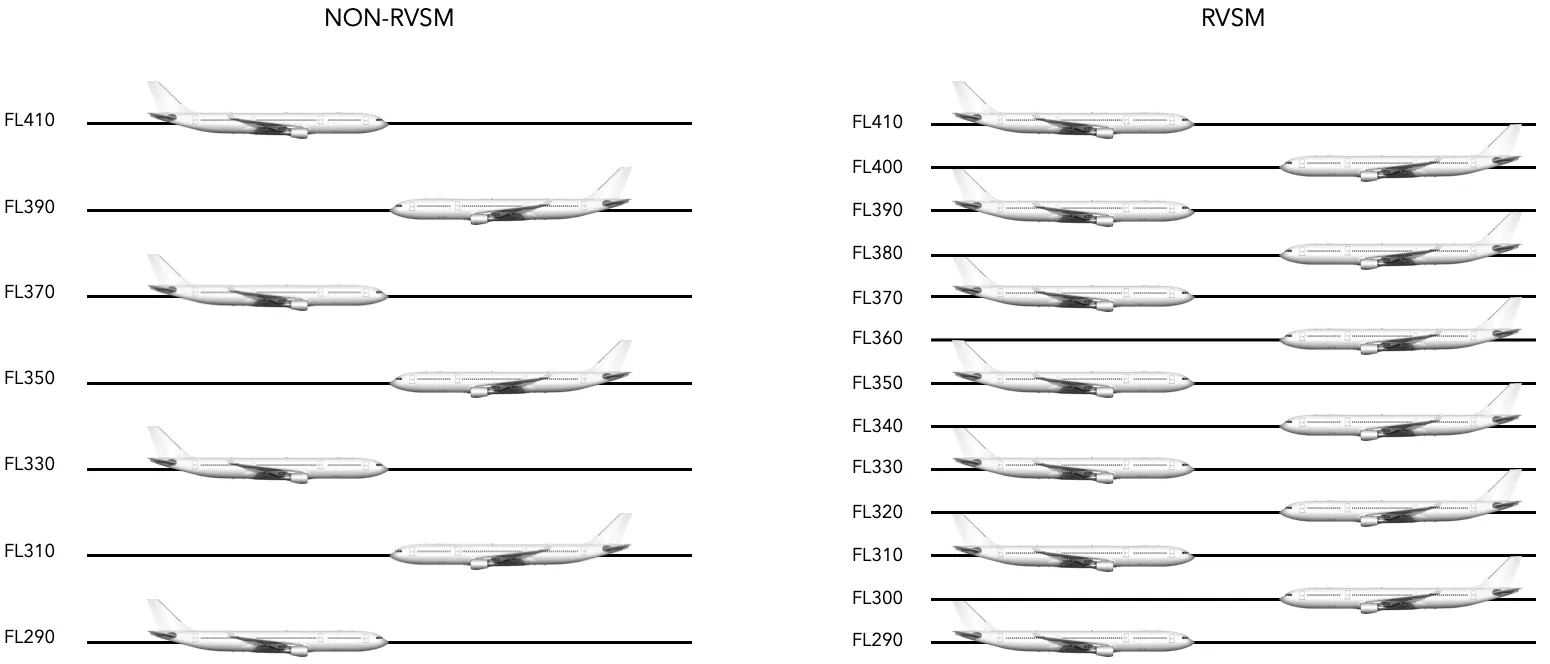
RVSM stands for Reduced Vertical Separation Minima. It refers to the airspace between FL290 and FL410, where aircraft are separated by 1000 feet vertically, reduced from the previous 2000 feet of separation.
RVSM offers two key benefits:
1. Increased airspace capacity.
2. More efficient flight operations, as aircraft are more likely to fly closer to their optimum altitude.
Above RVSM airspace (e.g., FL430), vertical separation is increased back to 2000 feet due to reduced altimeter accuracy.
Note: The maximum altimeter difference between the Captain’s and First Officer’s displays is 200 feet for RVSM operations. If any of these requirements are not met, flying within RVSM airspace is not allowed. For example, if the autopilot fails while cruising at FL370, you must request a level lower than FL290 for continued cruise.
MEL stands for Minimum Equipment List.
It is an operator-specific document that lists equipment or systems that may be inoperative for a flight to be dispatched, provided specific conditions and operational or maintenance procedures are followed as described in the MEL.
Key points:
- The MEL is based on the MMEL (Master MEL) but can be more restrictive, never less.
- If an item is not listed in the MEL, it means the aircraft cannot be dispatched with that item inoperative.
- The MEL is not a list of what must be operative, but rather what may be inoperative under certain conditions.
Note:
For example, you may dispatch with an inoperative APU if procedures allow. However, critical systems like an engine will not appear in the MEL, as dispatch is never allowed with such items inoperative.
Member-only answer
This is a real airline technical interview question. Unlock the structured, examiner-ready answer used by successful candidates.
Unlock full accessMember-only answer
This is a real airline technical interview question. Unlock the structured, examiner-ready answer used by successful candidates.
Unlock full accessMember-only answer
This is a real airline technical interview question. Unlock the structured, examiner-ready answer used by successful candidates.
Unlock full accessMember-only answer
This is a real airline technical interview question. Unlock the structured, examiner-ready answer used by successful candidates.
Unlock full accessMember-only answer
This is a real airline technical interview question. Unlock the structured, examiner-ready answer used by successful candidates.
Unlock full accessThe visual cues required during CAT II and CAT III approaches depend on the type of system used and whether a decision height (DH) is applied.
| Approach Type | Visual References Required at DH |
|---|---|
| CAT II | - At least three consecutive lights must be clearly visible and identifiable. - A lateral visual element is also required. - If a HUD or equivalent system is used down to touchdown, the lateral element is not needed. |
| CAT III (fail-passive or HUD-based) | - A segment of at least three consecutive lights must be visible and identifiable. |
| CAT III (fail-operational or hybrid system with DH) | - At least one runway centerline light must be visible and maintained. |
| CAT III (no DH) | - No visual reference is required prior to touchdown. |
Note:
The required three consecutive lights may consist of:
- Approach lighting system centreline lights
- Touchdown zone (TDZ) lights
- Runway centreline lights
- Runway edge lights
- Or any combination of the above
The lateral visual element may be:
- An approach lighting crossbar
- The runway threshold
- Or a barrette of the touchdown zone lighting
A destination alternate is not required in the following situations:
Note: This is often remembered as the 3-2-1 rule, where:
- 3 statute miles = about 5 km visibility
- 2 = 2000 ft ceiling
- 1 = 1 hour window around ETA
Important: Operators using the basic fuel scheme (without variations) are not permitted to dispatch a flight without selecting a destination alternate, even if all the above conditions are met.
Get access to 49 more questions by subscribing.
Get notified when new articles, new interview questions, and new pilot jobs are published.
PILOT INTERVIEW PREP // MEMBER ACCESS
Join now to access full interview answers, airline-specific assessment guides, and structured prep built by line pilots.