Air Law
Regulatory questions pilots are expected to know.
Regulatory questions pilots are expected to know.
The transition altitude is the altitude at or below which aircraft use the local QNH setting. Above this point, they switch to standard pressure (1013.25 hPa or 29.92 inHg).
→ It is used during climb.
→ It is fixed for each airport (e.g. always 18,000 ft in the US and Canada).
The transition level is the lowest usable flight level at or above which aircraft operate on standard pressure. Below this point, they must use the local QNH setting.
→ It is used during descent.
→ It usually varies depending on the current QNH, but may be fixed at some airports.
The airspace between the transition altitude and the transition level is called the transition layer.
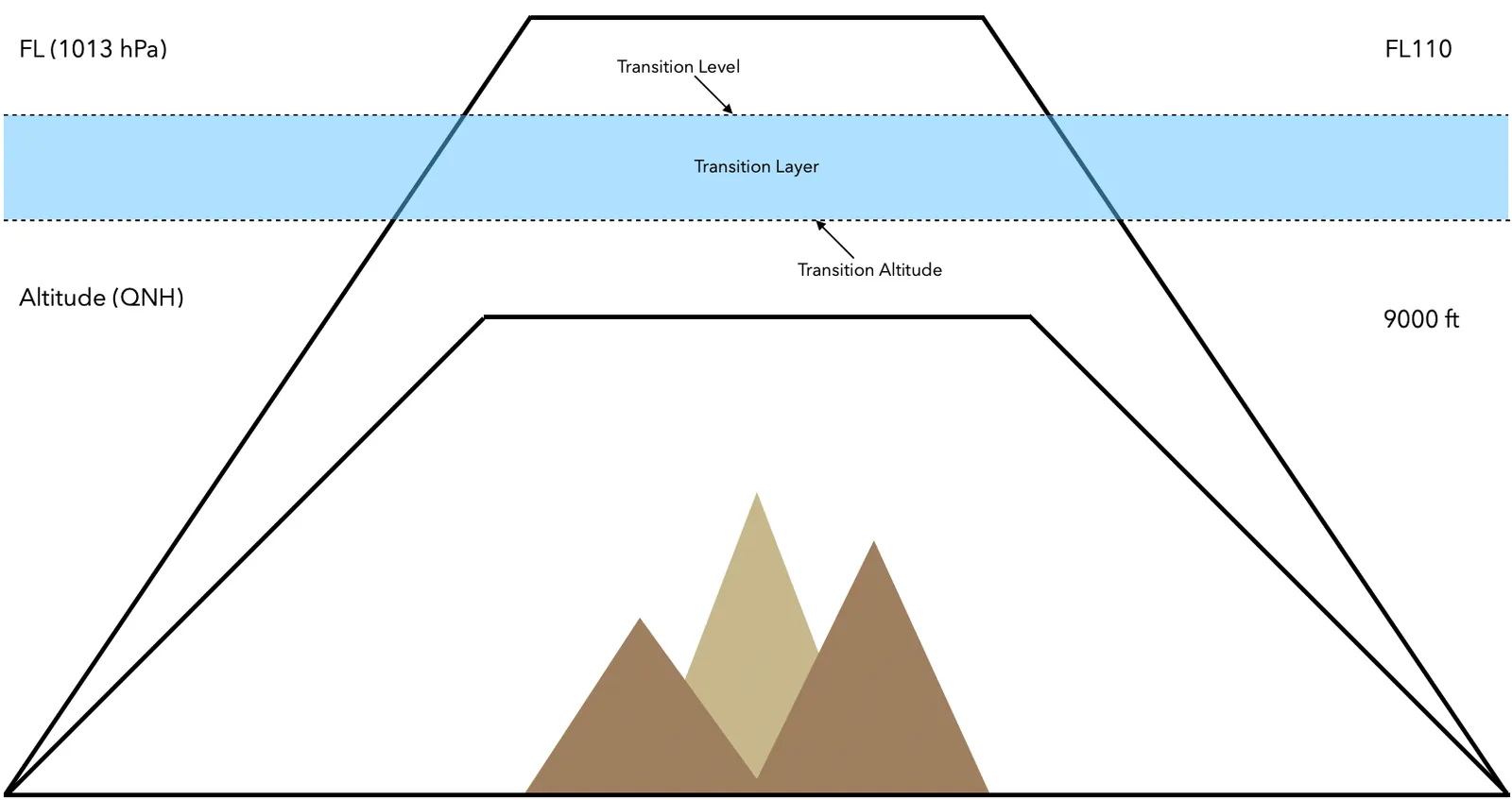
Note: Level flight is not permitted within the transition layer.
For example, if the transition altitude is 5000 ft and the transition level is FL070, an aircraft would not be cleared to maintain FL060 or 6,000 ft within that layer.
Aircraft approach categories are based on the aircraft’s $V_{AT}$, which is the indicated airspeed at threshold.
Vat is defined as 1.3 × $V_{SREF}$ (stalling speed in landing configuration) at the maximum certified landing weight.
| Category | $V_{AT}$ Range |
|---|---|
| A | < 91 kt |
| B | 91 kt ≤ $V_{AT}$ < 121 kt |
| C | 121 kt ≤ $V_{AT}$ < 141 kt |
| D | 141 kt ≤ $V_{AT}$ < 166 kt |
| E | 166 kt ≤ $V_{AT}$ < 211 kt (military) |
Note: These categories are used to determine approach minima, obstacle clearance requirements, and procedure design.
The number of stripes painted at the runway threshold provides a visual indication of the runway width:
| Number of Threshold Stripes | Runway Width |
|---|---|
| 8 stripes | 30 meters |
| 12 stripes | 45 meters |
| 16 stripes | 60 meters |
Note:
Each white stripe is 3.75 meters wide.
This method allows pilots to quickly assess runway width, especially at unfamiliar airports.
The ICAO maximum holding speeds depend on the holding altitude and aircraft category:
| Altitude | Max Holding Speed |
|---|---|
| ≤ 14,000 ft | 230 kt (Category C–E) / 170 kt (Category A–B) |
| > 14,000 ft to ≤ 20,000 ft | 240 kt |
| > 20,000 ft to ≤ 34,000 ft | 265 kt |
| > 34,000 ft | Mach 0.83 |
Note: These are standard ICAO limits. Local procedures or ATC instructions may specify lower values.
ICAO wake turbulence categories are based on an aircraft’s Maximum Certified Takeoff Weight (MTOW) and are used by ATC to apply appropriate separation minima to mitigate wake turbulence risk.
| Category | Letter Code | MTOW Criteria | Examples |
|---|---|---|---|
| Super | J | Specific aircraft designated as "Super" in ICAO Doc 8643 | Airbus A380 |
| Heavy | H | ≥ 136 tonnes and not classified as Super | Boeing 747, A350 |
| Medium | M | > 7 tonnes and < 136 tonnes | Boeing 737, A320, ATR72 |
| Light | L | ≤ 7 tonnes | Cessna 172, PC-12 |
Note:
- The "Super" category is not based solely on MTOW, but on ICAO designation found in Doc 8643.
- Wake turbulence categories are filed in the ICAO flight plan (Item 9) using the codes J, H, M, or L.
The ICAO airspace classes (A to G) determine the level of ATC services, separation, and communication requirements provided to aircraft.
| Class | ATC Clearance Required | Separation Provided | Traffic Information | VFR Flights Allowed |
|---|---|---|---|---|
| A | Yes | IFR vs IFR | Not applicable | ❌ Not allowed |
| B | Yes | IFR vs IFR, IFR vs VFR, VFR vs VFR | Yes (to all) | ✅ Yes |
| C | Yes | IFR vs IFR, IFR vs VFR | VFR receives traffic info on VFR | ✅ Yes |
| D | Yes | IFR vs IFR | VFR receives info on IFR, traffic info as far as practical | ✅ Yes |
| E | IFR: Yes / VFR: No | IFR vs IFR | VFR gets info as far as practical | ✅ Yes |
| F | IFR: Advised / VFR: No | Advisory only (IFR) | Info available if possible | ✅ Yes |
| G | No | None | Available if possible | ✅ Yes |
Important: The exact usage of each class may vary depending on the state’s AIP.
Member-only answer
This is a real airline technical interview question. Unlock the structured, examiner-ready answer used by successful candidates.
Unlock full accessMember-only answer
This is a real airline technical interview question. Unlock the structured, examiner-ready answer used by successful candidates.
Unlock full accessMember-only answer
This is a real airline technical interview question. Unlock the structured, examiner-ready answer used by successful candidates.
Unlock full accessMember-only answer
This is a real airline technical interview question. Unlock the structured, examiner-ready answer used by successful candidates.
Unlock full accessMember-only answer
This is a real airline technical interview question. Unlock the structured, examiner-ready answer used by successful candidates.
Unlock full accessGet access to 22 more questions by subscribing.
Get notified when new articles, new interview questions, and new pilot jobs are published.
PILOT INTERVIEW PREP // MEMBER ACCESS
Join now to access full interview answers, airline-specific assessment guides, and structured prep built by line pilots.